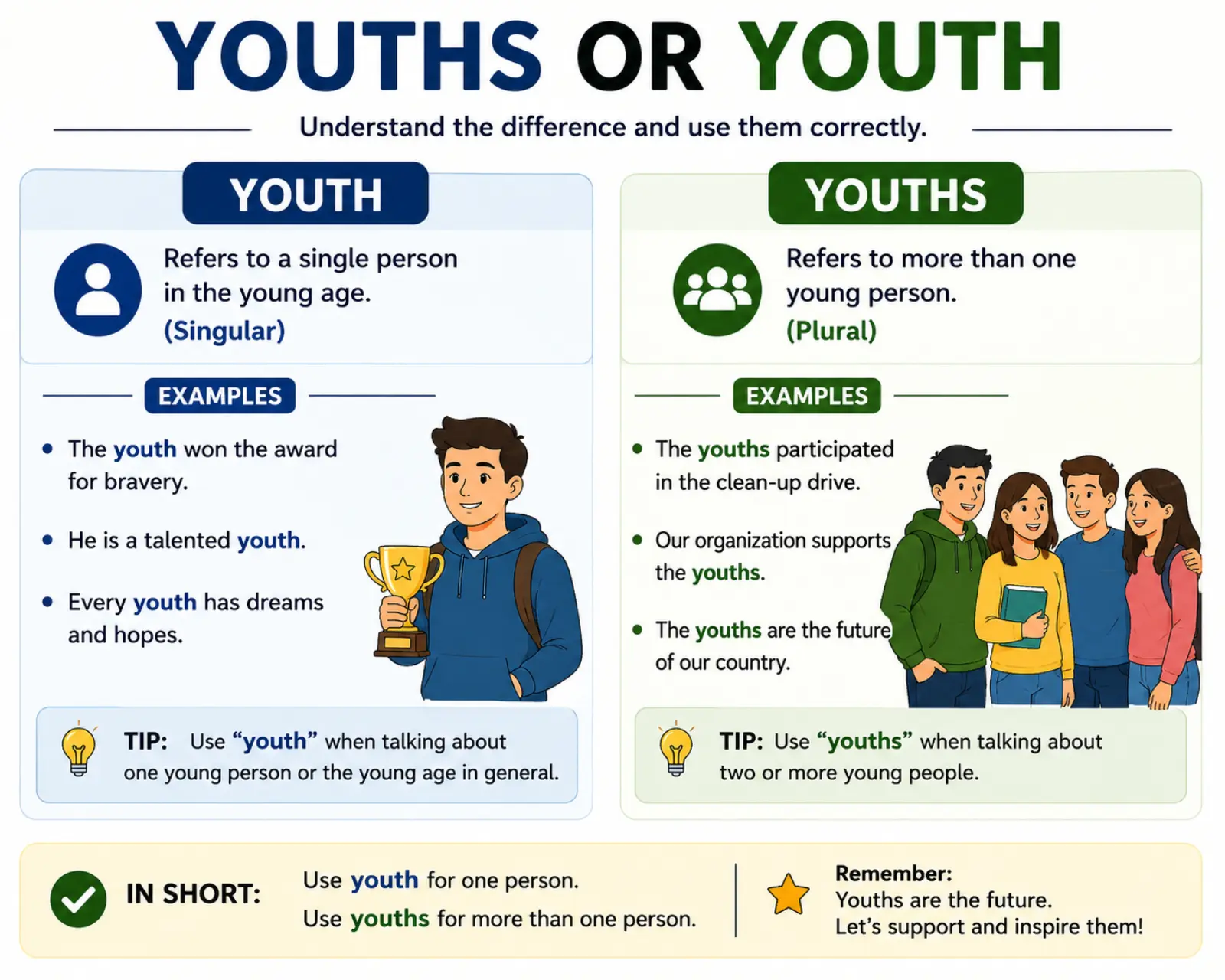
Youths or youth is a common grammar question that confuses many English learners and writers. Both words are correct, but they have different meanings and uses. Knowing when to use youth and when to use youths helps you write and speak more clearly.
The word youth can describe a young person or the period of being young. The word youths is simply the plural form when talking about several young people. However, English speakers often use young people instead of youths in everyday conversation.
In this guide, you will learn the meaning of each word, their differences, examples, common mistakes, and simple tips to remember the correct usage.
Quick Summary Box
- Youth = one young person or the time of being young.
- Youths = more than one young person.
- Youth is often an uncountable noun.
- Youths is less common in everyday English.
- Many native speakers prefer young people instead of youths.
- Choose the word based on whether you mean one person, many people, or the stage of life.
What Does “Youth” Mean?
The word youth has several meanings.
It can refer to:
- A young person.
- The period between childhood and adulthood.
- Young people as a group.
Examples
- Her youth was full of adventure.
- The youth volunteered at the local shelter.
- Today’s youth face many new challenges.
In many cases, youth acts as an uncountable noun.
What Does “Youths” Mean?
Youths is the plural form of youth when referring to several young people.
Examples
- The police spoke with several youths.
- The sports camp welcomed fifty youths.
- The community center organized activities for local youths.
Although correct, many writers prefer young people, especially in casual English.
Youth vs Youths: Key Difference
The biggest difference is number and context.
| Feature | Youth | Youths |
|---|---|---|
| Meaning | One young person, young people in general, or the stage of life | More than one young person |
| Number | Singular or collective | Plural |
| Common Usage | Very common | Less common |
| Formality | Common in all writing | Often used in formal, legal, or news writing |
When Should You Use “Youth”?
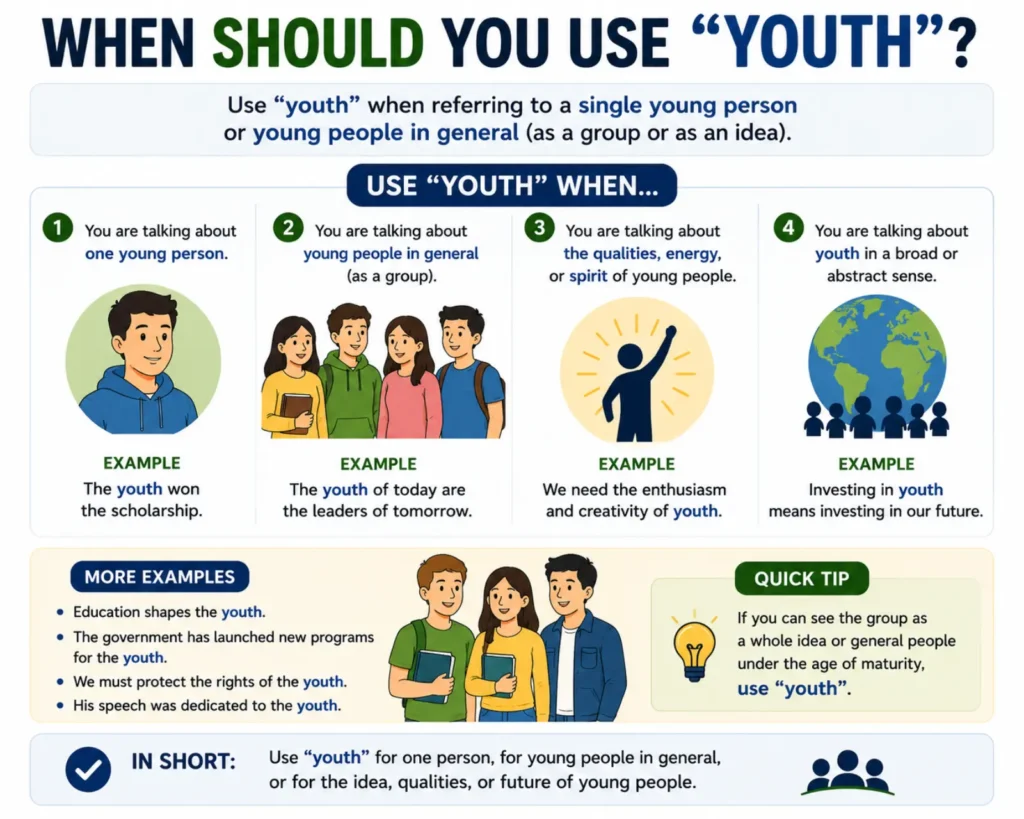
Use youth when talking about:
1. One young person
Example:
- The youth received an award.
2. The period of life
Example:
- She enjoyed her youth.
3. Young people as a group
Example:
- Modern youth spend more time online.
When Should You Use “Youths”?
Use youths only when you mean multiple individual young people.
Examples:
- Several youths entered the competition.
- Local youths cleaned the neighborhood.
- The coach trained talented youths.
Why Do Many People Avoid “Youths”?
Native English speakers often choose more natural alternatives.
Instead of saying:
- The youths attended the concert.
Many people say:
- The young people attended the concert.
Or:
- The teenagers attended the concert.
These alternatives sound more natural in everyday conversation.
Real-Life Examples of Youth and Youths
At School
Correct:
- Every youth deserves a good education.
Correct:
- The school welcomed many youths from nearby towns.
In Sports
Correct:
- His youth helped him recover quickly.
Correct:
- Young youths joined the football academy.
In News Reports
Correct:
- Several youths were rescued after the flood.
Correct:
- The government launched new programs for youth employment.
At Home
Correct:
- My grandfather often talks about his youth.
Correct:
- The neighborhood youths organized a charity event.
Common Mistakes
Many learners confuse these words.
Mistake 1
❌ The youths today love technology.
✅ Today’s youth love technology.
Mistake 2
❌ His youths were difficult.
✅ His youth was difficult.
Mistake 3
❌ Every youths should study hard.
✅ Every youth should study hard.
Mistake 4
❌ Youth are energetic.
✅ Youth is energetic. (collective)
OR
✅ Young people are energetic.
Easy Trick to Remember
Think about this simple rule:
- Youth = one or the stage of life
- Youths = many young people
If you can replace the word with young people, then youths may also work.
If you mean childhood or teenage years, use youth.
Youth vs Youths in Everyday Life
You may hear these sentences often.
Everyday English
- She had a happy youth.
- Today’s youth love social media.
- Local youths participated in the festival.
- The charity supports young people.
Notice that young people appears more often than youths.
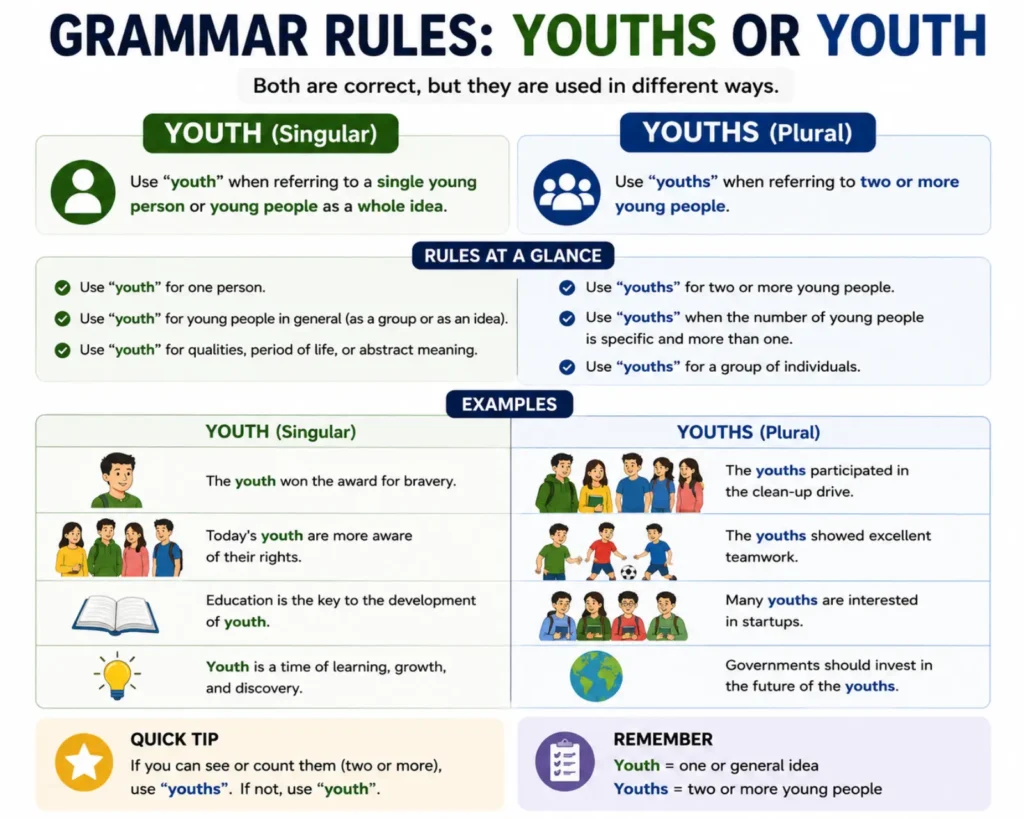
Grammar Rules
Here are some grammar tips.
Youth
Can be:
- Singular noun
- Collective noun
- Uncountable noun
Examples:
- The youth smiled.
- Modern youth enjoy technology.
- His youth ended quickly.
Youths
Always:
- Countable plural noun
Examples:
- Five youths entered the race.
- Several youths volunteered.
Synonyms and Related Words
Here are useful alternatives.
Synonyms for Youth
- Young person
- Teenager
- Adolescent
- Juvenile
- Minor
- Child (depending on age)
- Student
Related Keywords
- youth meaning
- youths meaning
- youth vs young people
- plural of youth
- youth grammar
- youths definition
- youth examples
- English grammar tips
- youth in a sentence
- youths in a sentence
Expert Insights
Professional editors recommend choosing the simplest word that matches your audience.
When writing for a general audience, young people often sounds more natural than youths. However, youths remains correct in formal reports, legal writing, and news articles.
Understanding the difference also improves grammar accuracy and helps avoid awkward wording. Clear word choices make your writing easier to read and increase trust with your audience.
FAQs
Is “youths” a correct word?
Yes. Youths is the correct plural form of youth when referring to several young people.
Is “youth” singular or plural?
Youth is usually singular, but it can also refer to young people as a collective group.
Which is more common: youth or youths?
Youth is much more common than youths.
Can I say “today’s youths”?
Yes, but today’s youth or today’s young people sounds more natural.
Is “youth” countable?
Sometimes.
It is countable when referring to one young person.
It is uncountable when referring to the stage of life.
Why do news articles use “youths”?
News organizations often use youths because it clearly refers to several individual young people.
What is the plural of youth?
The plural is youths.
Should I use “young people” instead?
For everyday conversation and most blog writing, young people usually sounds more natural.
Internal Linking Suggestions
To improve SEO and user engagement, consider linking this article to related grammar topics such as:
- Their vs There vs They’re
- Chose vs Choose
- Other vs Others
- Daddy’s vs Daddies
- Nosey vs Nosy
- Nil vs Nill
- Consigner vs Consignor
- Draws vs Drawers
These related articles help readers build stronger English grammar skills while increasing time on site.
Conclusion
Understanding the difference between youths or youth is easier than it first appears. Youth usually refers to one young person, the stage of being young, or young people as a group. Youths is simply the plural form when talking about several individual young people. In everyday English, many native speakers prefer young people, but youths is still correct, especially in formal writing and news reports.
By learning these simple grammar rules, you can avoid common mistakes and write with more confidence. Whether you are writing an essay, blog post, or business document, choosing the right word makes your message clearer and more professional.
Featured Snippet
What is the difference between youth and youths?
Youth refers to one young person, the period of being young, or young people as a group. Youths is the plural form and refers to several individual young people. In everyday English, many speakers prefer young people instead of youths because it sounds more natural.

Michael Reed is a language content writer and word comparison researcher based in the United States. He studied English Language and Communication and focuses on grammar, spelling differences, and word usage. His work helps readers understand confusing English words through clear comparisons and practical explanations. Michael creates simple, reader-friendly content designed to improve everyday language skills.