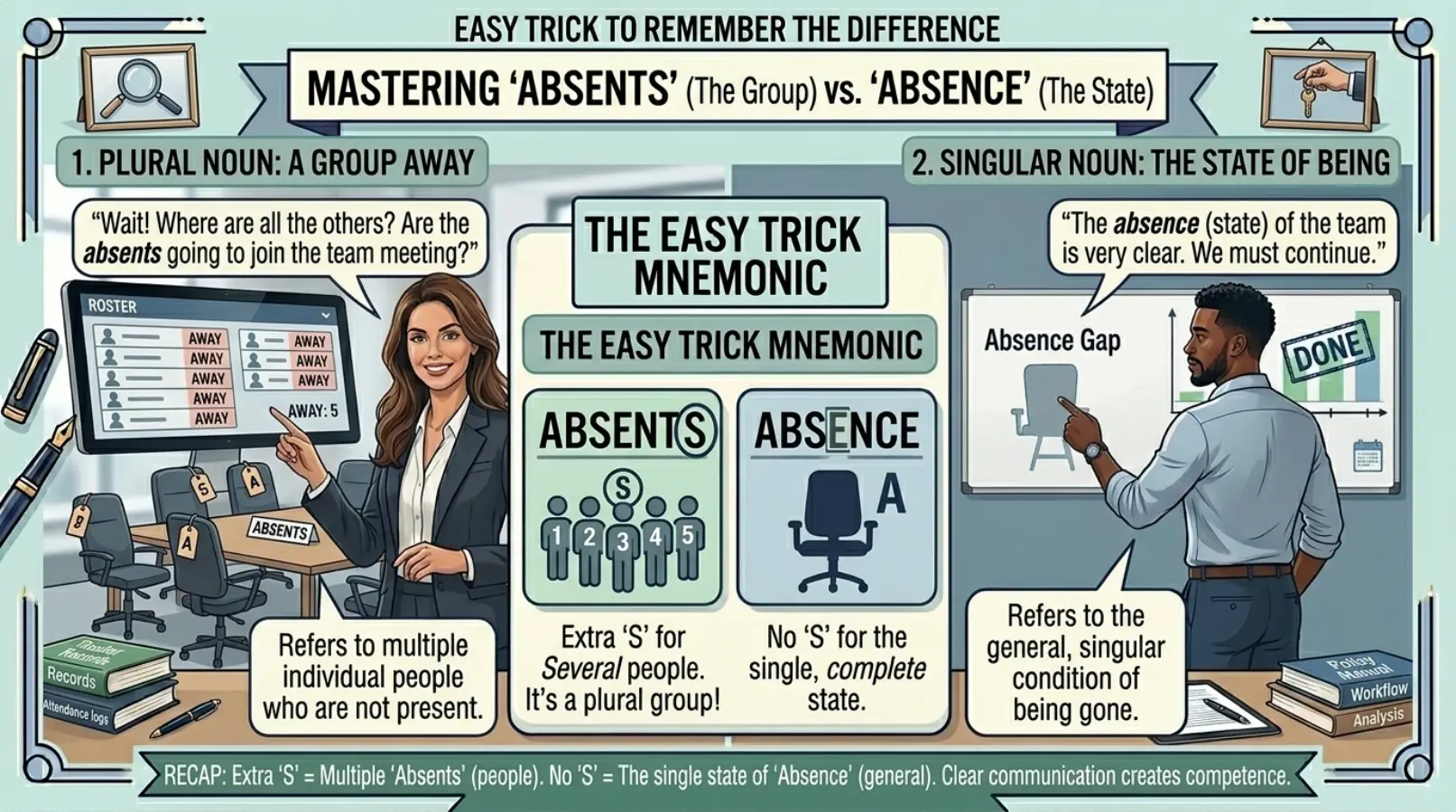
Absents or absence is a common grammar topic that confuses many English learners and writers. Although these words look similar, they have different meanings and uses. Using the wrong word can make your writing unclear.
Many people wonder whether they should use absents or absence in a sentence. The answer depends on what you want to say. One word acts as a noun, while the other usually works as a verb.
In this guide, you will learn the meaning of each word, their differences, common mistakes, and real-life examples. By the end, you will know exactly when to use absents and when to use absence.
Quick Summary Box
- Absence is a noun.
- Absence means the state of being away or not present.
- Absents is a verb form of “absent.”
- Absents means someone removes themselves or stays away.
- “Absence from school” is correct.
- “He absents himself from meetings” is also correct.
- The two words cannot replace each other.
- Understanding the difference improves writing and speaking skills.
What Does “Absence” Mean?
Absence is a noun that describes the state of not being present.
Simple Definition
Absence means being away from a place, event, or person.
Examples
- Her absence was noticed at the party.
- The teacher recorded his absence.
- Due to illness, she had a long absence from work.
- The team struggled during his absence.
In all these examples, absence refers to the condition of being away.
What Does “Absents” Mean?
Absents is a verb form of the word “absent.”
Simple Definition
Absents means deliberately staying away or removing oneself from something.
Examples
- He absents himself from social events.
- She often absents herself from office meetings.
- The student absents himself from class without permission.
The word usually appears with himself, herself, or another reflexive pronoun.
Absents or Absence: Key Difference
The main difference is their grammatical role.
- Absence = Noun
- Absents = Verb
You use absence to talk about being away.
You use absents to describe the action of staying away.
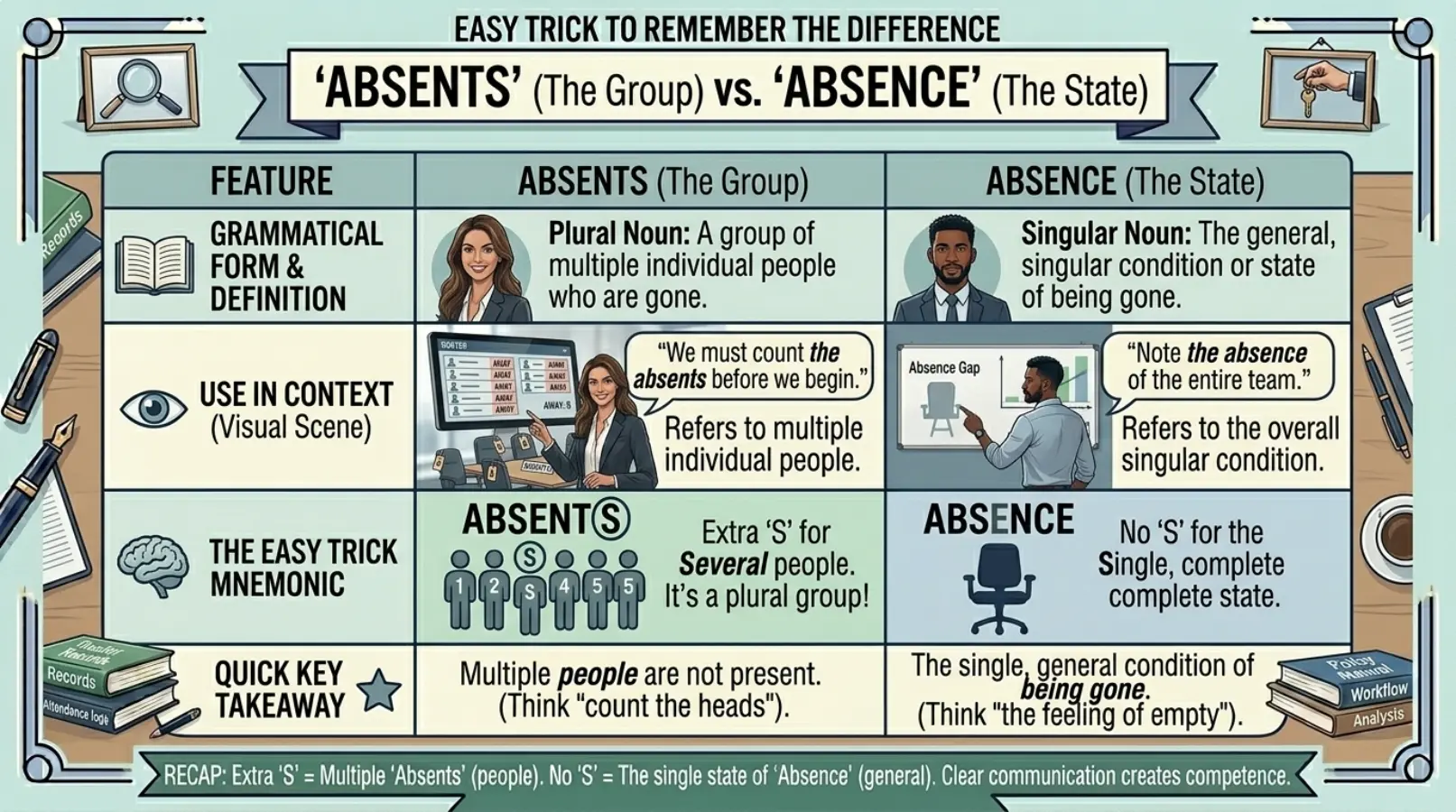
Absents vs Absence Comparison Table
| Feature | Absence | Absents |
|---|---|---|
| Part of Speech | Noun | Verb |
| Meaning | State of being away | Action of staying away |
| Usage | Talks about a condition | Describes an action |
| Common Context | School, work, events | Meetings, classes, gatherings |
| Example | His absence was noted. | He absents himself from class. |
| Frequency | Very common | Less common |
When Should You Use “Absence”?
Use absence whenever you discuss someone not being present.
Common Situations
- School attendance
- Work attendance
- Family gatherings
- Events and meetings
- Sports participation
Examples
- The company has a strict absence policy.
- Her absence affected the project.
- The doctor explained the reason for his absence.
- Frequent absence may impact performance.
When Should You Use “Absents”?
Use absents when describing someone actively staying away from something.
Examples
- He absents himself during difficult discussions.
- She absents herself from unnecessary meetings.
- The player absents himself from practice sessions.
This word is less common in everyday conversation but appears in formal writing.
Real-Life Examples of Absents and Absence
Understanding real situations makes the difference easier.
At School
Correct:
- The student’s absence was recorded.
- The student absents himself from class regularly.
At Work
Correct:
- Her absence delayed the project.
- He absents himself from team meetings.
At Family Events
Correct:
- Everyone noticed her absence.
- He absents himself from family gatherings.
Common Mistakes People Make
Many writers confuse these words because they look alike.
Mistake 1: Using Absents as a Noun
Incorrect:
- His absents was noticed.
Correct:
- His absence was noticed.
Mistake 2: Using Absence as a Verb
Incorrect:
- He absence himself from meetings.
Correct:
- He absents himself from meetings.
Mistake 3: Mixing Meanings
Incorrect:
- Her absents from school lasted two weeks.
Correct:
- Her absence from school lasted two weeks.
Easy Trick to Remember the Difference
A simple memory trick can help.
Think of the Endings
Absence = State
The ending -ence often forms nouns.
Examples:
- Difference
- Existence
- Confidence
- Absence
Absents = Action
The ending -s often appears in present-tense verbs.
Examples:
- Runs
- Writes
- Absents
This trick makes choosing the correct word much easier.
Usage in Daily Life
You will see absence more often than absents.
Common Daily Phrases
- Absence from school
- Absence from work
- Leave of absence
- Absence of evidence
- Absence policy
Formal Phrases with Absents
- Absents himself from duty
- Absents herself from meetings
- Absents himself from discussions
Synonyms and Related Words
Using related words can improve writing variety.
Synonyms for Absence
- Nonattendance
- Unavailability
- Lack
- Missing presence
- Vacancy
- Withdrawal
Related Terms
- Attendance
- Presence
- Leave
- Missing
- Away
- Participation
Opposite Words
- Presence
- Attendance
- Participation
- Availability
Why the Difference Matters
Using the correct word improves communication.
Benefits include:
- Better grammar
- More professional writing
- Clearer messages
- Stronger academic work
- Improved workplace communication
Even small grammar mistakes can affect credibility.
Expert Insight: What Grammar Experts Recommend
Language experts recommend focusing on the part of speech first.
Ask yourself:
“Am I describing a state or an action?”
If you describe a state of being away, choose absence.
If you describe the act of staying away, choose absents.
Most everyday situations require absence, which is why it appears more often in books, articles, and business writing.
Writers who understand this difference produce clearer and more professional content.
FAQs
Is it absents or absence from school?
Use absence from school because you are talking about being away.
Can absents be used as a noun?
No. Absents is a verb form, not a noun.
What is the meaning of absence?
Absence means the state of not being present.
Is “he absents himself” correct?
Yes. It means he deliberately stays away.
Which word is more common?
Absence is much more common in daily English.
What is the opposite of absence?
The opposite is presence.
Can I use absence in formal writing?
Yes. It is commonly used in academic, business, and professional writing.
How do I remember the difference?
Remember: absence = state, absents = action.
Internal Linking Suggestions
For better SEO, link this article to:
- Commonly Confused English Words
- Affect vs Effect
- Advice vs Advise
- Lose vs Loose
- Attendance vs Presence
- Grammar Rules for Beginners
- English Vocabulary Guide
Featured Snippet Answer
What is the difference between absents and absence?
Absence is a noun that means the state of being away or not present. Absents is a verb form that means someone deliberately stays away from a place, event, or activity. Use absence for a condition and absents for an action.
Conclusion
Understanding absents or absence becomes easy once you know their grammatical roles. Absence is a noun that describes being away, while absents is a verb that describes the action of staying away. Although they share the same root word, they serve different purposes in a sentence.
In everyday English, absence appears much more often, especially in school, workplace, and attendance-related situations. Meanwhile, absents usually appears in formal or specific contexts.
When choosing between absents or absence, remember one simple rule: use absence for a state and absents for an action. Following this guideline will help you write clearly, correctly, and confidently.

Emma Collins is a language writer and grammar enthusiast specializing in English vocabulary, spelling comparisons, and word usage guides. She creates easy-to-understand content that helps readers improve their writing, communication, and language skills with confidence.