
Bent or bend is a common grammar question for English learners and native speakers alike. These two words look similar, but they have different jobs in a sentence. Using the wrong one can confuse your readers and make your writing less clear. The good news is that the difference is easy to learn. Once you understand when to use bend and when to use bent, you will avoid many common grammar mistakes. This guide explains each word in simple English with clear examples. You will also find comparison tables, daily-life examples, memory tricks, FAQs, and expert grammar tips. By the end, you will know exactly which word to choose in every situation.
Quick Summary Box
- Bend is the base form (present tense) of the verb.
- Bent is the past tense and past participle of bend.
- Bent can also be an adjective.
- Use bend for actions happening now or in the future.
- Use bent for actions that already happened.
- Bent sometimes describes something that is curved or damaged.
Featured Snippet: Bent or Bend
| Word | Part of Speech | Meaning | Example |
|---|---|---|---|
| Bend | Verb | To curve or change direction | Please bend the wire. |
| Bent | Verb (Past Tense), Adjective | Curved or already changed shape | She bent the spoon. The spoon is bent. |
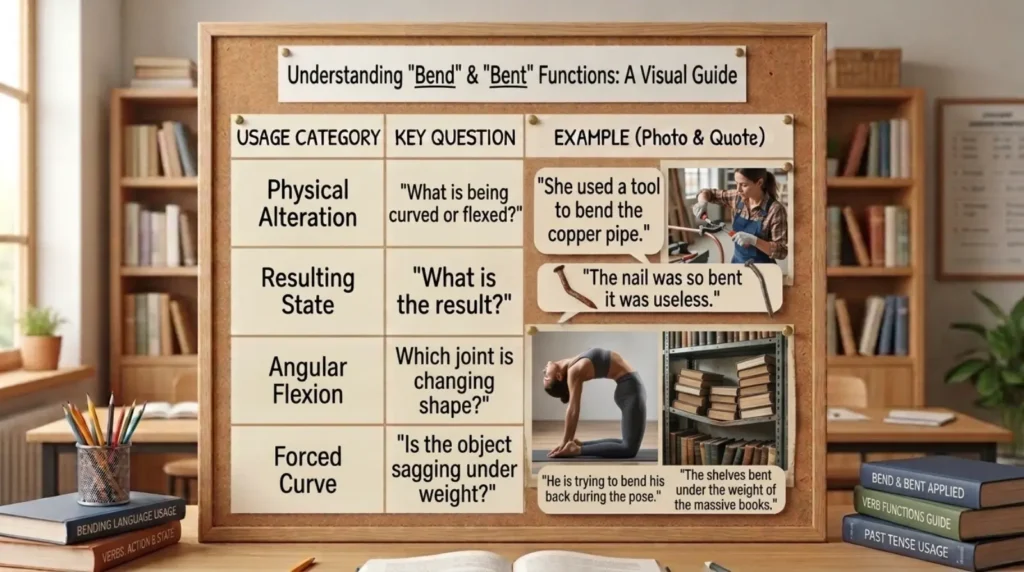
What Does “Bend” Mean?
Bend is the base form of the verb.
It means:
- To curve something
- To move your body
- To change direction
- To make something flexible
Examples
- Bend your knees before jumping.
- Please bend the paper carefully.
- The road will bend after the bridge.
- Try not to bend the glasses.
Whenever the action happens now or later, use bend.
What Does “Bent” Mean?
Bent is the past tense and past participle of bend.
It describes something that already happened.
It can also describe the condition of something.
Examples
- She bent the metal rod yesterday.
- He bent down to tie his shoes.
- The nail is bent.
- The bicycle wheel looks bent.
Notice that bent often describes something that is no longer straight.
Bent or Bend: Key Differences
| Feature | Bend | Bent |
|---|---|---|
| Word Type | Verb | Past tense verb / adjective |
| Time | Present or future | Past |
| Meaning | To curve | Curved or already curved |
| Example | Bend the stick. | He bent the stick. |
| Can Describe Objects? | No | Yes |
When Should You Use “Bend”?
Use bend when talking about:
- Present actions
- Future actions
- Commands
- Infinitives
Examples
- Bend your arms slowly.
- Do not bend the plastic.
- I can bend this wire.
- We will bend the rules only once.
When Should You Use “Bent”?
Use bent when:
- The action already happened.
- Something has a curved shape.
- Describing a damaged object.
Examples
- He bent the fork.
- Someone bent the fence.
- The pipe is bent.
- She had bent the paper before folding it.
Bent as an Adjective
Many people forget that bent is also an adjective.
It describes the shape or condition of something.
Examples
- The bent branch fell.
- He fixed the bent wheel.
- The bent spoon cannot be used.
- We replaced the bent frame.
Real-Life Examples of Bent and Bend
Home
- Bend the hanger carefully.
- The hanger became bent.
School
- Bend your knees during exercise.
- The student bent down to pick up a pencil.
Work
- Bend the cable slowly.
- The technician found a bent connector.
During Sports
- Bend your elbows while lifting.
- He bent his ankle during the game.
Common Grammar Patterns
Present Tense
- I bend.
- You bend.
- They bend.
Past Tense
- I bent.
- She bent.
- We bent.
Present Perfect
- I have bent the wire.
- They have bent the pipe.
Future
- I will bend the metal.
Common Mistakes with Bent or Bend
Many learners confuse these words.
Mistake 1
❌ Yesterday I bend the wire.
✅ Yesterday I bent the wire.
Mistake 2
❌ The stick bend.
✅ The stick is bent.
Mistake 3
❌ He has bend the pipe.
✅ He has bent the pipe.
Mistake 4
❌ The road bent to the left tomorrow.
✅ The road will bend to the left tomorrow.
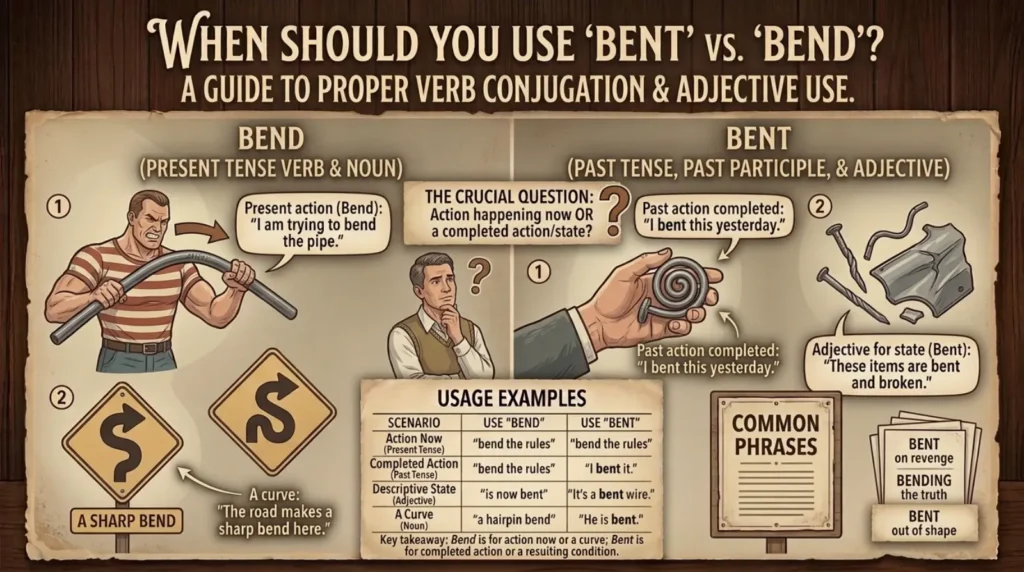
Easy Trick to Remember Bent or Bend
Here is a simple memory trick.
- Bend = Before it happens
- Bent = After it happened
Think about this sentence:
Today I bend the wire. Yesterday I bent the wire.
This simple rule works almost every time.
Bent or Bend in Daily Conversations
People use these words every day.
Examples
Parent:
“Bend your knees before you jump.”
Teacher:
“Who bent this ruler?”
Mechanic:
“The wheel is bent.”
Doctor:
“Do not bend your back too quickly.”
Coach:
“Bend your arms while running.”
Synonyms and Related Words
Synonyms for Bend
- Curve
- Flex
- Twist
- Fold
- Lean
- Arch
Related Grammar Terms
- Past tense
- Past participle
- Irregular verbs
- Action verb
- Adjective
- Verb forms
- Grammar rules
- English vocabulary
Bent vs Bend in Different Sentence Types
Statement
I bend the pipe.
I bent the pipe.
Question
Can you bend the wire?
Who bent the gate?
Negative
Do not bend the book.
He did not bend the spoon.
Command
Bend your knees.
Do not bend the card.
Practice Sentences
Choose the correct word.
- Please ____ the straw.
1.Answer: Bend
- She ____ the key yesterday.
2.Answer: Bent
- The fence is ____.
3.Answer: Bent
- Can you ____ this branch?
4.Answer: Bend
- Someone has ____ the sign.
5.Answer: Bent
Expert Insights
Grammar experts recommend learning irregular verbs together because they do not follow regular -ed patterns. Bend becomes bent, not bended, in standard English. Reading, writing, and speaking with correct verb forms builds confidence and improves communication. When you master common verb pairs like bend and bent, your English becomes more natural and accurate.
FAQs:
Is it bend or bent?
Use bend for present or future actions. Use bent for past actions or to describe something curved.
Is bent the past tense of bend?
Yes. Bent is both the past tense and past participle of bend.
Can bent be an adjective?
Yes. It describes something that is curved or damaged.
Example:
“The bent nail cannot be used.”
Is “bended” correct?
Usually, no. Standard English uses bent.
What is the past participle of bend?
The past participle is bent.
Example:
“I have bent the wire.”
Can I say “bend down”?
Yes.
Example:
“Please bend down slowly.”
Is “bent” always about physical objects?
No. It can also describe people or intentions.
Example:
“He is bent on winning.”
Internal Linking Suggestions
You may also enjoy reading:
- Lay vs Lie: What’s the Difference?
- Burst or Bursted: Which Is Correct?
- Taken or Took Explained
- Sank vs Sunk Grammar Guide
- Farthest vs Furthest
- Choose vs Chose
- Rise vs Raise
Conclusion
Understanding bent or bend is much easier once you know how each word works. Bend is the base verb that describes an action happening now or in the future. Bent is the past tense and past participle, and it can also act as an adjective to describe something curved or damaged. Remember the simple rule: bend before the action, bent after the action. Practice with everyday examples and pay attention to verb tenses when speaking or writing. Over time, choosing the correct word will become natural. Mastering this small grammar rule will make your English clearer, stronger, and more professional.

Michael Reed is a language content writer and word comparison researcher based in the United States. He studied English Language and Communication and focuses on grammar, spelling differences, and word usage. His work helps readers understand confusing English words through clear comparisons and practical explanations. Michael creates simple, reader-friendly content designed to improve everyday language skills.