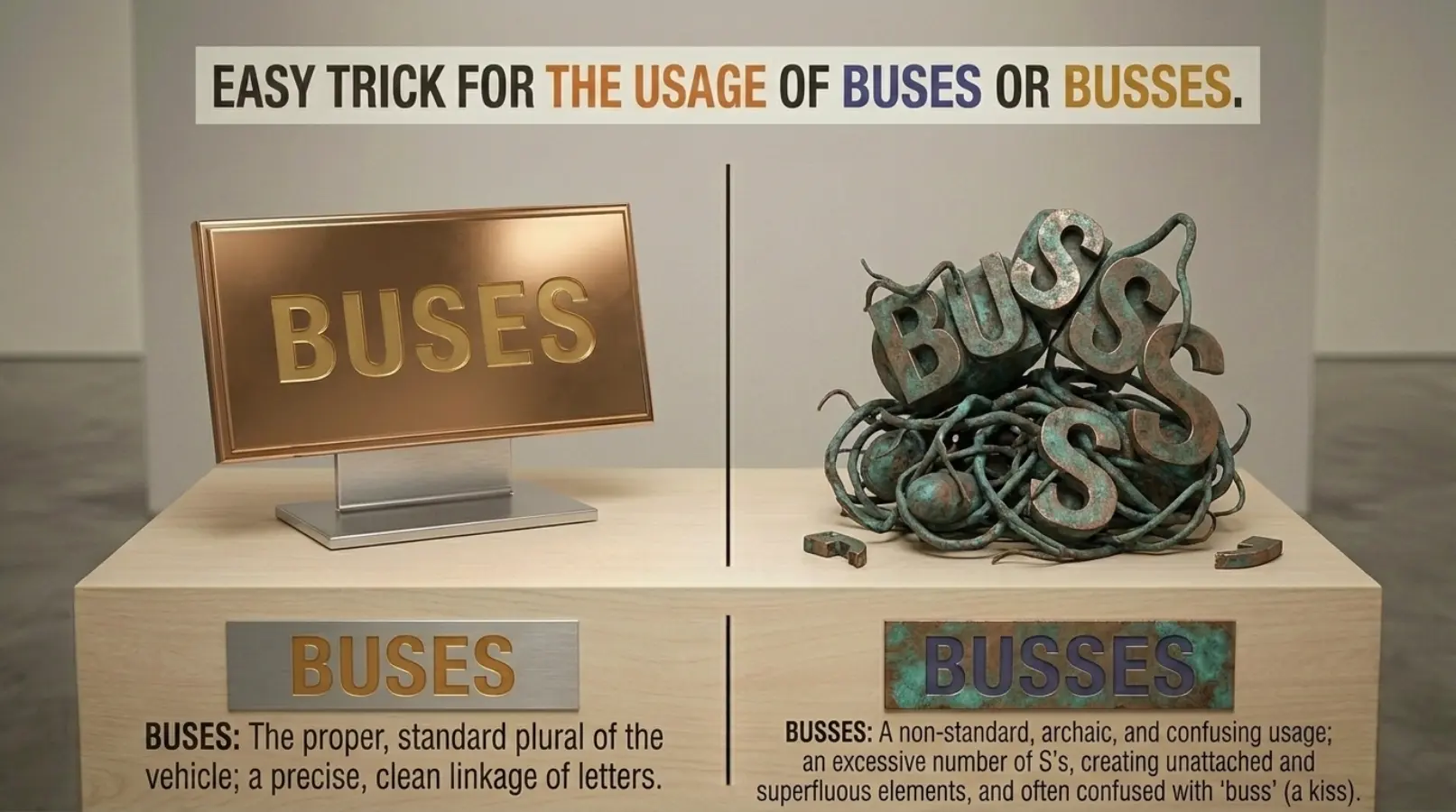
Busses or buses is a common grammar question that confuses many English learners and native speakers. Both words look correct at first glance. However, they do not always mean the same thing.
The spelling you choose depends on what you want to say. In most cases, buses is the correct plural of bus. The word busses also exists, but it has a different use in English.
This guide explains the difference in simple words. You will learn when to use each spelling. You will also see examples, grammar rules, common mistakes, and expert tips. By the end, you will know which word fits every situation.
Quick Summary Box
Featured Snippet Answer
- Buses is the correct plural form of bus.
- Busses is the third-person singular form of the verb buss, which means “to kiss.”
- Use buses when talking about vehicles.
- Use busses only when referring to someone who kisses.
- In modern English, buses is correct almost every time.
What Does “Buses” Mean?
The word buses is the plural form of bus.
A bus is a large vehicle that carries many passengers.
Examples
- Three buses arrived at the station.
- The school owns five buses.
- We waited for two buses this morning.
- City buses run every fifteen minutes.
Whenever you mean more than one bus, write buses.
What Does “Busses” Mean?
The word busses comes from the verb buss.
The verb buss means to kiss, usually in an old-fashioned or literary way.
Examples
- She busses her child before school.
- The grandmother busses each grandchild goodbye.
This word is uncommon in modern English.
Most people never use it in everyday writing.
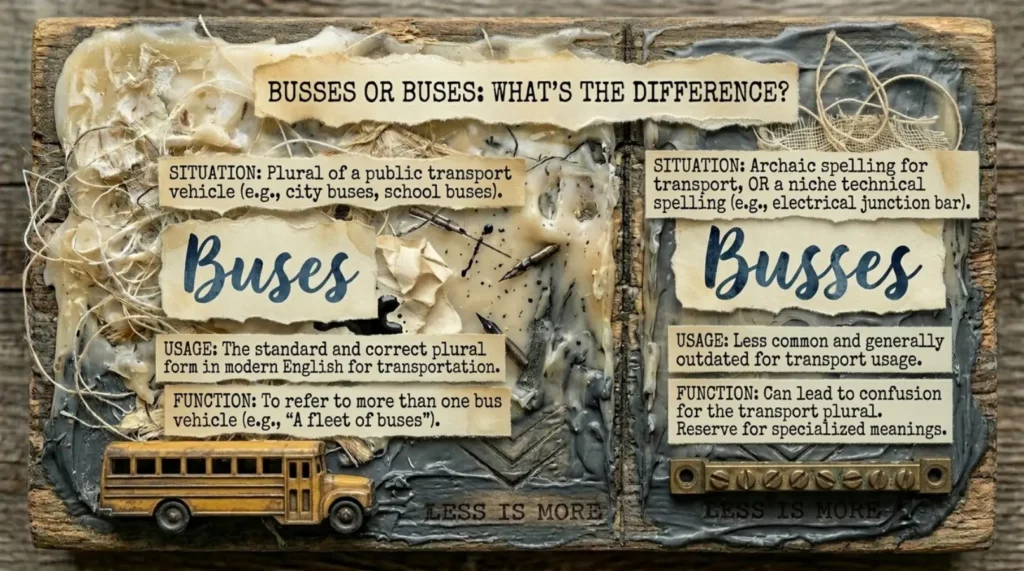
Busses or Buses: What’s the Difference?
The biggest difference is their meaning.
| Word | Part of Speech | Meaning | Common Usage |
|---|---|---|---|
| Buses | Noun | More than one bus | Very common |
| Busses | Verb | Kisses | Rare |
Easy Rule
- Talking about vehicles? → Buses
- Talking about kissing? → Busses
Why Is “Buses” the Correct Plural?
Most English nouns ending in -s form the plural by adding -es.
Examples include:
| Singular | Plural |
|---|---|
| Bus | Buses |
| Class | Classes |
| Box | Boxes |
| Dish | Dishes |
| Glass | Glasses |
Since bus ends with s, its plural becomes buses.
Real-Life Examples of Buses
Here are everyday examples.
School
- Yellow buses take children to school.
Public Transport
- City buses stop at every station.
Travel
- Tourist buses visit famous landmarks.
Airport
- Shuttle buses carry passengers between terminals.
Real-Life Examples of Busses
These examples use the verb buss.
- The actor busses his co-star in the movie.
- She gently busses the baby’s forehead.
- The queen busses the child on the cheek.
These examples sound formal or old-fashioned.
Common Mistakes People Make
Many writers confuse these spellings.
❌ Incorrect
- The school bought new busses.
✅ Correct
- The school bought new buses.
❌ Incorrect
- City busses run every hour.
✅ Correct
- City buses run every hour.
✅ Correct Verb Example
- She busses her little daughter goodnight.
How to Remember the Correct Spelling
Use this easy trick.
Think about transportation.
If you see roads, stations, schools, or passengers, choose buses.
If someone gives a kiss, choose busses.
Simple memory tip:
Buses carry people. Busses give kisses.
Buses in Daily Life
You will often see the word buses in daily situations.
Examples include:
- School buses
- City buses
- Airport buses
- Tourist buses
- Electric buses
- Shuttle buses
The word appears in newspapers, websites, signs, and travel guides.
Synonyms and Related Keywords
Synonyms
- Coaches
- Transit vehicles
- Public transport
- Shuttle buses
- Passenger vehicles
Related Search Terms
- buses meaning
- bus plural
- plural of bus
- bus grammar
- buses spelling
- bus vs buses
- English plural rules
- grammar guide
- transportation vocabulary
- common English spelling mistakes
Grammar Rule Behind “Bus”
English follows regular plural spelling rules.
Add -es after nouns ending in:
- s
- x
- z
- sh
- ch
Examples:
| Singular | Plural |
|---|---|
| Bus | Buses |
| Box | Boxes |
| Church | Churches |
| Dish | Dishes |
| Buzz | Buzzes |
This rule makes pronunciation easier.
Expert Writing Tips
Professional writers almost always use buses.
Only use busses when discussing the verb buss.
Before publishing your writing:
- Check the meaning first.
- Think about the sentence.
- Read it aloud.
- Use a grammar checker if unsure.
This habit improves writing accuracy.
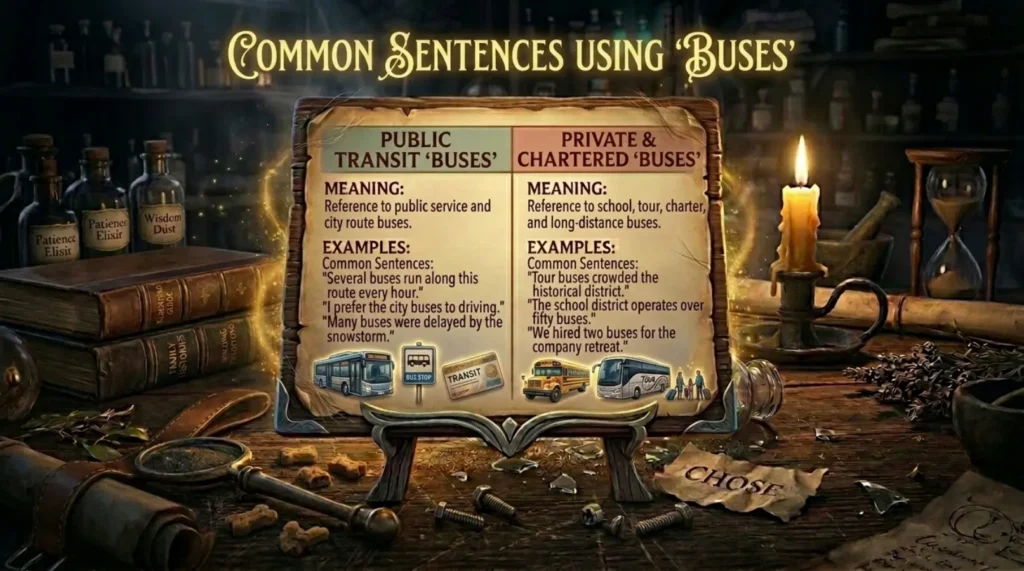
Common Sentences Using “Buses”
Here are more examples.
- The city added twenty new buses.
- Electric buses reduce pollution.
- School buses start at seven.
- Many buses stop near the mall.
- Tour buses visit the museum daily.
- The company replaced old buses with new ones.
FAQs
Is it buses or busses?
Buses is correct when talking about more than one bus. Busses is a verb meaning “kisses.”
Is “busses” ever correct?
Yes. It is correct as a form of the verb buss, meaning “to kiss.”
Why is the plural of bus “buses”?
The noun bus ends with s, so English grammar adds -es to make the plural.
Do dictionaries accept “busses”?
Yes. Dictionaries list busses as a verb, not as the preferred plural of bus.
Which spelling should students use?
Students should use buses for school assignments unless they are writing about the verb buss.
Is “busses” old-fashioned?
Yes. The verb buss appears mostly in older books or literary writing.
What is the plural of school bus?
The correct plural is school buses.
Can grammar checkers detect this mistake?
Most grammar tools suggest buses when you mean the plural of bus.
Expert Insight
Correct spelling builds trust with readers and improves communication. Search engines also favor clear, accurate content. Using buses correctly prevents confusion and makes your writing look professional.
The word busses remains part of English, but it rarely appears outside literature or historical writing. For everyday communication, business writing, education, and blogging, buses is almost always the right choice.
When you understand the difference, you avoid one of the most common English spelling mistakes.
Internal Linking Suggestions
Consider linking this article to related grammar topics such as:
- Bus or coach
- Affect vs effect
- Their vs there vs they’re
- Stationary vs stationery
- Lose vs loose
- Principal vs principle
- Everyday vs every day
- Advice vs advise
Conclusion
The difference between busses or buses is simple once you know their meanings. Buses is the correct plural of bus and is the spelling you should use when talking about vehicles. Busses is a verb that means “kisses,” and it appears only in limited or literary contexts.
Remember the easy rule: if you mean transportation, choose buses. If you mean the old-fashioned verb buss, then busses is correct. Following this rule will make your writing clearer, more accurate, and more professional. Whether you’re writing school assignments, blog posts, emails, or everyday messages, using the correct spelling helps readers understand your meaning right away.

Emma Collins is a language writer and grammar enthusiast specializing in English vocabulary, spelling comparisons, and word usage guides. She creates easy-to-understand content that helps readers improve their writing, communication, and language skills with confidence.