Cancelation or cancellation is a common spelling question that confuses many English writers. Both words seem correct at first glance. However, only one spelling is widely accepted in modern English.
Many people see different versions online, in books, and even in official documents. That creates uncertainty. If you write emails, reports, blog posts, or academic papers, using the correct spelling matters.
In this guide, you will learn the difference between cancelation and cancellation, when to use each spelling, and how dictionaries treat them. You will also see real-life examples, common mistakes, expert tips, and a helpful comparison table.
By the end, you will know exactly which spelling to use with confidence.
Quick Summary Box
- Cancellation is the standard and preferred spelling.
- Cancelation is a less common alternative spelling.
- Most dictionaries recommend cancellation.
- British and American English both mainly use cancellation.
- Use cancellation in formal writing, business documents, and academic work.
- Choosing the standard spelling helps avoid mistakes.
What Does Cancellation Mean?
Cancellation means the act of stopping, ending, or calling off something that was planned.
It can apply to events, bookings, subscriptions, appointments, contracts, and services.
Simple Definition
Cancellation is the action of canceling something before it happens or continues.
Examples
- The flight cancellation upset many travelers.
- We received a cancellation notice from the hotel.
- The event faced cancellation because of bad weather.
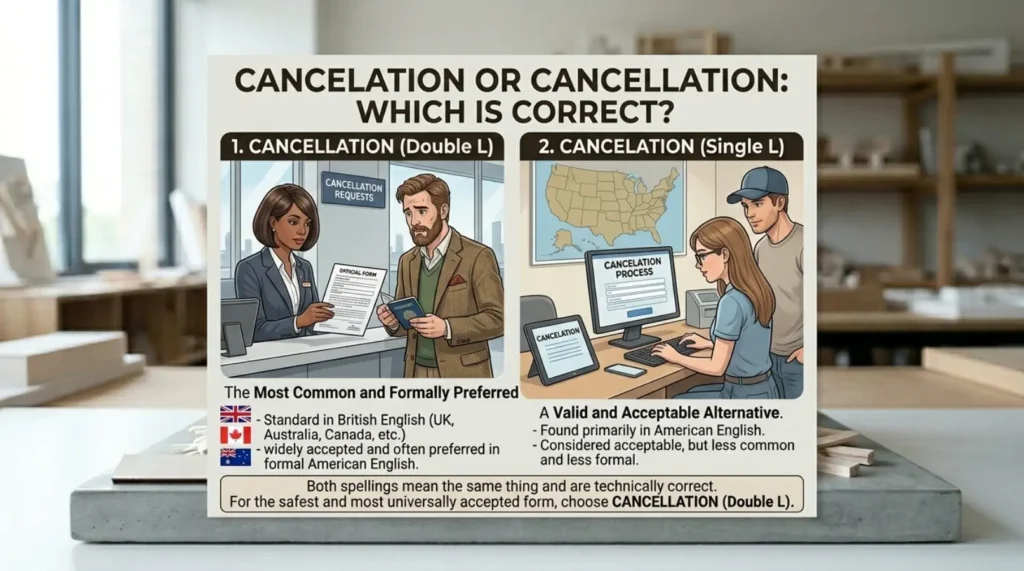
Cancelation or Cancellation: Which Is Correct?
The correct and preferred spelling is cancellation.
Although cancelation appears in some dictionaries as a variant spelling, it is much less common.
Most style guides, publishers, schools, and businesses recommend using cancellation.
Correct
✅ Cancellation
Less Common
⚠️ Cancelation
For professional writing, choose cancellation every time.
Why Does Cancellation Have Two “L”s?
The word comes from the verb cancel.
When forming the noun, English usually doubles the final L before adding -ation.
This creates:
- Cancel + l + ation
- Cancellation
The doubled L follows common English spelling patterns.
Similar Examples
- Install → Installation
- Compel → Compelling
- Propel → Propeller
Because of this pattern, cancellation became the dominant spelling.
Comparison Table: Cancelation vs Cancellation
| Feature | Cancelation | Cancellation |
|---|---|---|
| Accepted spelling | Yes, but rare | Yes |
| Most common spelling | No | Yes |
| Used in professional writing | Rarely | Frequently |
| Preferred by dictionaries | Usually not | Yes |
| Academic writing | Not recommended | Recommended |
| Business communication | Not recommended | Recommended |
| Search popularity | Low | High |
Winner
✅ Cancellation is the spelling most people should use.
How Dictionaries Treat the Two Spellings
Major dictionaries recognize both spellings. However, they clearly favor cancellation.
Most dictionary entries list cancelation as a variant.
That means it exists but appears far less often.
Dictionary Preference
- Cancellation – Standard spelling
- Cancelation – Alternative spelling
When in doubt, use the standard version.
Real-Life Examples of Cancellation
Here are common situations where the word appears.
Travel
- Flight cancellation due to storms.
- Train cancellation because of maintenance.
Business
- Subscription cancellation request.
- Contract cancellation notice.
Healthcare
- Appointment cancellation email.
- Surgery cancellation announcement.
Education
- Class cancellation during holidays.
- Course cancellation because of low enrollment.
These examples show how often the word appears in daily life.
Why People Write Cancelation
Many people assume the noun follows the same pattern as the verb cancel.
As a result, they remove one L when adding -ation.
This seems logical, but standard English developed differently.
Common Reasons
- Typing quickly
- Spelling confusion
- Lack of familiarity
- Seeing the variant spelling online
Fortunately, the mistake is easy to avoid.

Common Mistakes to Avoid
Many writers make small errors with this word.
Mistake 1: Using Cancelation in Formal Writing
❌ The cancellation policy allows free cancelation.
✅ The cancellation policy allows free cancellation.
Mistake 2: Mixing Both Spellings
Use one consistent spelling.
Mistake 3: Ignoring Spell Check Warnings
Most writing tools flag cancelation because it is uncommon.
Mistake 4: Assuming American English Uses Cancelation
American English still strongly prefers cancellation.
Easy Trick to Remember the Correct Spelling
A simple memory trick can help.
Remember This
Cancellation has two Ls because it helps you avoid two spelling mistakes.
Think:
- cancel → cancellation
- install → installation
Both words keep the doubled letter pattern.
This makes cancellation easier to remember.
Cancellation in Daily Life
The word appears everywhere.
Online Shopping
- Order cancellation requests
Streaming Services
- Membership cancellation
Airlines
- Flight cancellation notices
Schools
- Class cancellation alerts
Events
- Concert cancellation announcements
Because the term appears so often, using the correct spelling improves communication.
Synonyms and Related Words
Using related terms helps improve writing variety and SEO relevance.
Synonyms
- Termination
- Withdrawal
- Revocation
- Annulment
- Discontinuation
- Abolition
- Suspension
- Rescission
Related Terms
- Cancel
- Canceled
- Cancelled
- Canceling
- Cancelling
- Cancellation policy
- Booking cancellation
- Subscription cancellation
Cancelled, Canceled, and Cancellation
Many spelling questions connect to this topic.
British English
- Cancelled
- Cancelling
- Cancellation
American English
- Canceled
- Canceling
- Cancellation
Interestingly, both British and American English still prefer cancellation with two Ls.
This creates confusion for many learners.
Expert Insight: Why Correct Spelling Matters
Correct spelling builds trust.
Readers notice errors quickly. A misspelled word can reduce credibility.
Businesses, schools, and professional writers use standard spelling because consistency matters.
Expert Tip
Use cancellation in:
- Blog posts
- Business emails
- Academic papers
- Legal documents
- Marketing content
Following standard spelling improves professionalism and readability.
Internal Linking Suggestions
To strengthen SEO, link this article to related content such as:
- Cancelled vs Canceled
- License vs Licence
- Traveler vs Traveller
- Judgment vs Judgement
- Program vs Programme
These topics attract readers interested in English spelling differences.
FAQs
Is cancelation a real word?
Yes. It exists as an alternative spelling. However, it is much less common than cancellation.
Which spelling is correct, cancelation or cancellation?
Cancellation is the standard and preferred spelling.
Do Americans use cancelation?
Rarely. Most American writers use cancellation.
Is cancellation used in British English?
Yes. British English strongly prefers cancellation.
Why does cancellation have two Ls?
The noun follows a spelling pattern that doubles the final L before adding -ation.
Should I use cancelation in professional writing?
No. Use cancellation for professional and academic writing.
Which spelling appears more often online?
Cancellation appears far more frequently in books, websites, and publications.
Does spell check accept cancelation?
Some dictionaries recognize it, but many writing tools recommend cancellation.
Conclusion
The debate between cancelation or cancellation has a simple answer. While both spellings exist, cancellation is the standard, accepted, and widely preferred form. It appears in professional writing, business communication, academic work, and everyday English.
Using cancellation helps your writing look polished and trustworthy. It also matches the spelling most readers expect to see. Although cancelation is not technically wrong, it remains uncommon and may confuse readers.
When you need the noun form of cancel, choose cancellation with confidence. Following the standard spelling will improve clarity, consistency, and professionalism in every type of writing.

Michael Reed is a language content writer and word comparison researcher based in the United States. He studied English Language and Communication and focuses on grammar, spelling differences, and word usage. His work helps readers understand confusing English words through clear comparisons and practical explanations. Michael creates simple, reader-friendly content designed to improve everyday language skills.