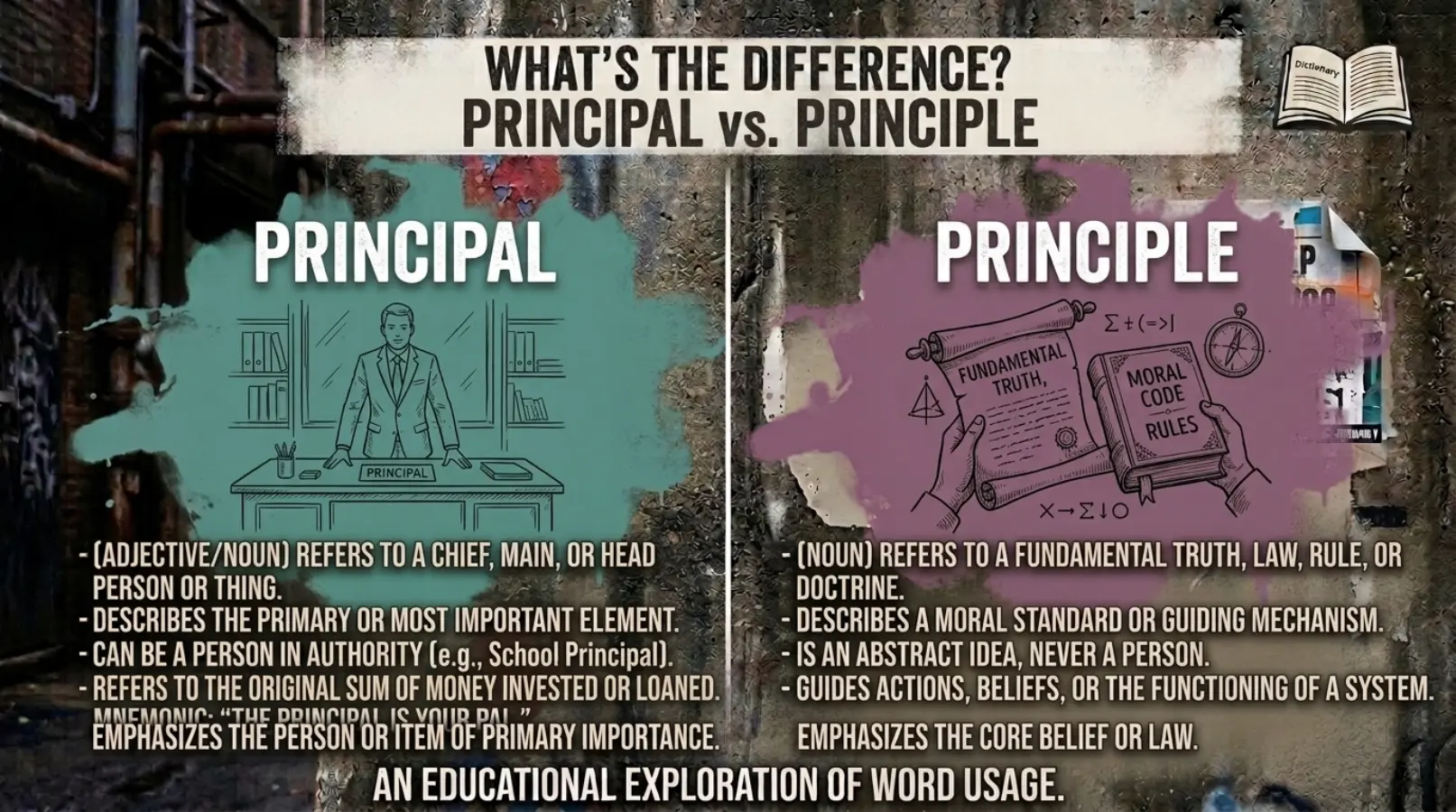
Many people confuse principal vs principle meaning because the words sound exactly the same. However, they have different meanings and uses.
One word refers to a person, thing, or amount of money. The other refers to a rule, belief, or moral value. Knowing the difference helps you write clearly and avoid common grammar mistakes.
In this guide, you will learn the meanings, definitions, examples, and memory tricks for both words. You will also see a comparison table, real-life examples, FAQs, and expert tips.
By the end, you will never mix up principal and principle again.
Quick Summary Box
- Principal usually means the main person, main thing, or original amount of money.
- Principle means a rule, belief, or basic truth.
- Principal can be a noun or an adjective.
- Principle is always a noun.
- Think: The principal is your pal because both contain “pal.”
- Think: Principles guide your actions.
What Does Principal Mean?
Principal has several meanings depending on the sentence.
Principal as a Noun
It can mean the head of a school.
Examples
- The principal welcomed the new students.
- Our principal announced the holiday schedule.
- She spoke with the principal after class.
Principal as an Adjective
It means main, leading, or most important.
Examples
- Exercise is the principal reason for his good health.
- Rice is the principal crop in this region.
- Safety remains our principal concern.
Principal in Finance
It also means the original amount of money borrowed or invested.
Examples
- She paid off the principal before paying interest.
- The loan principal is $10,000.
What Does Principle Mean?
A principle is a basic rule, belief, law, or moral idea.
People follow principles when making decisions.
Examples
- Honesty is an important principle.
- She lives by strong moral principles.
- Fairness is one of our company’s guiding principles.
- Respect should be a basic principle in every workplace.
Principal vs Principle Meaning in Simple Words
The easiest way to remember the difference is this:
- Principal = Main person or main thing
- Principle = Rule or belief
Although they sound alike, they have completely different meanings.
Principal vs Principle Comparison Table
| Feature | Principal | Principle |
|---|---|---|
| Part of speech | Noun, adjective | Noun |
| Main meaning | Main person or main thing | Rule or belief |
| School meaning | Head of a school | Not used |
| Finance meaning | Original amount of money | Not used |
| Moral meaning | No | Yes |
| Easy memory trick | The principal is your pal | Principles guide your life |
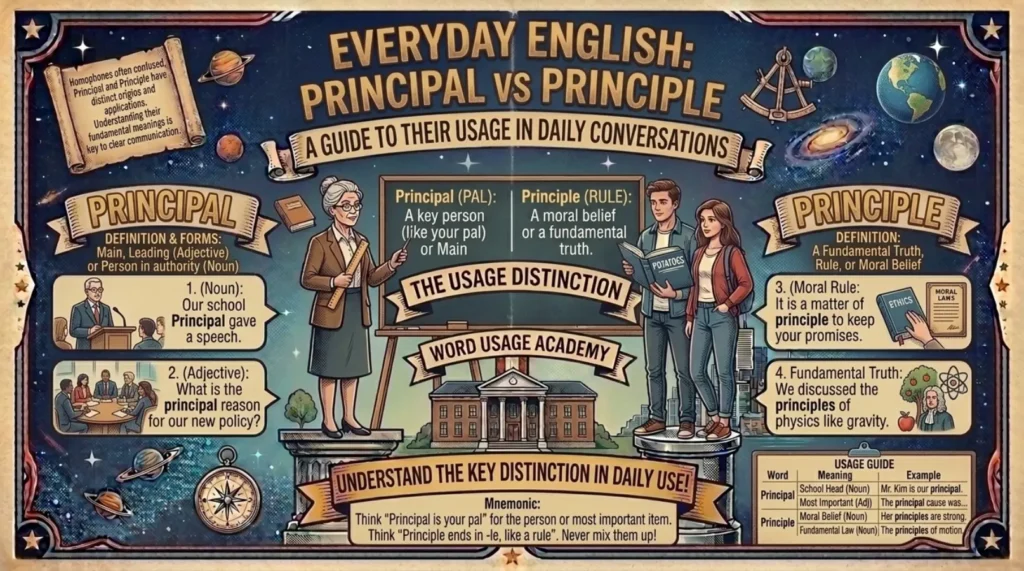
Real-Life Examples of Principal and Principle
At School
✅ The principal visited every classroom.
❌ The principle visited every classroom.
At Work
✅ Safety is our principal concern.
✅ Safety is an important principle.
Both are correct but have different meanings.
In Finance
✅ I paid the principal on my loan.
❌ I paid the principle on my loan.
In Personal Life
✅ She follows strong principles.
❌ She follows strong principals.
Principal vs Principle in Daily Conversations
Here are common situations.
1.Talking about school
- The principal gave a speech.
- The principal met with parents.
2.Talking about beliefs
- My principle is to always tell the truth.
- Respect is an important principle.
3.Talking about money
- I reduced the loan principal.
- Interest is charged after the principal.
4.Talking about importance
- Education is our principal goal.
- Water is the principal source of life.
Common Mistakes People Make
Many writers confuse these words because they sound the same.
Mistake 1
❌ The school principle spoke today.
✅ The school principal spoke today.
Mistake 2
❌ Honesty is my principal.
✅ Honesty is my principle.
Mistake 3
❌ I believe in good principals.
✅ I believe in good principles.
Mistake 4
❌ The principle amount of the loan.
✅ The principal amount of the loan.
Memory Tricks to Remember the Difference
These simple tricks work well.
Trick 1
The principal is your pal.
Both words contain “pal.”
Trick 2
Principles guide your behavior.
Think of principles as your personal rules.
Trick 3
If the sentence talks about school, money, or the main thing, use principal.
If it talks about beliefs or values, use principle.
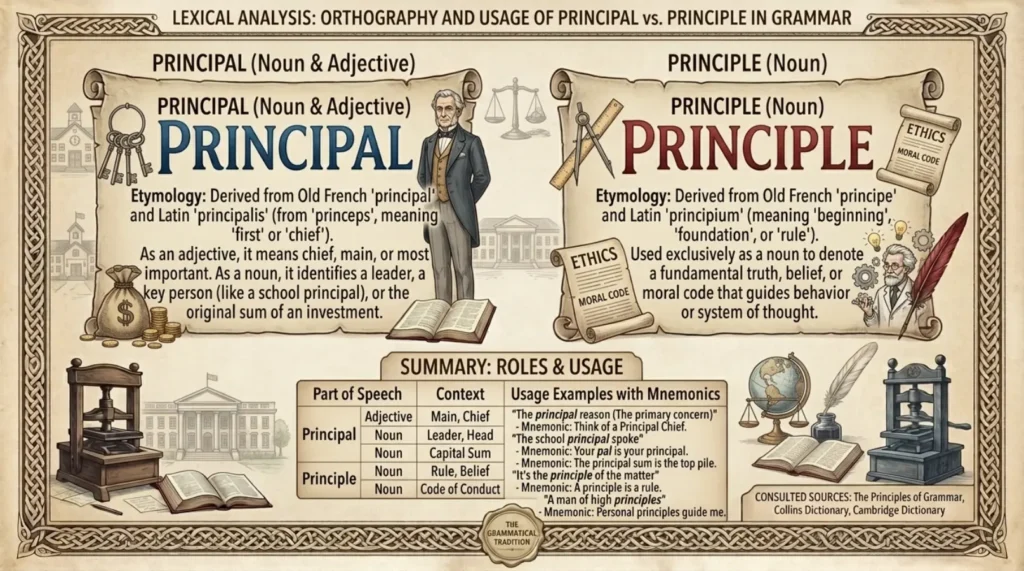
Principal vs Principle in Grammar
Principal
Can be:
- Noun
- Adjective
Examples
- The principal greeted everyone.
- This is the principal reason.
Principle
Only a noun.
Examples
- Freedom is an important principle.
- Justice is a basic principle.
Synonyms and Related Words
Principal
- Main
- Chief
- Leading
- Primary
- Major
- Head
- Primary figure
Principle
- Rule
- Belief
- Value
- Standard
- Doctrine
- Ethics
- Moral
Related Search Terms
- principal meaning
- principle meaning
- principal vs principle examples
- principal or principle
- difference between principal and principle
- principal definition
- principle definition
- principal in finance
- school principal meaning
- moral principle meaning
Principal vs Principle Quiz
Choose the correct word.
1. The school _____ welcomed the students.
Answer: Principal
2. Honesty is an important _____.
Answer: Principle
3. We paid the loan _____ first.
Answer: Principal
4. Respect should be a guiding _____.
Answer: Principle
5. This is our _____ goal.
Answer: Principal
Why People Confuse Principal and Principle
There are three main reasons.
- They sound exactly alike.
- They differ by only one letter.
- Both appear in education and formal writing.
Learning their meanings makes writing much easier.
Expert Insights
Language experts recommend learning words by their meaning instead of spelling alone.
A simple memory trick often works better than memorizing rules.
Using principal correctly improves business, financial, and educational writing.
Using principle correctly makes your writing more professional and accurate.
Reading quality books also helps you recognize the correct usage naturally.
FAQs:
Is it principal or principle at school?
Use principal because it refers to the head of a school.
Is honesty a principal or a principle?
Honesty is a principle because it is a moral belief.
What is the principal amount?
It is the original amount of money borrowed or invested before interest.
Can principal mean main?
Yes. As an adjective, principal means main or most important.
Is principle ever an adjective?
No. Principle is always a noun.
How do I remember the difference?
Remember:
The principal is your pal.
Principles are rules that guide your life.
Which word is used in finance?
Principal refers to the original loan or investment amount.
Why do these words sound the same?
They are homophones. Homophones have different meanings but identical pronunciation.
Featured Snippet: Principal vs Principle Meaning
| Word | Meaning |
|---|---|
| Principal | The head of a school, the main thing, or the original amount of money |
| Principle | A rule, belief, moral value, or basic truth |
Easy Tip: If you’re talking about a person, importance, or money, choose principal. If you’re talking about beliefs or rules, choose principle.
Internal Linking Suggestions
To improve SEO and user experience, link this article to related grammar guides such as:
- Affect vs Effect
- Then vs Than
- Who’s vs Whose
- Stationary vs Stationery
- Further vs Farther
- Accept vs Except
- Advice vs Advise
- Compliment vs Complement
Conclusion
Understanding principal vs principle meaning is easier once you know what each word represents. Principal refers to a main person, a main thing, or the original amount of money in finance. Principle refers to a rule, belief, value, or moral standard. Although these words sound the same, they serve very different purposes in English.
Use the simple memory trick, “The principal is your pal,” to remember the school leader or the main person. Think of principles as the rules that guide your decisions. With regular practice and real-life examples, choosing the correct word becomes natural. The next time you write, you can confidently use principal and principle without hesitation, making your communication clearer and more professional.

James Carter is a comparison writer and research specialist with over 10 years of experience in digital publishing. With a background in business communication and consumer research, he creates detailed comparison articles, buying guides, and reviews that help readers make informed decisions with confidence. “Every comparison should help readers make better decisions. My goal is to turn complex information into clear, practical guidance that people can trust.” — James Carter