
Ensure vs assure is a common grammar question. Many English learners mix these words because they sound alike. However, they have different meanings and uses. Knowing the difference helps you write and speak more clearly. The good news is that the rule is simple once you understand it. In most cases, ensure means to make something happen. Assure means to give someone confidence or remove doubt. This guide explains each word in plain English. You will also find examples, comparison tables, memory tricks, and common mistakes. By the end, you will know exactly when to use ensure and when to use assure.
Quick Summary Box (Featured Snippet)
- Ensure means to make certain something happens.
- Assure means to make someone feel confident.
- Ensure focuses on an action or result.
- Assure focuses on a person.
- Remember:
- Ensure = Event
- Assure = Person
- Both words are correct but used differently.
What Does “Ensure” Mean?
Ensure means to make certain that something happens.
It focuses on achieving a result.
Examples
- Please ensure the door is locked.
- Exercise helps ensure good health.
- We ensure quality before shipping.
- Double-check your work to ensure accuracy.
Simple Definition
Ensure = Make sure something happens.
What Does “Assure” Mean?
Assure means to tell someone that everything is okay.
It focuses on giving confidence to a person.
Examples
- I assure you everything is fine.
- The teacher assured the students before the test.
- She assured her parents she was safe.
- He assured customers their data was secure.
Simple Definition
Assure = Give confidence to a person.
Ensure vs Assure Comparison Table
| Feature | Ensure | Assure |
|---|---|---|
| Main meaning | Make certain | Give confidence |
| Focus | Event or result | Person |
| Object | Thing, action, outcome | Person |
| Purpose | Prevent problems | Remove doubt |
| Example | Ensure success | Assure customers |
| Question answered | Will it happen? | Is someone worried? |
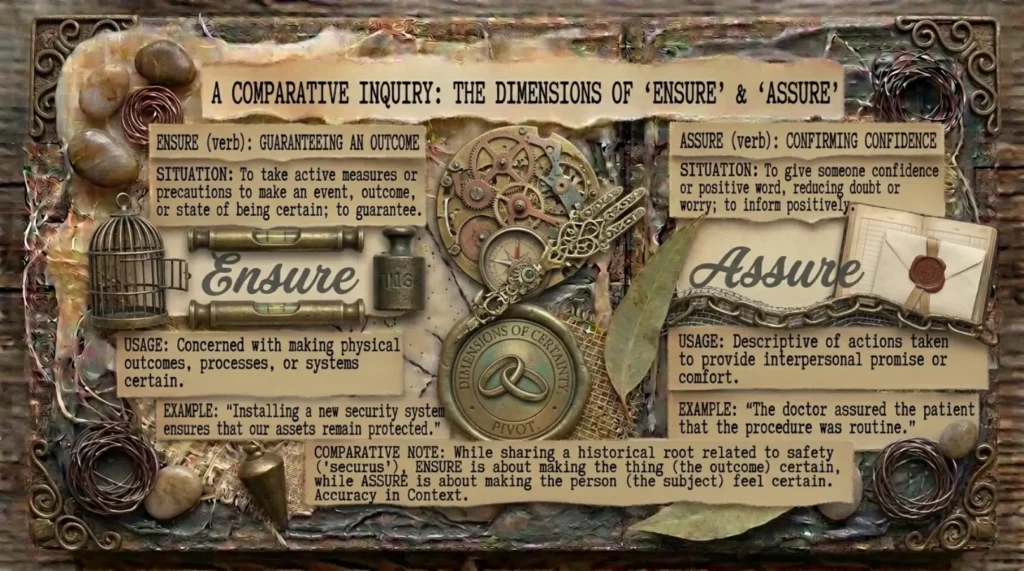
The Biggest Difference Between Ensure and Assure
The easiest way to remember is:
- Ensure affects things.
- Assure affects people.
Example
✅ I ensured the report was complete.
✅ I assured my manager the report was complete.
The first sentence guarantees the report.
The second comforts the manager.
Real-Life Examples of Ensure vs Assure
At Work
Ensure
- Ensure the files are backed up.
- Ensure all emails are answered.
Assure
- I assure you the project is on schedule.
- The manager assured the team everything was under control.
At School
Ensure
- Study daily to ensure good grades.
- Teachers ensure classroom safety.
Assure
- The teacher assured nervous students.
- Parents assured their children before exams.
While Traveling
Ensure
- Ensure your passport is valid.
- Ensure your luggage is labeled.
Assure
- The guide assured tourists they were safe.
- Staff assured passengers about the delay.
In Healthcare
Ensure
- Doctors ensure proper treatment.
- Hospitals ensure patient safety.
Assure
- The nurse assured the patient before surgery.
- The doctor assured the family of good care.
When Should You Use Ensure?
Use ensure when talking about results or actions.
Examples:
- Ensure everyone signs the form.
- We ensure high-quality service.
- Please ensure your phone is charged.
- The helmet helps ensure safety.
When Should You Use Assure?
Use assure when talking directly to a person.
Examples:
- I assure you everything is okay.
- She assured her friend.
- They assured customers of fast delivery.
- He assured us he would arrive early.
Common Mistakes People Make
Mistake 1
❌ I ensured my friend.
✅ I assured my friend.
Why?
You comfort a person.
Mistake 2
❌ I assured the report was correct.
✅ I ensured the report was correct.
Why?
The report is not a person.
Mistake 3
❌ The company assured quality.
✅ The company ensured quality.
Quality is a result.
Mistake 4
❌ Ensure me.
✅ Assure me.
You reassure people.
Easy Trick to Remember
Remember this sentence:
Ensure Events. Assure People.
Or think:
- Ensure = Outcome
- Assure = Confidence
This simple trick works almost every time.
Ensure vs Assure in Daily Conversations
Office
“I’ll ensure the meeting starts on time.”
“I assure you we’ll finish today.”
Family
“I ensured the kids wore seat belts.”
“I assured my daughter she would be okay.”
Shopping
“The store ensures product quality.”
“The salesperson assured me the warranty was valid.”
Travel
“We ensured our tickets were confirmed.”
“The airline assured passengers about safety.”
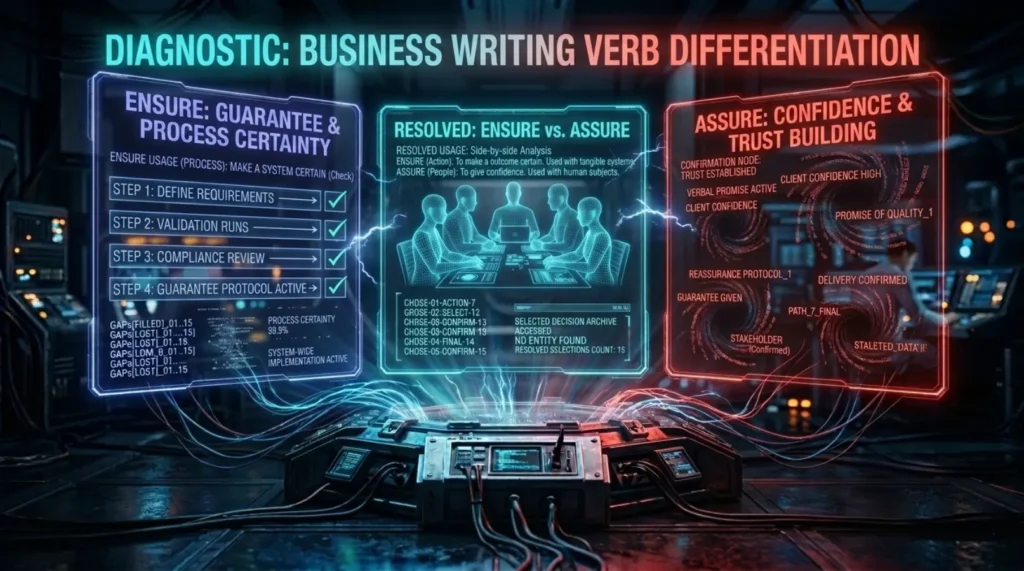
Ensure vs Assure in Business Writing
Business writing often uses both words.
Ensure
- Ensure compliance.
- Ensure accuracy.
- Ensure customer satisfaction.
- Ensure security.
Assure
- Assure clients.
- Assure investors.
- Assure employees.
- Assure customers.
Professional writers choose the correct word because it improves clarity.
Synonyms of Ensure
Related words include:
- Guarantee
- Secure
- Confirm
- Make certain
- Verify
- Protect
- Establish
- Safeguard
Synonyms of Assure
Related words include:
- Reassure
- Comfort
- Convince
- Encourage
- Promise
- Calm
- Give confidence
- Confirm
Ensure vs Assure vs Insure
Many people also confuse insure.
| Word | Meaning |
|---|---|
| Ensure | Make certain |
| Assure | Give confidence |
| Insure | Provide insurance coverage |
Examples
- Ensure the work is finished.
- I assure you we’ll help.
- I insured my car.
Expert Grammar Tips
Language experts recommend focusing on the object of the sentence.
Ask yourself:
Is it a person?
Use assure.
Is it an action or result?
Use ensure.
This simple habit improves grammar quickly.
Professional editors also suggest reading the sentence aloud. If you are comforting someone, assure usually fits. If you are guaranteeing an outcome, ensure is almost always correct.
FAQs:
Is ensure and assure the same?
No. Ensure guarantees a result. Assure gives confidence to a person.
Can ensure and assure be used interchangeably?
Usually no. They have different meanings.
Is “I assure you” correct?
Yes. It is one of the most common uses of assure.
Is “ensure safety” correct?
Yes. You ensure safety because safety is an outcome.
Can I say “assure safety”?
Normally no. Instead, say ensure safety.
What is the easiest way to remember the difference?
Remember:
Ensure = Event
Assure = Person
Is ensure formal?
Yes. It is common in both formal and informal English.
Which word appears more in business writing?
Both appear often. However, ensure is more common because businesses frequently discuss processes and results.
Expert Insights
Understanding ensure vs assure improves both speaking and writing. Choosing the right word makes your message clearer and more professional. Editors, teachers, and recruiters notice accurate word choice. In business documents, using ensure correctly shows precision. Using assure appropriately builds trust and confidence with readers. Learning this distinction is a small grammar improvement that has a big impact on communication.
Internal Linking Suggestions
To strengthen your grammar content cluster, consider linking this article to related topics such as:
- Ensure vs Insure
- Assure vs Reassure
- Affect vs Effect
- Then vs Than
- Who’s vs Whose
- Advice vs Advise
- Lay vs Lie
- Everyday vs Every Day
Final Comparison at a Glance
| Situation | Correct Word |
|---|---|
| Guarantee a result | Ensure |
| Comfort someone | Assure |
| Make something happen | Ensure |
| Give confidence | Assure |
| Talk about safety | Ensure |
| Talk to worried people | Assure |
Conclusion
The difference between ensure vs assure becomes simple once you know what each word targets. Ensure means making certain that an action or result happens. Assure means giving confidence to a person or removing doubt. A quick way to remember is “Ensure Events, Assure People.” This rule works in most situations and helps you avoid common grammar mistakes. Whether you are writing emails, business reports, school assignments, or everyday messages, choosing the correct word makes your communication clearer and more professional. Practice using both words in real-life sentences, and the distinction will soon become second nature. Mastering this pair is a small step that leads to stronger English skills.

Michael Reed is a language content writer and word comparison researcher based in the United States. He studied English Language and Communication and focuses on grammar, spelling differences, and word usage. His work helps readers understand confusing English words through clear comparisons and practical explanations. Michael creates simple, reader-friendly content designed to improve everyday language skills.