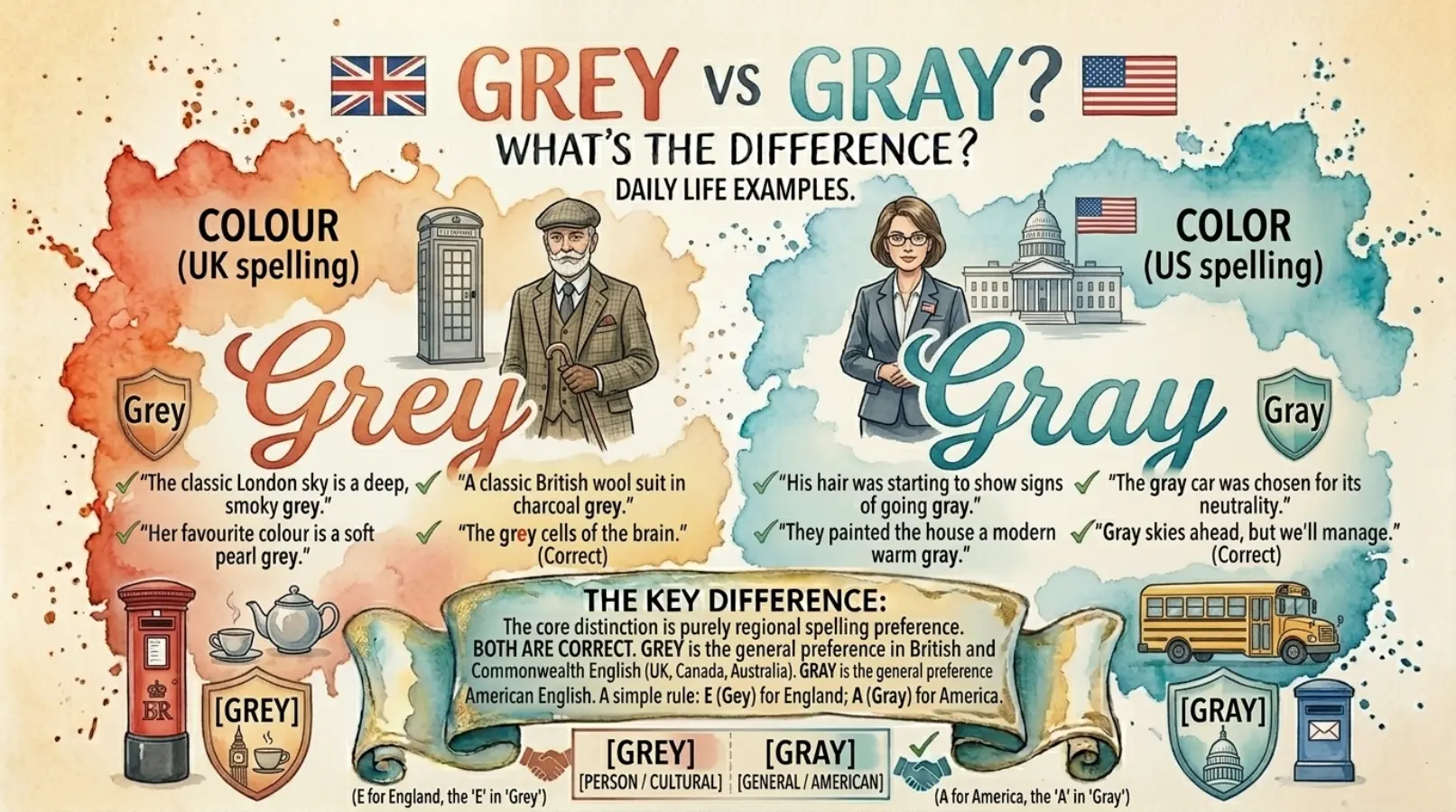
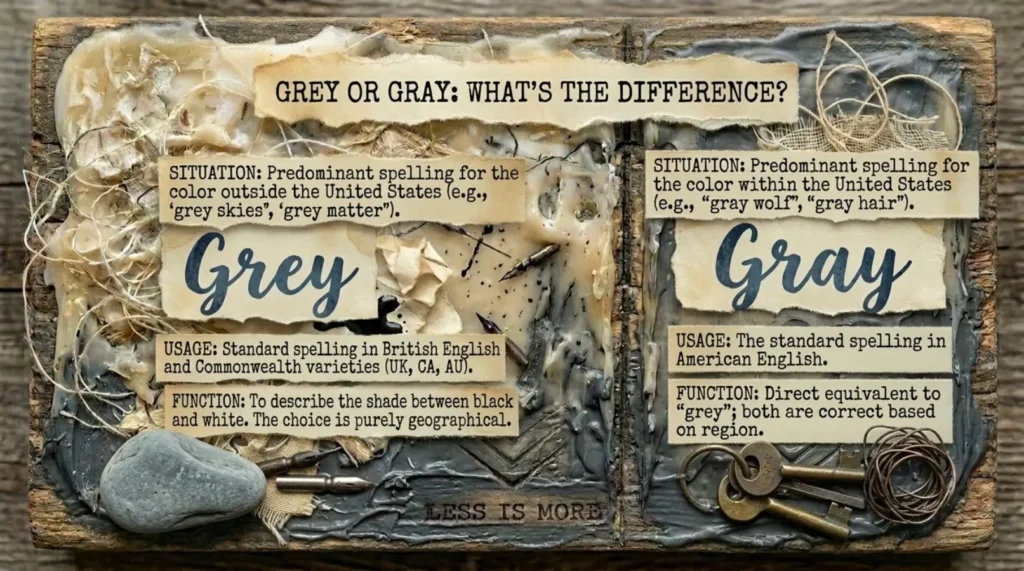
Grey or gray is one of the most common spelling questions in English. Many people wonder which version is correct. The good news is that both spellings are correct. The right choice depends on where you live and who you write for.
In general, gray is the preferred spelling in American English. Grey is more common in British English and many other English-speaking countries. Both words describe the same color between black and white. However, using the correct spelling for your audience helps your writing look more natural and professional.
This guide explains the difference in simple words. You will learn when to use each spelling, avoid common mistakes, and remember the correct choice with easy examples.
Quick Summary Box
Grey and gray have the same meaning.
Gray is the standard spelling in American English.
Grey is the standard spelling in British English.
Both words describe the color between black and white.
Choose one spelling and stay consistent throughout your writing.
Match your spelling to your audience or style guide.
What Does “Grey or Gray” Mean?
Both grey and gray refer to the same neutral color between black and white.
There is no difference in meaning. The only difference is the preferred spelling based on regional English.
Simple Definition
Gray = American English spelling
Grey = British English spelling
Whether you write “gray clouds” or “grey clouds,” readers understand the same color.
Is Grey or Gray Correct?
Yes. Both spellings are correct.
The difference comes from the version of English you use.
English Version
Preferred Spelling
American English
Gray
British English
Grey
Canadian English
Grey (more common)
Australian English
Grey
New Zealand English
Grey
If you write for an American audience, use gray.
If your readers are in the UK or Australia, use grey.
Grey vs Gray Comparison Table
Feature
Grey
Gray
Meaning
Color between black and white
Color between black and white
Correct?
Yes
Yes
American English
Less common
Standard
British English
Standard
Rare
Canadian English
More common
Sometimes used
Australian English
Standard
Rare
Pronunciation
Same
Same
Meaning Difference
None
None
Why Are There Two Spellings?
English has many words with regional spellings.
These differences developed over hundreds of years.
American English simplified many spellings during the 1800s.
British English kept many traditional spellings.
That is why we also see:
American English
British English
Color
Colour
Favorite
Favourite
Center
Centre
Gray
Grey
Both spellings remain accepted today.
When Should You Use “Gray”?
Use gray when writing for an American audience.
Examples
The sky turned gray before the storm.
My car is gray.
She wore a gray sweater.
The walls are painted gray.
His hair is turning gray.
American schools, newspapers, and businesses almost always use gray.
When Should You Use “Grey”?
Use grey when writing for readers in the UK or countries that follow British English.
Examples
The sky became grey.
She bought a grey jacket.
The old house had grey walls.
His beard is now grey.
We painted the fence grey.
British publishers usually prefer this spelling.
Grey or Gray in Daily Life
You see these spellings everywhere.
Examples include:
Paint colors
Fashion
Home decoration
Weather reports
School assignments
Graphic design
Marketing materials
Interior design
The spelling simply changes with the country.
Real-Life Examples
American English
Gray clouds covered the city.
The gray cat slept all afternoon.
She chose a gray sofa.
British English
Grey clouds covered the city.
The grey cat slept all afternoon.
He bought a grey suit.
Notice that only the spelling changes.
Grey vs Gray in Popular Brands and Names
Some companies choose one spelling regardless of country.
Examples include:
Grey Goose (brand)
Grey’s Anatomy (TV show)
Gray Line Tours (company)
Gray Wolf (animal name in American English)
Always use the official spelling when writing brand names or titles.
Common Mistakes People Make
1. Mixing Both Spellings
❌ The walls are gray but the roof is grey.
✅ Choose one spelling and stay consistent.
2. Using British Spelling for American Content
American websites usually prefer:
✅ Gray
3. Using American Spelling for British Readers
British publications usually expect:
✅ Grey
4. Thinking They Have Different Meanings
They do not.
Both words describe exactly the same color.
Easy Trick to Remember
Use this simple memory trick.
Gray = America
Both words contain the letter A.
Grey = England
Both words contain the letter E.
This trick helps many writers remember the correct spelling.
Grey or Gray in Digital Writing
Consistency matters online.
If your website targets American readers:
Use gray throughout the article.
Keep image alt text consistent.
Use the same spelling in headings.
If your audience is British:
Use grey everywhere.
This improves readability and professionalism.
Synonyms and Related Words
Synonyms
Ash
Slate
Silver
Charcoal
Smoky
Steel
Neutral
Dove
Graphite
Related Search Terms (LSI Keywords)
gray vs grey
grey meaning
gray meaning
British vs American spelling
color spelling
English spelling differences
grey color
gray color
correct spelling of grey
grey or gray differenceExpert Insights
Professional writers choose the spelling that matches their audience.
Search engines understand both spellings.
However, readers notice consistency.
For better SEO:
Use one spelling throughout the article.
Match your target country.
Keep headings and image descriptions consistent.
Follow your brand’s style guide.
Small spelling choices build trust with readers.
Common Grammar Tips
Remember these points:
Both spellings are nouns and adjectives.
They have identical pronunciation.
Neither spelling is more correct worldwide.
Context decides which one fits best.
Stay consistent in one document.
Grey or Gray in School and Exams
Students should follow their teacher’s instructions.
If your school teaches American English:
Use gray.
If your school teaches British English:
Use grey.
In international exams, either spelling is acceptable if you stay consistent.
Featured Snippet: Grey vs Gray
Grey and gray both describe the color between black and white. Gray is the preferred spelling in American English, while grey is the preferred spelling in British English. The meanings are identical, and the choice depends on your audience and writing style.
FAQs
Is gray or grey more correct?
Both are correct. Gray is American English, while grey is British English.
Which spelling does the United States use?
American English almost always uses gray.
Which spelling does the United Kingdom use?
British English normally uses grey.
Do grey and gray have different meanings?
No.
They refer to the same color.
Which spelling is better for SEO?
Use the spelling your audience searches for.
American websites usually perform better with gray.
British websites usually prefer grey.
Can I use both spellings in one article?
It is better not to.
Choose one spelling and stay consistent.
Why are there two spellings?
American and British English developed different spelling standards over time.
Is grey an old spelling?
No.
Grey remains the standard spelling in British English today.
Internal Linking Suggestions
You can link this article to related grammar guides such as:
Color or Colour
Favorite or Favourite
Center or Centre
Theater or Theatre
Cancelled or Canceled
Practice or Practise
Toward or Towards
Meter or Metre
Conclusion
The answer to grey or gray is simple. Both spellings are correct and mean exactly the same thing. The only real difference is the type of English you use. Gray is standard in American English, while grey is preferred in British English and many other countries.
When writing, think about your audience first. Then use one spelling consistently throughout your article, email, or document. This keeps your writing clear, professional, and easy to read. Whether you choose grey or gray, readers will understand the color perfectly. Consistency—not the spelling itself—is what makes your writing look polished and trustworthy.
Michael Reed is a language content writer and word comparison researcher based in the United States. He studied English Language and Communication and focuses on grammar, spelling differences, and word usage. His work helps readers understand confusing English words through clear comparisons and practical explanations. Michael creates simple, reader-friendly content designed to improve everyday language skills.