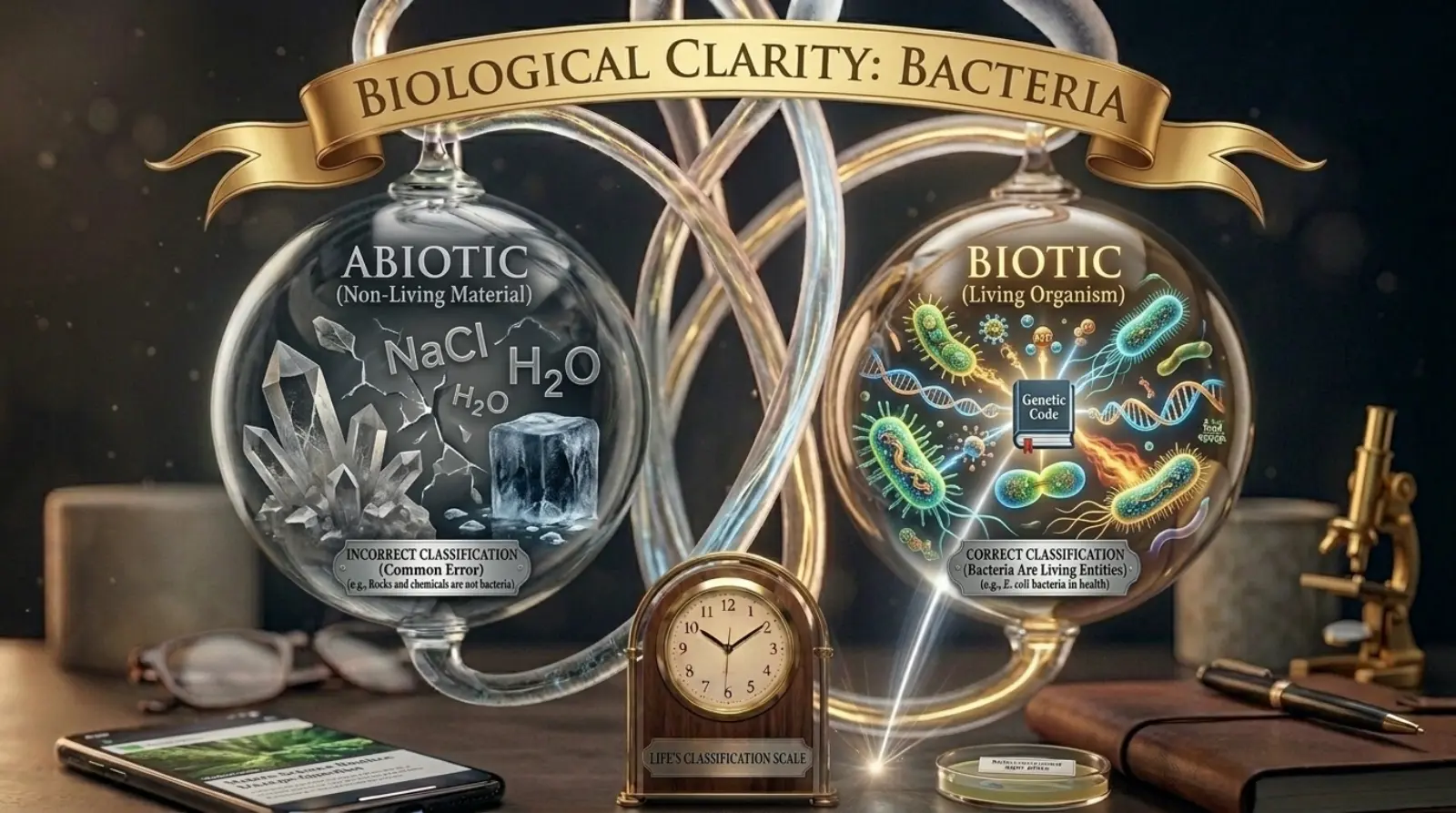
Is bacteria biotic or abiotic? Bacteria are biotic because they are living organisms. They can grow, reproduce, use energy, and respond to their surroundings. Although bacteria look tiny, they show key signs of life. This makes them different from abiotic things, such as water, rocks, air, and sunlight. Some bacteria can also survive harsh conditions for long periods. However, they still belong to the biotic part of an ecosystem. Understanding this difference helps explain how ecosystems work. It also makes biology and environmental science easier to understand. In this guide, we will explain why bacteria are biotic. We will also compare biotic and abiotic factors with simple examples. By the end, you will clearly understand where bacteria belong and why.
Quick Summary: Are Bacteria Biotic or Abiotic?
- Bacteria are biotic factors.
- Bacteria are living, single-celled organisms.
- They can grow, reproduce, and use energy.
- They respond to changes in their environment.
- Abiotic factors are nonliving parts of an ecosystem.
- Water, sunlight, air, soil minerals, and temperature are abiotic.
- Bacteria can interact with both biotic and abiotic factors.
- Even dormant bacterial spores come from living bacteria.
- Therefore, bacteria belong to the biotic component of an ecosystem.
What Does Biotic Mean?
The word biotic refers to living things or factors related to life.
A biotic factor exists as a living organism or comes from living organisms. These factors can affect other living things in an ecosystem.
Common biotic factors include:
- Bacteria
- Plants
- Animals
- Fungi
- Algae
- Protozoa
- Humans
- Other microorganisms
Biotic factors play important roles in ecosystems. They may provide food, competition, shelter, or nutrients.
For example, plants provide food for many animals. Bacteria break down dead material and return nutrients to soil.
Therefore, bacteria clearly fit the meaning of a biotic factor.
What Does Abiotic Mean?
The word abiotic means nonliving.
Abiotic factors do not grow, reproduce, or carry out life processes. However, they strongly affect living organisms.
Examples of abiotic factors include:
- Water
- Sunlight
- Temperature
- Air
- Rocks
- Soil minerals
- Humidity
- Wind
- pH
- Salinity
For example, bacteria need water to carry out many biological processes. Temperature can also affect how quickly bacteria grow.
However, water and temperature remain abiotic factors.
This difference is important. A living organism can depend on an abiotic factor without becoming abiotic.
Is Bacteria Biotic or Abiotic? Comparison Table
| Feature | Biotic | Abiotic |
|---|---|---|
| Meaning | Refers to living or once-living things | Refers to non-living things |
| Bacteria | ✅ Bacteria are biotic | ❌ Bacteria are not abiotic |
| Living? | Yes, bacteria are living organisms | No, abiotic factors are non-living |
| Growth | Can grow and reproduce | Cannot grow or reproduce |
| Metabolism | Bacteria carry out metabolic processes | Abiotic factors do not have metabolism |
| Examples | Bacteria, plants, animals, fungi | Water, sunlight, air, temperature, rocks |
| Role in ecosystems | Bacteria can act as decomposers or producers | Abiotic factors affect how organisms survive |
| Example sentence | “Bacteria are a biotic factor in soil.” | “Water is an abiotic factor in soil.” |
Quick answer: 🦠 Bacteria are biotic because they are living organisms.
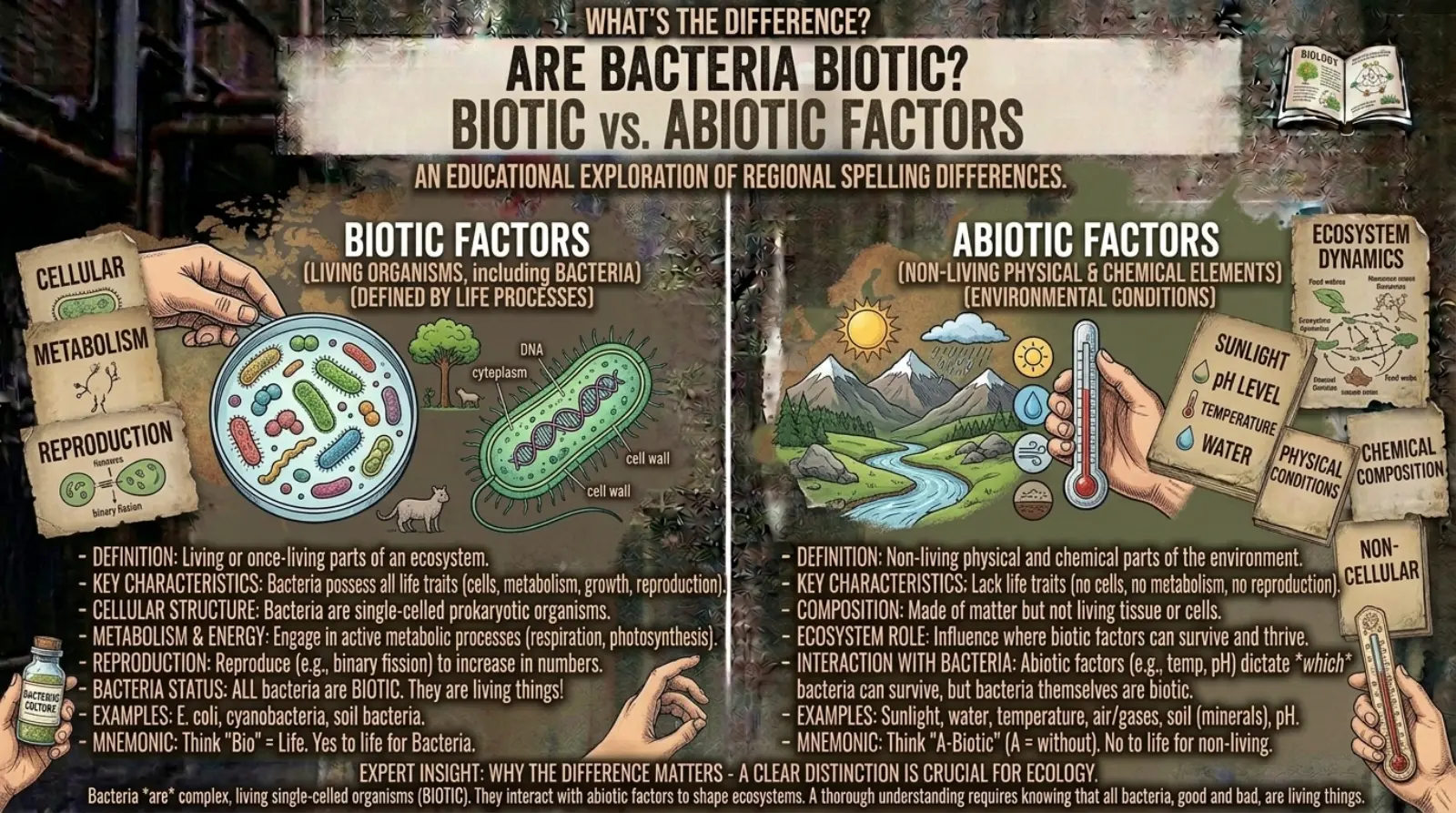
Why Are Bacteria Biotic?
Bacteria are biotic because they are living organisms.
They perform several activities associated with life. For example, bacteria can obtain nutrients from their surroundings.
They can also produce energy and grow under suitable conditions.
Many bacteria reproduce through binary fission. During this process, one bacterial cell divides into two cells.
Bacteria also respond to environmental changes. Some bacteria move toward nutrients or away from harmful conditions.
These characteristics show that bacteria are living organisms.
Therefore:
Bacteria = biotic
Rocks = abiotic
Water = abiotic
Sunlight = abiotic
This simple rule can help you answer many biology questions.
What Makes Something Biotic?
A living organism usually shows several characteristics of life.
These characteristics include:
- Growth – Living organisms can increase in size or cell number.
- Reproduction – Living organisms can produce new organisms.
- Energy use – Living cells need energy for biological processes.
- Response – Living organisms respond to environmental changes.
- Cellular structure – Living organisms contain cells.
- Metabolism – Living organisms carry out chemical reactions.
- Adaptation – Populations can develop traits that help survival.
Bacteria show these characteristics.
They are made of cells and carry out metabolic processes. They also reproduce and respond to environmental conditions.
That evidence supports their classification as biotic organisms.
Are All Bacteria Considered Living?
Yes, bacteria are generally classified as living organisms.
However, bacterial activity can change greatly under different conditions.
Some bacteria enter inactive states when conditions become unfavorable. Certain bacteria can form structures called endospores.
An endospore helps some bacterial species survive extreme conditions. It can resist heat, dryness, and other environmental stresses.
An endospore may remain inactive for a long time.
However, this does not make bacteria abiotic.
The bacterial organism remains part of the living world. When conditions improve, some bacteria can return to active growth.
So, inactive or dormant bacteria do not become nonliving abiotic factors.
Biotic vs Abiotic: Key Difference
The easiest way to understand the difference is to compare living and nonliving factors.
| Feature | Biotic | Abiotic |
|---|---|---|
| Meaning | Living component | Nonliving component |
| Contains living cells | Yes | No |
| Can reproduce | Yes | No |
| Uses biological energy | Yes | No |
| Can grow biologically | Yes | No |
| Responds to surroundings | Yes | Not as a living organism |
| Examples | Bacteria, plants, animals | Water, sunlight, rocks |
| Role in ecosystems | Living interactions | Environmental conditions |
Bacteria belong in the biotic column.
Water, sunlight, and temperature belong in the abiotic column.
Both types matter because ecosystems depend on their interaction.
Examples of Bacteria as Biotic Factors
Bacteria perform many important roles in nature.
1. Soil Bacteria
Many bacteria live in soil.
They help break down organic material. Some bacteria also help cycle nutrients through ecosystems.
Certain bacteria can convert nitrogen into forms that plants can use.
2. Gut Bacteria
Many animals, including humans, contain bacteria in their digestive systems.
These microorganisms interact with their hosts. Some help break down food and support normal biological processes.
This is another example of bacteria acting as biotic factors.
3. Decomposer Bacteria
Bacteria can help decompose dead plants and animals.
They break down organic matter into simpler substances.
This process returns nutrients to the environment.
4. Aquatic Bacteria
Bacteria live in freshwater and marine environments.
They interact with algae, plants, animals, and other microorganisms.
Water temperature, oxygen levels, and nutrient availability affect their activity.
5. Disease-Causing Bacteria
Some bacteria cause diseases in humans, animals, or plants.
These bacteria interact with their hosts.
Their biological activity can affect the health of other organisms.
How Bacteria Interact With Abiotic Factors
Bacteria are biotic, but they depend on abiotic factors.
For example, bacteria need suitable environmental conditions for growth.
Important abiotic factors include:
- Temperature
- Water availability
- Oxygen
- pH
- Salinity
- Nutrients
- Pressure
Consider soil bacteria.
The bacteria are biotic. Soil moisture and temperature are abiotic.
If the soil becomes too dry, bacterial activity may decrease.
If the temperature becomes unsuitable, bacterial growth may also slow down.
This shows how biotic and abiotic factors work together.
Real-Life Examples of Biotic and Abiotic Factors
Understanding real examples makes the concept easier.
Example 1:
A Garden
A garden contains many biotic factors.
These include plants, insects, fungi, worms, and bacteria.
It also contains abiotic factors.
These include sunlight, water, soil, temperature, and minerals.
Bacteria help break down organic material in the soil.
Meanwhile, soil moisture and temperature influence bacterial activity.
Example 2:
A Pond
A pond contains bacteria, fish, algae, plants, and insects.
These are biotic factors.
Water temperature, sunlight, oxygen, and minerals are abiotic factors.
All these components interact within the pond ecosystem.
Example 3:
A Compost Pile
A compost pile contains bacteria and fungi.
These organisms break down food scraps and plant material.
Heat, moisture, oxygen, and pH affect decomposition.
Here, microorganisms are biotic factors.
Environmental conditions are abiotic factors.
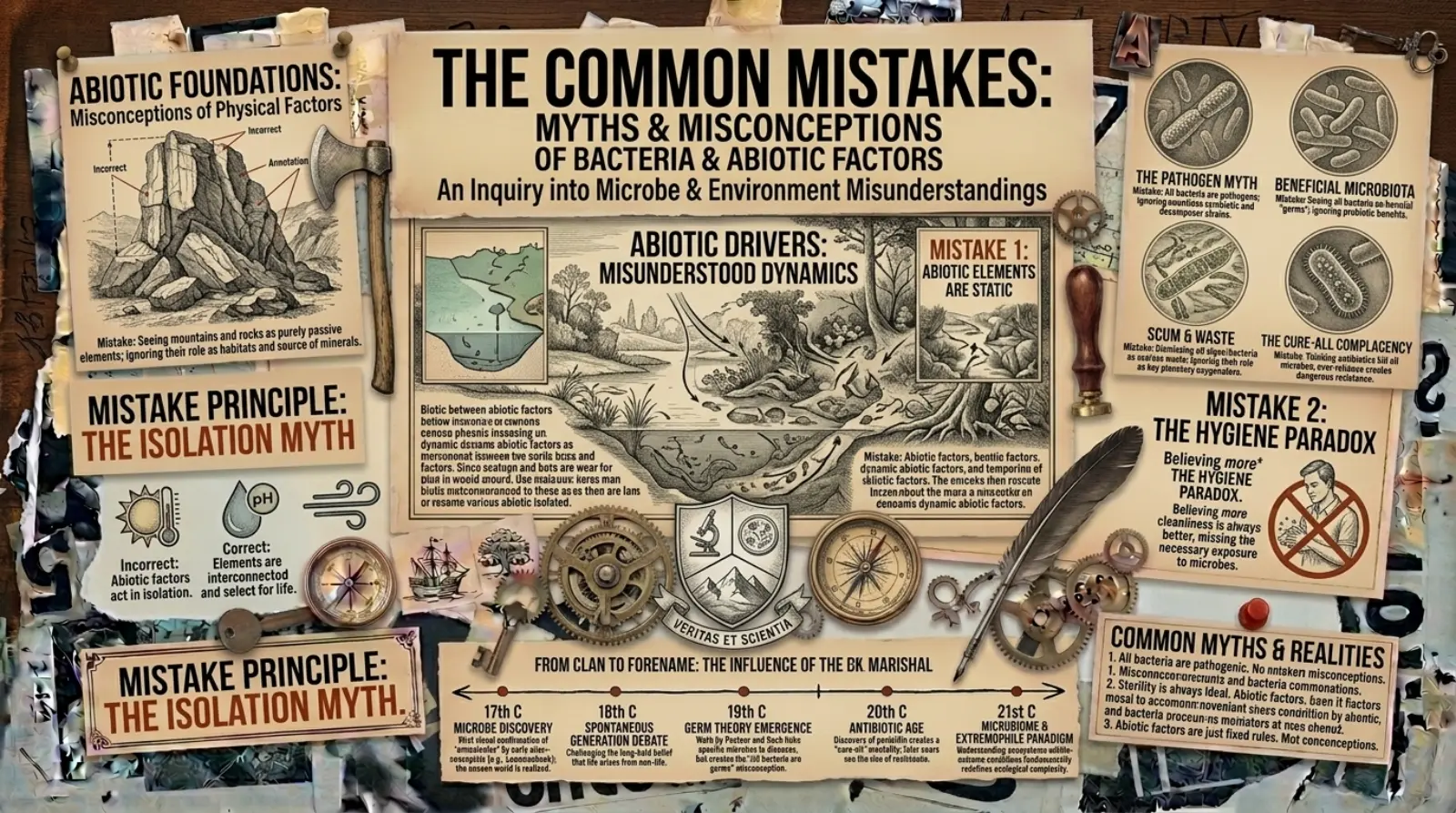
Common Mistakes About Bacteria and Abiotic Factors
Many students confuse bacteria with abiotic factors.
Here are some common mistakes to avoid.
Mistake 1:
Calling Bacteria Abiotic Because They Are Tiny
Size does not determine whether something is biotic.
Bacteria are tiny, but they are living organisms.
Therefore, they remain biotic.
Mistake 2:
Thinking Microorganisms Are Nonliving
Microorganisms can be living organisms.
Bacteria, fungi, and many protozoa are examples.
Their microscopic size does not make them abiotic.
Mistake 3:
Confusing Bacterial Spores With Nonliving Matter
Some bacteria form resistant endospores.
These structures can remain dormant under harsh conditions.
However, they originate from living bacterial cells.
Mistake 4:
Thinking Anything in Soil Is Abiotic
Soil contains both biotic and abiotic components.
Minerals, water, and rocks are abiotic.
Bacteria, fungi, plant roots, and worms are biotic.
Mistake 5:
Confusing Dead Organisms With Abiotic Factors
This point requires more care.
A dead organism is no longer alive, but it came from a living organism.
In ecology, dead organic matter is often discussed as detritus or organic material.
So, do not simply classify every dead biological material as an abiotic factor.
Easy Trick to Remember the Answer
Use this simple question:
“Is it alive?”
If the answer is yes, think biotic.
If it is naturally nonliving, think abiotic.
For example:
- Bacteria → Biotic
- Plants → Biotic
- Animals → Biotic
- Fungi → Biotic
- Water → Abiotic
- Sunlight → Abiotic
- Rocks → Abiotic
- Temperature → Abiotic
You can also remember:
BIO = life
The word “biotic” contains bio, which relates to life.
Therefore, bacteria are biotic.
Bacteria in the Ecosystem
Bacteria play major roles in ecosystems.
Some bacteria act as decomposers. They break down dead organic material.
Other bacteria participate in nutrient cycles.
For example, bacteria play important roles in the nitrogen cycle.
Certain bacteria convert nitrogen into useful compounds. Other bacteria perform different steps in nitrogen movement.
Bacteria also interact with plants, animals, fungi, and other microorganisms.
These interactions can affect ecosystem health.
Without microorganisms, many natural processes would work very differently.
Therefore, bacteria are important biotic components of ecosystems.
Are Bacteria a Biotic or Abiotic Component?
Bacteria are a biotic component of an ecosystem.
An ecosystem contains living organisms and nonliving environmental factors.
Living components include:
- Bacteria
- Plants
- Animals
- Fungi
- Protists
- Other microorganisms
Nonliving components include:
- Water
- Air
- Temperature
- Light
- Minerals
- Soil chemistry
Bacteria belong to the living component.
However, bacteria interact constantly with nonliving environmental conditions.
This interaction helps ecosystems function properly.
Bacteria vs. Other Microorganisms
Bacteria are not the only microorganisms considered biotic.
Many microorganisms are living organisms.
For example:
| Organism | Biotic or Abiotic? |
|---|---|
| Bacteria | Biotic |
| Fungi | Biotic |
| Protozoa | Biotic |
| Algae | Biotic |
| Microscopic animals | Biotic |
| Viruses | More complex classification |
| Water molecules | Abiotic |
| Mineral particles | Abiotic |
Viruses deserve special attention.
Scientists debate how to classify viruses because they cannot reproduce independently like living cells.
Bacteria do not have this same classification problem.
Bacteria are cellular organisms with their own biological processes.
Is Bacteria Biotic or Abiotic in Soil?
Bacteria in soil are biotic factors.
Soil contains both living and nonliving components.
The living components include bacteria, fungi, plant roots, worms, and other organisms.
The nonliving components include minerals, water, air spaces, and organic compounds.
Soil bacteria can help break down organic matter.
Some also participate in nutrient cycling.
Therefore, finding bacteria in soil does not make them abiotic.
They remain living organisms within the soil ecosystem.
Is Bacteria Biotic or Abiotic in Water?
Bacteria found in water are also biotic factors.
The water itself is abiotic.
The bacteria living in that water are biotic.
For example, a pond can contain bacteria, algae, fish, and plants.
These are living components.
The water temperature, sunlight, dissolved oxygen, and mineral content are abiotic factors.
This distinction helps scientists understand aquatic ecosystems.
Is Bacteria Biotic or Abiotic in Food?
Bacteria in food are biotic because bacteria are living organisms.
Some bacteria are useful in food production.
For example, certain bacteria help produce yogurt and other fermented foods.
Other bacteria can cause food spoilage.
Some harmful bacteria can also cause foodborne illness.
The food itself may contain nutrients and water that support bacterial growth.
These nutrients and environmental conditions are not the bacteria themselves.
Therefore, bacteria remain biotic regardless of where they live.
Daily-Life Uses of the Biotic and Abiotic Concept
You can use this concept in many everyday situations.
Consider a refrigerator.
Bacteria are biotic organisms.
The cold temperature is an abiotic factor.
The temperature can slow bacterial growth.
Consider a garden.
Bacteria are biotic.
Water, sunlight, and soil minerals are abiotic.
Consider a swimming pool.
Bacteria are biotic.
Water temperature and chlorine levels are abiotic conditions.
This simple distinction helps explain why living organisms respond to environmental changes.
Biotic and Abiotic Keywords to Know
Understanding related terms can strengthen your biology vocabulary.
Biotic
A living component of an ecosystem.
Abiotic
A nonliving component of an ecosystem.
Ecosystem
A community of organisms interacting with their environment.
Microorganism
A living organism that usually requires magnification to see clearly.
Bacteria
Single-celled microorganisms that belong to the domain Bacteria.
Decomposer
An organism that breaks down dead organic material.
Nutrient Cycle
The movement of nutrients through organisms and the environment.
Environmental Factor
A condition that affects organisms in an ecosystem.
These terms often appear together in biology and environmental science.
Expert Insights: Why This Difference Matters
Knowing whether bacteria are biotic or abiotic helps build a strong foundation in ecology.
The distinction also helps students understand ecosystem relationships.
Bacteria do not simply exist in ecosystems.
They actively interact with other organisms and environmental conditions.
They can decompose organic matter and influence nutrient cycles.
Their growth can also change when temperature, moisture, oxygen, or pH changes.
Therefore, bacteria show the close relationship between biotic and abiotic factors.
Expert tip: When answering an exam question, state the classification first.
Then give one or two biological reasons.
For example:
“Bacteria are biotic because they are living organisms that grow, reproduce, and use energy.”
This answer is short, clear, and scientifically appropriate.
Frequently Asked Questions
1. Is bacteria biotic or abiotic?
Bacteria are biotic because they are living organisms.
2. Why are bacteria called biotic factors?
Bacteria are biotic because they are living organisms that interact with their environment.
3. Are bacteria living organisms?
Yes. Bacteria are living, single-celled organisms.
4. Is water biotic or abiotic?
Water is abiotic because it is nonliving.
5. Are bacteria in soil biotic?
Yes. Soil bacteria are biotic components of the soil ecosystem.
6. Are microorganisms biotic or abiotic?
Many microorganisms, including bacteria and fungi, are biotic because they are living organisms.
7. Is sunlight biotic or abiotic?
Sunlight is abiotic because it is a nonliving environmental factor.
8. Can bacteria interact with abiotic factors?
Yes. Bacteria respond to factors such as temperature, water, oxygen, and pH.
Internal Linking Suggestions
To strengthen your website’s topical authority, consider linking this article to related educational posts.
Useful internal-link topics include:
- What Are Biotic Factors?
- What Are Abiotic Factors?
- Biotic vs. Abiotic Factors
- Examples of Biotic Factors in an Ecosystem
- Examples of Abiotic Factors in an Ecosystem
- What Is an Ecosystem?
- What Are Decomposers?
- What Is the Nitrogen Cycle?
- Living vs. Nonliving Things
- Are Viruses Living or Nonliving?
Use descriptive anchor text rather than generic phrases like “click here.”
Conclusion
So, is bacteria biotic or abiotic? The answer is simple: bacteria are biotic.
Bacteria are living, single-celled organisms. They can grow, reproduce, use energy, and respond to their surroundings. These traits make them part of the biotic world. They also play important roles in ecosystems. Many bacteria help decompose organic material and cycle nutrients. However, bacteria depend on abiotic factors such as water, temperature, oxygen, and pH. These environmental conditions can affect their growth and activity. Remember the simple rule: biotic means living, while abiotic means nonliving. Bacteria are living, so they are biotic. Water, sunlight, rocks, and temperature are abiotic. This distinction makes many ecology questions much easier to understand.

James Carter is a comparison writer and research specialist with over 10 years of experience in digital publishing. With a background in business communication and consumer research, he creates detailed comparison articles, buying guides, and reviews that help readers make informed decisions with confidence. “Every comparison should help readers make better decisions. My goal is to turn complex information into clear, practical guidance that people can trust.” — James Carter