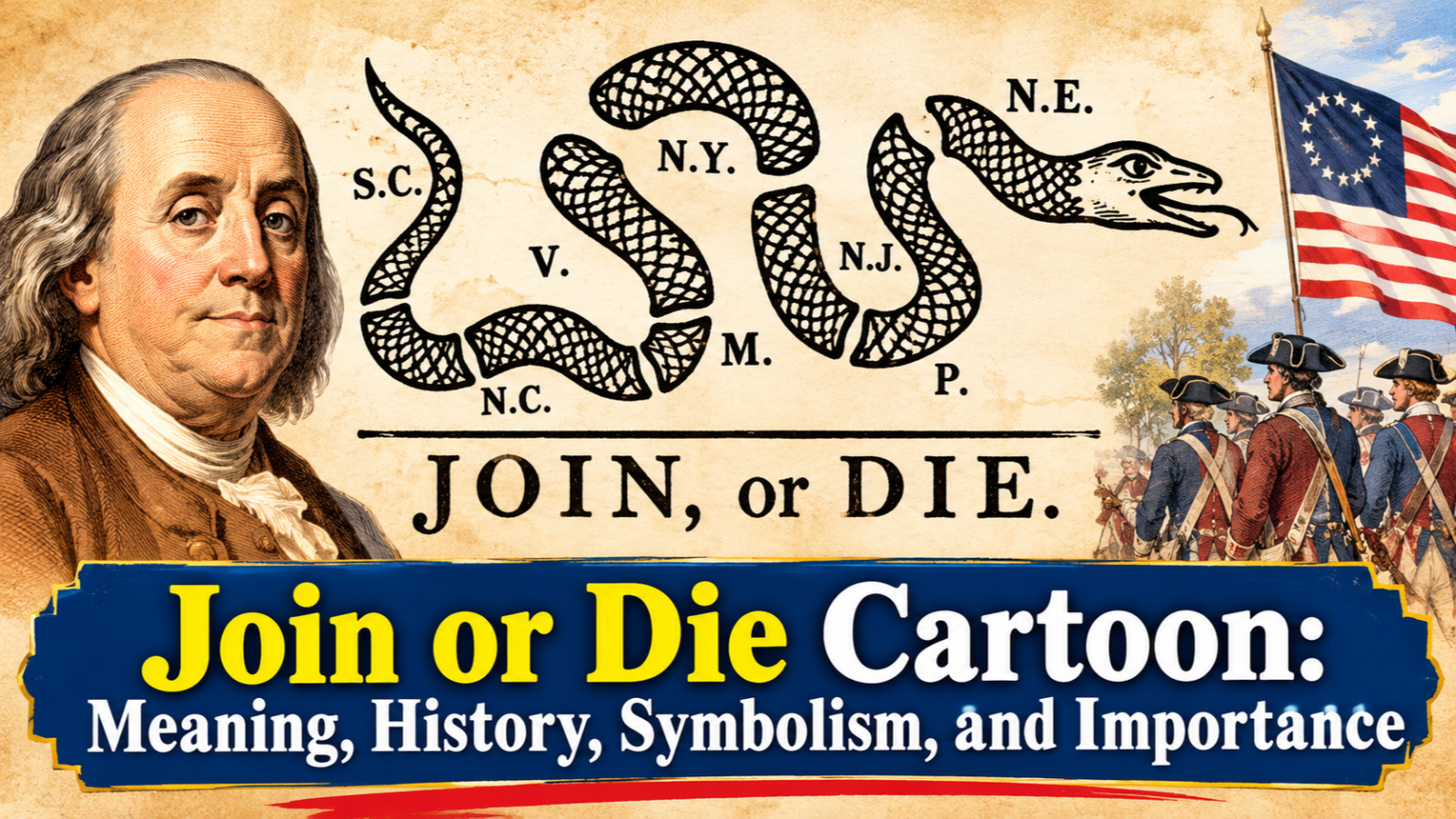
The Join or Die cartoon is one of the most famous political images in American history. Benjamin Franklin published it on May 9, 1754. It shows a snake divided into eight separate pieces. Each piece represents a different colonial region. The words “Join, or Die” appear beneath the snake. These words carried a powerful message about unity and survival. Franklin wanted the American colonies to work together against growing French threats. At that time, the colonies faced serious problems along their western borders. However, they lacked strong cooperation and shared leadership. This cartoon encouraged people to understand the power of working together. Later, it became an important symbol during the American Revolution. Today, students study it to understand colonial history, political messages, and American independence.
Quick Summary: Join or Die Cartoon
- Creator: Benjamin Franklin.
- Publication date: May 9, 1754.
- Newspaper: The Pennsylvania Gazette.
- Main image: A snake divided into eight pieces.
- Main message: The colonies needed to unite for survival.
- Historical background: The growing conflict between Britain and France.
- Original purpose: Encourage colonial cooperation against French expansion.
- Later importance: Became a symbol of unity during the American Revolution.
- Historical significance: One of the earliest political cartoons published in an American newspaper.

What Is the Join or Die Cartoon?
The Join or Die cartoon is a famous political illustration created by Benjamin Franklin in 1754. It shows a snake cut into eight separate sections. Each section represents a colonial region in British North America.
The cartoon sends a simple message: people become stronger when they work together.
Franklin believed the colonies could not protect their interests alone. They needed better communication, planning, and cooperation.
The image appeared in The Pennsylvania Gazette. It quickly attracted attention because of its powerful message.
The cartoon also introduced an important political idea. Unity could help separate colonies face a common danger.
According to the Library of Congress, the original woodcut appeared on May 9, 1754. It is widely recognized as the first political cartoon published in an American newspaper. Research Guides+1
Who Created the Join or Die Political Cartoon?
Benjamin Franklin
Benjamin Franklin was an American printer, writer, inventor, and political thinker. He owned and published The Pennsylvania Gazette in Philadelphia. He used his newspaper to share political ideas and encourage public discussion.
Franklin understood the importance of communication between the colonies.
In 1754, he became concerned about growing French influence in North America. He believed separate colonial governments needed to cooperate.
Therefore, he published the Join or Die cartoon to support colonial unity.
Franklin also supported a larger political plan called the Albany Plan of Union. This plan aimed to bring the colonies together under a shared government.
His cartoon helped explain why cooperation mattered. It turned a complicated political issue into a simple visual message. Exhibitions – Library of Congress+1
When Was the Join or Die Cartoon Published?
The original Join or Die cartoon appeared on May 9, 1754.
Franklin published it in The Pennsylvania Gazette, a newspaper based in Philadelphia.
This date matters because tensions between Britain and France were increasing. Both European powers wanted greater influence over North American territory.
The colonies also faced challenges involving defense, trade, and relations with Native American nations.
Franklin believed cooperation could help the colonies respond to these challenges.
The cartoon appeared shortly before the Albany Congress began in June 1754. Colonial representatives met there to discuss cooperation and a possible union.
The Albany Plan of Union was adopted on July 10, 1754. However, the colonial governments and British authorities did not put it into effect. Research Guides+1
What Does the Join or Die Cartoon Mean?
The Join or Die cartoon means that separate colonies needed to unite to protect their common interests.
Its message is easy to understand. A divided group becomes weaker when it faces a powerful enemy.
The broken snake represents the divided colonies. Its separate pieces show their lack of political unity.
The slogan gives viewers a serious warning. The colonies must work together, or they may fail to survive.
Franklin wanted readers to understand three important ideas:
- Unity creates strength: Working together makes a group stronger.
- Division creates weakness: Separate groups may struggle against common threats.
- Cooperation supports survival: Shared action can protect everyone’s interests.
The cartoon was more than a simple drawing. It was a political argument designed to change public opinion.
Its message remains useful today because teamwork and cooperation still matter in communities and governments.
What Does the Snake Symbolize in the Cartoon?
The snake is the most important symbol in the Join or Die cartoon.
It represents the British colonies in North America. Franklin divided the snake into eight pieces to show their political separation.
The snake’s broken body suggests weakness and danger. Each section represents a colonial region that needed cooperation.
The image also uses a powerful visual idea. A complete snake represents unity, while a divided snake represents separation.
This made the political message easier to understand. Even people with little formal education could recognize the warning.
The snake was not simply an artistic choice. It helped Franklin communicate an urgent political message.
The original illustration also used the belief that a cut snake could survive if its pieces were joined quickly. This familiar idea made the image even more meaningful. Guardians of Memory+1
What Do the Eight Snake Pieces Represent?
The eight snake sections represent different colonial regions. They show how the colonies were divided before greater cooperation.
Here is what each abbreviation means:
| Snake label | Colonial region |
|---|---|
| N.E. | New England |
| N.Y. | New York |
| N.J. | New Jersey |
| P. | Pennsylvania |
| M. | Maryland |
| V. | Virginia |
| N.C. | North Carolina |
| S.C. | South Carolina |
Important: New England represents a group of four colonies, not just one colony. Pennsylvania’s historical boundaries and Delaware’s political status also require care when interpreting the image.
The cartoon uses eight sections to represent the colonial regions. It does not show all thirteen colonies as thirteen separate pieces.
This detail helps students understand the original drawing correctly. The Library of Congress+2
Why Did Benjamin Franklin Create ?
Benjamin Franklin created the cartoon because he saw a growing danger to the British colonies.
France and Britain competed for control of land in North America. Their rivalry created tension along the western frontier.
Individual colonies often handled their problems separately. This made cooperation difficult during dangerous times.
Franklin believed the colonies needed a shared plan.
His main reasons included:
- Military protection: The colonies needed stronger cooperation for defense.
- Political unity: Colonial leaders needed to work together.
- Shared interests: The colonies faced many similar challenges.
- Better communication: Leaders needed to share information and plans.
- Common action: United colonies could respond more effectively to threats.
The cartoon encouraged readers to think beyond their individual colonies.
Franklin wanted them to recognize their shared future. May 9+2
How Was the Cartoon Connected to the French and Indian War?
The Join or Die cartoon appeared in 1754, when conflict between Britain and France was growing.
The French and Indian War became part of a larger struggle between these European powers. Both wanted greater control over North American territory.
Native American nations also played important roles in this conflict. Different Indigenous nations made their own diplomatic and military decisions. Some supported the French, while others supported the British or pursued independent interests.
Franklin believed colonial cooperation could improve British defense.
His cartoon encouraged the colonies to organize and respond together.
The image therefore connects directly to the political and military tensions that helped lead to the French and Indian War.
It also shows how newspapers and political images influenced public discussions during the colonial period.
What Was the Albany Plan of Union?
The Albany Plan of Union was a proposal to unite the British colonies under a shared government.
Benjamin Franklin supported this idea in 1754. He believed the colonies needed better coordination.
The Albany Congress brought colonial representatives together in Albany, New York.
They discussed ways to improve defense, manage common affairs, and cooperate with one another.
The proposed government included two important parts:
- Grand Council: Colonial governments would choose representatives.
- President-General: The British Crown would appoint this leader.
The plan received approval from the Albany Congress on July 10, 1754. However, neither the colonial governments nor the British authorities accepted it as a working system.
The Albany Plan was important because it showed an early effort to create political unity among the colonies.
Franklin’s cartoon supported the same general idea through a simple visual message. Office of the Historian+1
How Did the Join or Die Cartoon Influence the American Revolution?
The original cartoon encouraged unity against French expansion. However, its meaning changed over time.
During the 1760s and 1770s, tensions between Britain and its American colonies increased.
Colonists protested British policies and taxes. They also began to support greater cooperation against British control.
The Join or Die image appeared again in newspapers during the growing resistance movement.
Its message now supported colonial solidarity against British policies.
This change shows how political symbols can develop new meanings.
The same snake that once encouraged cooperation within the British Empire later represented resistance to British authority.
During the American Revolution, the cartoon became a powerful symbol of colonial unity.
It helped communicate the belief that the colonies needed to stand together to defend their rights. Research Guides+2
Join or Die Cartoon vs. Its Original and Later Meanings
The cartoon’s historical meaning changed as political conditions changed.
| Feature | Original meaning in 1754 | Later meaning during the Revolution |
|---|---|---|
| Main purpose | Encourage colonial cooperation | Encourage colonial unity against Britain |
| Main threat | French expansion | British policies and authority |
| Snake symbolism | Divided colonial governments | United American colonies |
| Political goal | Better colonial defense | Resistance and independence |
| Main message | Work together for protection | Stand together for freedom |
This comparison explains why the cartoon remains important.
Its original message focused on cooperation within the British Empire. Later, colonists used it to support resistance against that same empire.
The image stayed familiar, but its political purpose changed.
What Are the Main Symbols?
Political cartoons often use simple objects to explain complex ideas. Franklin’s cartoon uses several important visual elements.
1. The broken snake
The broken snake represents the separate colonial governments. Its divided body shows their political weakness.
2. The eight sections
The eight pieces represent the colonial regions shown in the illustration. They highlight the need for cooperation.
3. The snake’s head
The head forms part of the same divided body. It helps viewers recognize that all sections belong together.
4. The words “Join, or Die”
These words create urgency. They warn the colonies about the dangers of remaining divided.
5. The complete snake idea
A complete snake suggests unity and strength. Franklin wanted the colonies to understand the value of becoming one organized group.
Together, these elements make the cartoon easy to understand and remember.
Real-Life Examples
The message of the Join or Die cartoon still applies to everyday life.
It teaches people that teamwork can solve problems more effectively than working alone.
Here are some simple examples:
Example 1: School teamwork
Students working on a group project can share tasks. They can complete their work faster through cooperation.
Example 2: Sports teams
A football team needs every player to work together. One player cannot easily win a match alone.
Example 3: Community support
Neighbors can work together to clean their streets. Their combined effort creates a better environment.
Example 4: Workplace cooperation
Employees can share ideas and responsibilities. This helps a business reach its goals.
Example 5: Family responsibilities
Family members can divide household tasks. Everyone benefits when they help one another.
These examples show that the central message remains relevant. Unity can make people stronger when they face common challenges.
Common Mistakes Students Make
Students sometimes misunderstand the cartoon’s original purpose and historical background.
Avoid these common mistakes when studying it:
- Wrong creator: Do not confuse Benjamin Franklin with another historical figure.
- Wrong publication date: The original cartoon appeared on May 9, 1754.
- Wrong original purpose: It first encouraged colonial unity against French expansion, not American independence.
- Wrong number of sections: The original drawing shows eight sections, not thirteen.
- Wrong interpretation: The snake represents divided colonial regions, not individual people.
- Ignoring historical context: The French and Indian War helps explain the cartoon’s original message.
- Confusing later use: Colonists reused the image during the American Revolution with a different political purpose.
Understanding these details makes historical analysis more accurate.
Tips for Analyzing the Join or Die Political Cartoon
You can understand this historical image more easily by following a few simple steps.
- Identify the creator: Find out who made the cartoon.
- Check the date: Understand what happened during that period.
- Study the symbols: Look closely at the snake and its sections.
- Read the slogan: Consider why Franklin chose these words.
- Understand the audience: Think about who Franklin wanted to influence.
- Find the main message: Explain why unity mattered to the colonies.
- Compare historical events: Connect the cartoon with the French and Indian War and American Revolution.
These tips can help students write stronger history answers and understand political cartoons.
Why Is the Join or Die Cartoon Important Today?
The Join or Die cartoon remains important because it explains an early effort toward colonial unity.
It also shows how one image can influence political thinking.
Today, teachers use it to explain several historical concepts:
- Colonial America and its political divisions.
- Benjamin Franklin’s role in American history.
- The French and Indian War.
- The Albany Plan of Union.
- The development of American political identity.
- The importance of political cartoons.
- The growing movement toward colonial cooperation.
The cartoon also teaches a broader lesson about teamwork.
Its historical message reminds people that cooperation can help groups face difficult challenges.
Expert Insights: What Makes the Join or Die Cartoon So Powerful?
From a historical perspective, the cartoon’s greatest strength is its simple visual argument.
Franklin did not need a long political speech. He used a broken snake and a short slogan to explain a complicated problem.
Three features make the image especially effective:
1. Simple symbolism: The broken snake makes political division easy to recognize.
2. Emotional message: The words create a sense of urgency and danger.
3. Historical flexibility: Later generations reused the image for a different political purpose.
For accurate historical analysis, always separate the cartoon’s original purpose from its later revolutionary meaning.
This distinction is essential for understanding its importance in American history.
FAQs
1. What is the main message of the Join or Die cartoon?
The main message is that the American colonies needed to unite. Franklin believed cooperation would help them protect their common interests.
2. Who created the Join or Die cartoon?
Benjamin Franklin created and published the cartoon in The Pennsylvania Gazette in 1754.
3. When was the Join or Die cartoon published?
The original cartoon appeared on May 9, 1754, in Philadelphia, Pennsylvania.
4. What does the snake represent in the Join or Die cartoon?
The snake represents the British colonies in North America. Its eight sections show their political divisions.
5. Why did Benjamin Franklin use a broken snake?
Franklin used a broken snake to show the weakness of divided colonies. He wanted them to work together.
6. What war is connected to the Join or Die cartoon?
The cartoon is connected to the French and Indian War. It encouraged colonial cooperation as tensions between Britain and France increased.
7. Did the Join or Die cartoon support American independence?
Not originally. Franklin first wanted the colonies to unite within the British Empire. Later, colonists reused it to support resistance against Britain.
8. Why is the Join or Die cartoon important in American history?
It represents an early call for colonial unity. It also shows how political cartoons can influence public opinion and historical events.
Conclusion
The Join or Die cartoon is an important part of American history. Benjamin Franklin published it in 1754 to encourage colonial unity. Its broken snake represented the divided British colonies. The famous slogan warned people about the dangers of separation. Originally, Franklin wanted the colonies to cooperate against growing French threats. Later, the cartoon became a symbol of unity during the American Revolution. Its meaning changed as political events developed. Today, students study this image to understand colonial history, political symbolism, and the power of communication. It also teaches an important lesson about teamwork. When people work together, they can face difficult challenges more effectively. The main lesson of the Join or Die cartoon is simple: unity creates strength, while division creates weakness.

Emma Collins is a language writer and grammar enthusiast specializing in English vocabulary, spelling comparisons, and word usage guides. She creates easy-to-understand content that helps readers improve their writing, communication, and language skills with confidence.