
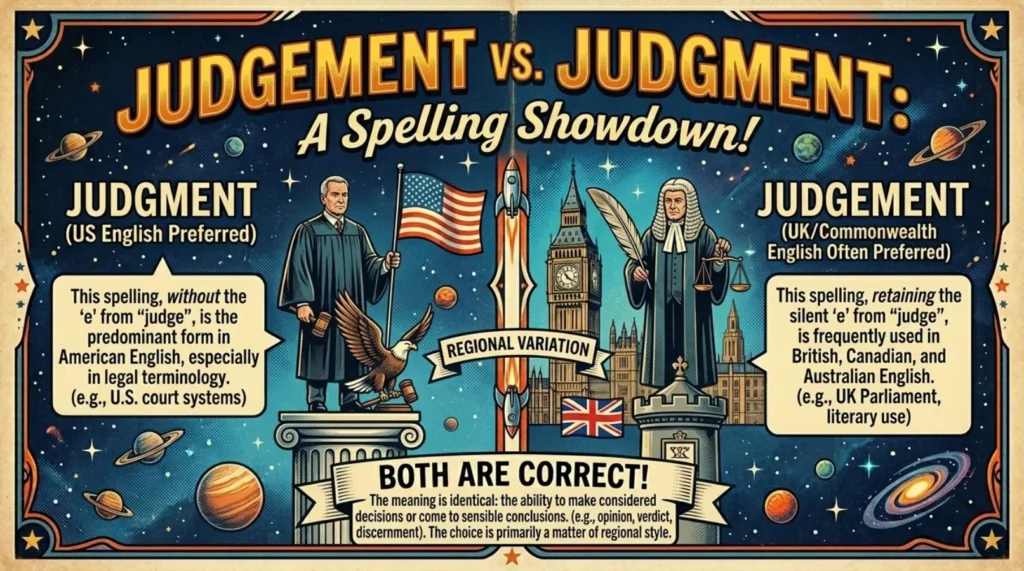
Judgement or judgment is a common spelling question. Many English learners and writers get confused. The good news is that both spellings are correct. However, each one fits different types of English.
American English usually prefers judgment. British English accepts both spellings, but judgement appears more often in general writing.
Knowing the difference helps you write with confidence. It also makes your work look more professional. Whether you write emails, essays, or legal documents, choosing the right spelling matters.
This guide explains both words in simple English. You will learn when to use each spelling, avoid common mistakes, and improve your writing skills.
Quick Summary Box
- Judgment is the preferred spelling in American English.
- Judgement is common in British English.
- Both words mean the same thing.
- The meaning never changes because of the spelling.
- Legal writing often prefers judgment, even in many British courts.
- Always stay consistent within one document.
What Does “Judgement” or “Judgment” Mean?
Both judgement and judgment mean:
- The ability to make good decisions.
- An opinion after careful thinking.
- A decision made by a judge or court.
- The act of evaluating something.
Simply put, a judgment is a conclusion or decision.
Examples
- She showed excellent judgment during the meeting.
- His judgement helped the team succeed.
- The judge announced the final judgment.
- Good judgement comes with experience.
Judgement vs Judgment: What’s the Difference?
The biggest difference is spelling, not meaning.
| Feature | Judgment | Judgement |
|---|---|---|
| Meaning | Decision or opinion | Decision or opinion |
| American English | ✅ Preferred | Rare |
| British English | Common | Very common |
| Legal documents | Usually preferred | Less common |
| Pronunciation | Same | Same |
| Meaning | Same | Same |
Key takeaway:
- Use judgment for American English.
- Use judgement if following British English style.
Why Are There Two Spellings?
English has changed over many centuries.
American English simplified many spellings. That is why judgment became the standard in the United States.
British English kept many traditional spellings. As a result, judgement remained popular.
Today, dictionaries recognize both forms.
When Should You Use “Judgment”?
Use judgment when writing:
- American English articles
- Business documents
- Academic papers in the US
- Legal documents
- Professional emails
Examples
- Her judgment impressed everyone.
- Trust your judgment.
- The court entered its final judgment.
When Should You Use “Judgement”?
Use judgement when writing:
- British English content
- UK newspapers
- British schools
- UK business writing
- Personal writing following British style
Examples
- His judgement improved over time.
- Good judgement prevents mistakes.
- She used careful judgement.
Real-Life Examples of Judgement and Judgment
At School
American teacher:
Use your best judgment when answering.
British teacher:
Show good judgement during the exam.
At Work
Manager in the US:
Your judgment helped solve the problem.
Manager in the UK:
Your judgement saved the project.
In Court
- The judge delivered the final judgment.
- Everyone accepted the court’s judgment.
Many legal systems prefer judgment, even outside the United States.
Everyday Conversation
- I trust your judgment.
- She has excellent judgement.
Both sound natural depending on your audience.
Common Mistakes People Make
Many writers make these errors.
1. Mixing Both Spellings
❌ The judgment showed poor judgement.
✅ Choose one spelling and stay consistent.
2. Using British Spelling in American Writing
If your audience is American, use judgment.
3. Thinking One Is Wrong
Both spellings are correct.
Only the writing style changes.
4. Ignoring Style Guides
Always follow your company’s or school’s preferred style.
Easy Trick to Remember
Remember this simple rule:
- US = Judgment
- UK = Judgement
Another trick:
If writing for an international audience, judgment is usually the safest choice.
Judgment in Legal Writing
Legal English often uses judgment, regardless of country.
Examples include:
- Final judgment
- Summary judgment
- Default judgment
Many courts prefer this spelling because it has become a legal standard.
Judgment and Judgement in Daily Life
You use this word more often than you think.
Examples include:
- Making smart decisions
- Buying products
- Choosing schools
- Hiring employees
- Solving family problems
- Driving safely
Good judgment helps people every day.

Synonyms and Related Words
Here are useful alternatives.
Synonyms
- Decision
- Opinion
- Assessment
- Evaluation
- Wisdom
- Reasoning
- Choice
- Verdict
- Conclusion
- Insight
Related Keywords (LSI)
- judgment meaning
- judgement meaning
- judgment vs judgement
- British vs American spelling
- grammar guide
- English spelling rules
- court judgment
- good judgment
- decision making
- writing tips
Expert Writing Tips
Professional writers follow simple rules.
- Know your audience before writing.
- Stay consistent throughout the article.
- Follow your style guide.
- Use American spelling for US readers.
- Use British spelling for UK readers.
- Proofread before publishing.
These habits improve clarity and professionalism.
Why This Difference Matters
Correct spelling builds trust.
Readers notice consistent writing.
Businesses expect professional communication.
Students earn better grades with correct spelling.
Content creators improve credibility.
Small grammar choices create a stronger impression.
FAQs:
Is judgment or judgement correct?
Both are correct. American English prefers judgment, while British English often uses judgement.
Which spelling is used in the United States?
American English almost always uses judgment.
Which spelling is common in Britain?
British English commonly uses judgement, although judgment is also accepted.
Do both words have different meanings?
No.
They have exactly the same meaning.
Which spelling should I use for SEO content?
Use the spelling that matches your target audience.
If your audience is global, judgment often works best.
Is judgment correct in legal writing?
Yes.
Most legal documents use judgment.
Can I use both spellings in one article?
No.
Choose one spelling and stay consistent.
Which spelling appears more often online?
Judgment generally appears more often because American English has a larger online presence.
Internal Linking Suggestions
Consider linking this article with related grammar topics:
- Affect vs Effect
- Accept vs Except
- Then vs Than
- Advice vs Advise
- Practice vs Practise
- Toward vs Towards
- Licence vs License
- Grey vs Gray
- Centre vs Center
- Program vs Programme
Featured Snippet Answer
Judgement and judgment both mean a decision, opinion, or ability to make good choices. Judgment is the preferred American English spelling, while judgement is commonly used in British English. The meaning stays the same, so choose the spelling that matches your audience and use it consistently.
Conclusion
Understanding judgement or judgment is easier than many people think. Both spellings are correct and share the same meaning. The main difference comes from regional English. American English prefers judgment, while British English often uses judgement in everyday writing. Legal documents frequently use judgment, regardless of location.
The best approach is to know your audience and stay consistent throughout your writing. This simple habit improves readability and makes your work look professional. Whether you write for school, business, or online content, choosing the correct spelling helps build trust with readers. Now that you know the difference between judgement and judgment, you can write with greater confidence and accuracy every time.

James Carter is a comparison writer and research specialist with over 10 years of experience in digital publishing. With a background in business communication and consumer research, he creates detailed comparison articles, buying guides, and reviews that help readers make informed decisions with confidence. “Every comparison should help readers make better decisions. My goal is to turn complex information into clear, practical guidance that people can trust.” — James Carter