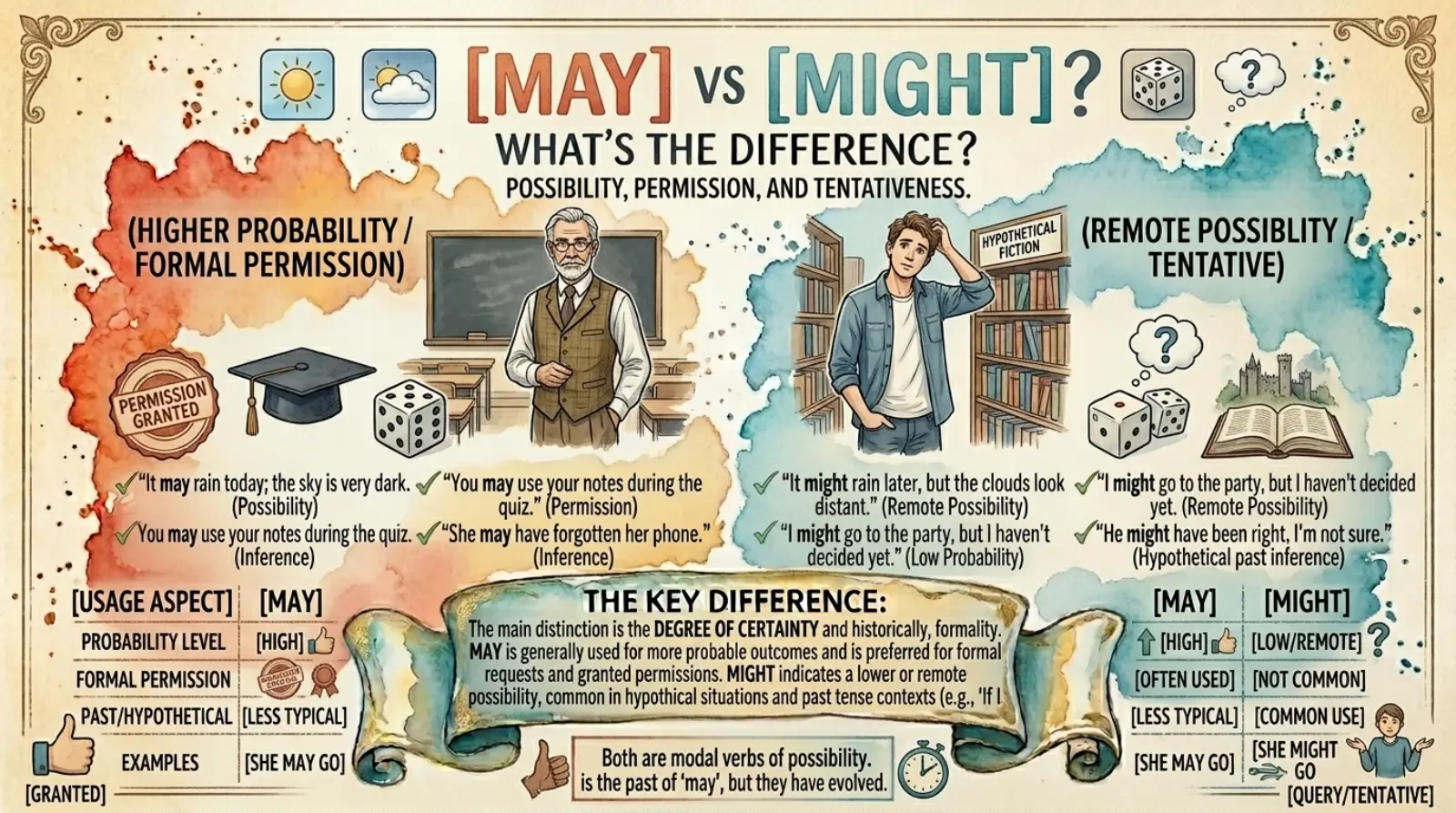
May vs might is one of the most common grammar questions in English. Many learners wonder which word they should use. Both words talk about possibility, but they are not always the same.
The good news is that the difference is easy to understand. Once you learn a few simple rules, you can use both words with confidence.
In this guide, you will learn what may and might mean, how they differ, and when to use each one. You will also see real-life examples, common mistakes, helpful tips, and a comparison table. By the end, choosing between may and might will feel much easier.
Quick Summary Box
- May shows possibility or asks for permission.
- Might shows a weaker possibility.
- Both words talk about something that is not certain.
- May often sounds more formal.
- Might often expresses more doubt.
- In many situations, both words are correct.
- Choose the word that matches the level of certainty.
What Does “May” Mean?
May is a modal verb. It usually shows possibility or permission.
Examples
- It may rain this afternoon.
- You may leave after the meeting.
- She may visit us next week.
- This answer may be correct.
In many cases, may suggests something has a reasonable chance of happening.
What Does “Might” Mean?
Might is also a modal verb. It usually shows possibility, but the chance is often smaller.
Examples
- It might snow tonight.
- I might join the trip.
- They might arrive late.
- She might know the answer.
People often use might when they are less sure.
May vs Might: Key Difference
The biggest difference is the level of certainty.
- May = more likely.
- Might = less likely.
However, in everyday English, many native speakers use them almost the same way.

May vs Might Comparison Table
| Feature | May | Might |
|---|---|---|
| Meaning | Possibility or permission | Possibility |
| Level of certainty | Higher | Lower |
| Permission | Yes | Rarely |
| Formal writing | Very common | Common |
| Everyday speech | Common | Common |
| Example | It may rain. | It might rain. |
When Should You Use “May”?
Use may when talking about a likely possibility.
Examples
- We may travel next month.
- He may get the job.
- Prices may increase soon.
- The package may arrive tomorrow.
Use May for Permission
- May I come in?
- May I ask a question?
- You may use my laptop.
- Students may leave early today.
This use is common in formal situations.
When Should You Use “Might”?
Use might when something is possible but less certain.
Examples
- I might order pizza tonight.
- They might cancel the event.
- She might call later.
- We might miss the train.
People often use might when guessing.
May vs Might in Daily Conversations
Here are common examples.
Weather
- It may rain today.
- It might rain later.
Work
- I may finish early.
- I might work from home tomorrow.
Family
- Mom may cook pasta tonight.
- Dad might join us later.
School
- The teacher may give extra homework.
- We might have a quiz tomorrow.
Real-Life Examples of May vs Might
Example 1
May: Sarah may visit her grandparents this weekend.
This sounds fairly likely.
Might: Sarah might visit her grandparents this weekend.
This sounds more uncertain.
Example 2
May: The store may open early.
Might: The store might stay closed because of the storm.
Example 3
May: You may use my phone.
Permission is given.
Might: You might want to charge your phone.
This is a polite suggestion.
May vs Might for Permission
Only may commonly asks for permission.
Correct
- May I leave now?
- May I help you?
- May I sit here?
Less Common
- Might I ask a question?
This sounds very formal or old-fashioned.
Common Mistakes with May and Might
1. Using Might for Permission
❌ Might I borrow your pen? (Very formal)
✅ May I borrow your pen?
2. Thinking They Always Mean Different Things
Sometimes both words are correct.
Example:
- It may rain tomorrow.
- It might rain tomorrow.
Both sentences are natural.
3. Forgetting the Meaning Changes
Compare these:
- She may come.
- She might come.
The second sentence usually shows less confidence.
Easy Trick to Remember
Ask yourself one question:
How sure am I?
- Fairly sure → May
- Less sure → Might
Another easy trick:
Permission? Use May.
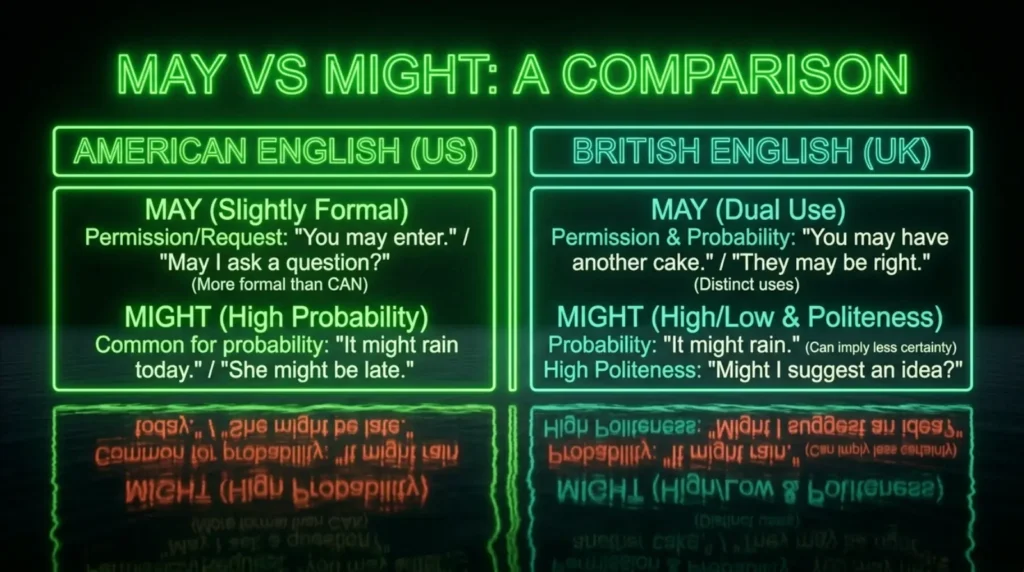
May vs Might in American and British English
Both American and British English use may and might.
However:
- American English often uses both words interchangeably.
- British English sometimes keeps a clearer difference between certainty levels.
Even so, both forms are accepted.
Synonyms and Related Words
These words relate to may vs might.
Synonyms
- Perhaps
- Maybe
- Possibly
- Probably
- Conceivably
- Potentially
Related Grammar Terms
- Modal verbs
- Helping verbs
- English grammar
- Possibility
- Permission
- Degree of certainty
- Probability
- Formal English
- Informal English
Expert Insights
Understanding may vs might improves both speaking and writing.
Many English learners worry too much about choosing the perfect word. In reality, native speakers often use both naturally.
The most important rule is simple:
- Use may for permission.
- Use may when something seems more likely.
- Use might when you feel less certain.
Clear communication matters more than memorizing complex grammar rules.
Common Situations Where Both Work
Sometimes either word sounds natural.
Travel
- We may visit Paris.
- We might visit Paris.
Plans
- I may call you later.
- I might call you later.
Shopping
- We may buy a new car.
- We might buy a new car.
In these cases, the meaning changes only slightly.
Featured Snippet: May vs Might
May and might are modal verbs that express possibility. May often suggests a stronger chance or gives permission. Might usually suggests a weaker possibility. In many everyday situations, both words are acceptable, but may is the standard choice for asking permission.
Frequently Asked Questions
Is “may” stronger than “might”?
Yes. May usually shows a greater chance that something will happen.
Can I use may and might interchangeably?
Yes, in many situations. However, may often sounds more certain.
Which is more formal, may or might?
May is generally more common in formal writing, especially for permission.
Can “might” ask for permission?
It can, but it sounds very formal and is rarely used today.
Is “may” correct in business writing?
Yes. Business writing often uses may because it sounds professional.
Which word should beginners use?
Start with may for permission and might for less certain possibilities.
Why do native speakers use both?
Both words are correct. Native speakers choose the one that best matches their level of certainty.
Internal Linking Suggestions
You can strengthen your grammar content by linking this article to:
- Can vs May: What’s the Difference?
- Could vs Would Explained
- Must vs Have To
- Shall vs Will
- Should vs Ought To
- May Be vs Maybe
- Modal Verbs in English
- Common English Grammar Mistakes
Conclusion
Understanding may vs might is easier than many learners think. Both words express possibility, but they show different levels of certainty. May usually suggests a stronger chance and is the correct choice for asking permission. Might often expresses a weaker possibility or more doubt.
In everyday conversation, native speakers often use both words naturally, and either can be correct in many situations. The key is to think about how certain you feel before choosing one. With regular practice and real-life examples, you will quickly become comfortable using both may and might. Mastering this small grammar point will make your English sound more accurate, confident, and natural.

Emma Collins is a language writer and grammar enthusiast specializing in English vocabulary, spelling comparisons, and word usage guides. She creates easy-to-understand content that helps readers improve their writing, communication, and language skills with confidence.