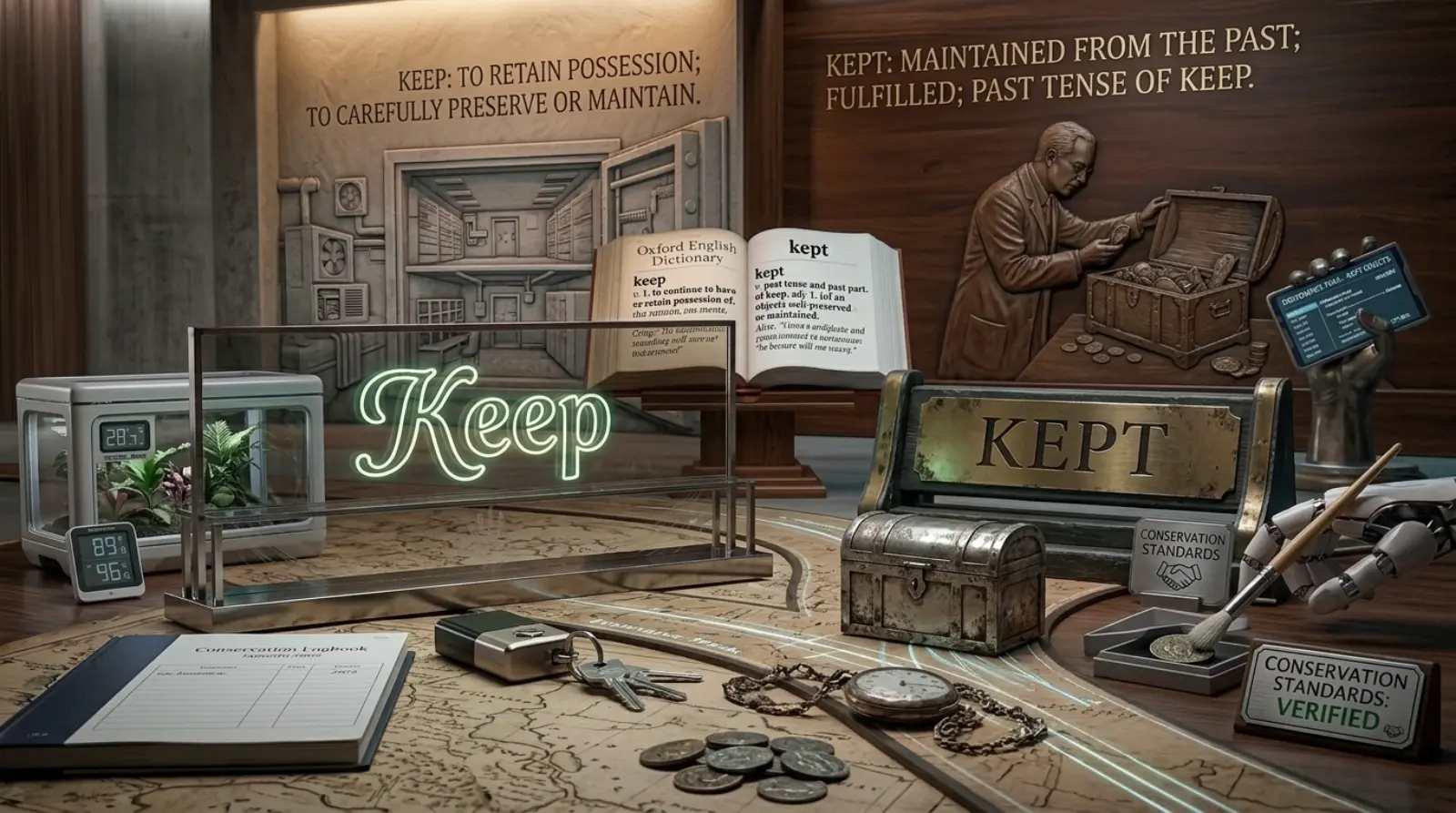
Keep or kept is a common grammar question for English learners. Many people mix these words because they come from the same verb. However, they have different meanings based on time. Knowing when to use each word helps you speak and write clearly.
The good news is that the rule is simple. Once you understand it, you will avoid many grammar mistakes. This guide explains everything in easy English. You will learn definitions, grammar rules, comparison tables, examples, and memory tips. By the end, you will know exactly when to use keep and when to use kept.
Quick Summary Box (Featured Snippet)
- Keep is the present form of the verb.
- Kept is the past tense and past participle of keep.
- Use keep for actions happening now or in the future.
- Use kept for actions completed in the past.
- Keep and kept never mean the same thing in one sentence.
What Does “Keep” Mean?
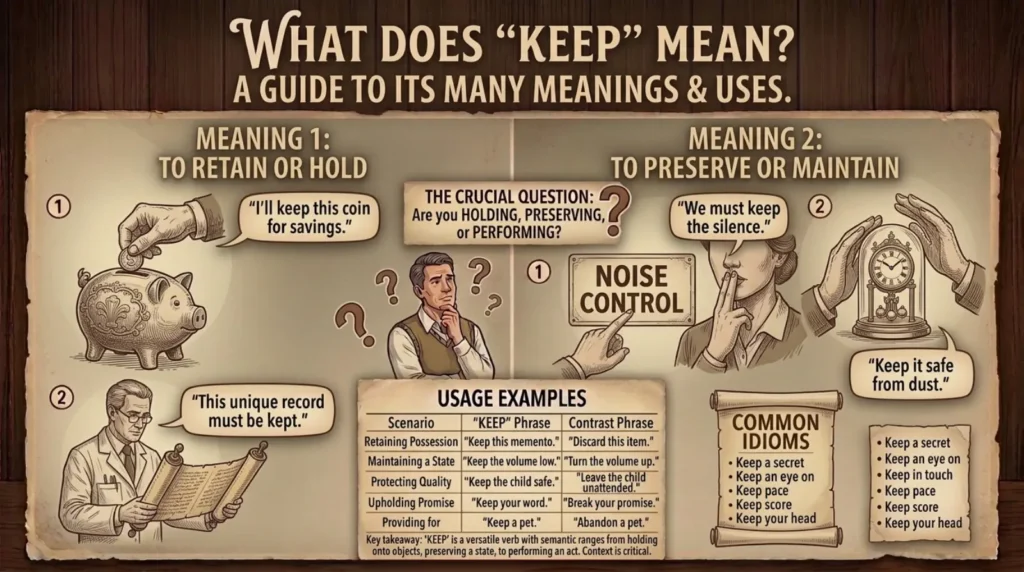
The word keep means to continue having something or to not lose it. It can also mean to continue doing something.
Definition
Keep (verb): To hold, stay with, continue, or maintain something.
Examples
- Please keep your phone with you.
- I keep my keys in my bag.
- They keep the house clean.
- We keep learning every day.
- You should keep smiling.
What Does “Kept” Mean?
Kept is the past tense and past participle of keep. It describes something that already happened.
Definition
Kept (verb): The past form of keep, showing a completed action.
Examples
- She kept the letter.
- We kept our promise.
- He kept working until midnight.
- They kept the secret for years.
- I kept the gift safely.
Keep or Kept: Key Difference
The biggest difference is time.
| Feature | Keep | Kept |
|---|---|---|
| Verb Form | Base form | Past tense & past participle |
| Time | Present or future | Past |
| Example | I keep my room clean. | I kept my room clean yesterday. |
| Grammar | Used with present tense | Used with past tense |
| Helping Verbs | Can, should, will keep | Have kept, had kept |
When Should You Use “Keep”?
Use keep when talking about the present or future.
Common situations
1. Daily habits
- I keep a notebook.
2. Giving advice
- Keep your password safe.
3. Future actions
- We will keep trying.
4. Continuous actions
- Keep reading.
- Keep practicing.
- Keep learning.
When Should You Use “Kept”?
Use kept when describing actions that happened in the past.
Examples
- I kept all my school books.
- She kept the receipt.
- We kept quiet during class.
- They kept their promise.
- He kept the money in a safe.
Grammar Rules for Keep and Kept
Here is the complete verb form.
| Verb Form | Word |
|---|---|
| Base Verb | Keep |
| Third Person | Keeps |
| Present Participle | Keeping |
| Past Tense | Kept |
| Past Participle | Kept |
Examples
Present:
- I keep my files organized.
Present Continuous:
- I am keeping my promise.
Past:
- I kept my promise.
Present Perfect:
- I have kept every receipt.
Past Perfect:
- She had kept the secret.
Future:
- We will keep improving.
Real-Life Examples of Keep and Kept
At School
Present:
- Students keep their books organized.
Past:
- Students kept their classroom clean.
At Home
Present:
- I keep snacks in the kitchen.
Past:
- I kept the leftovers in the fridge.
At Work
Present:
- We keep customer records safely.
Past:
- We kept every project document.
In Sports
Present:
- Goalkeepers keep the ball out.
Past:
- The goalkeeper kept a clean sheet.
Common Mistakes People Make
Incorrect
❌ Yesterday I keep my wallet.
✅ Yesterday I kept my wallet.
❌ I have keep the receipt.
✅ I have kept the receipt.
❌ She kepts everything.
✅ She keeps everything.
❌ Tomorrow I kept working.
✅ Tomorrow I will keep working.
Easy Trick to Remember
Think about time.
- Keep = Now or Later
- Kept = Already Happened
Memory Tip:
If yesterday is in the sentence, use “kept.”
Examples:
- Yesterday → kept
- Last week → kept
- Today → keep
- Tomorrow → keep
Keep and Kept in Everyday Conversations
Conversation 1
A: Where do you keep your passport?
B: I keep it in my drawer.
Conversation 2
A: Did you save the receipt?
B: Yes, I kept it.
Conversation 3
A: Will you continue practicing?
B: Yes, I will keep practicing.
Common Expressions Using Keep
Many English phrases use keep.
Examples:
- Keep calm
- Keep going
- Keep trying
- Keep in touch
- Keep quiet
- Keep safe
- Keep moving
- Keep smiling
- Keep your promise
- Keep an eye on
Past examples:
- Kept calm
- Kept quiet
- Kept going
- Kept smiling
Synonyms and Related Words
Synonyms for Keep
- Hold
- Maintain
- Preserve
- Continue
- Save
- Retain
- Protect
- Guard
Related Grammar Words
- Keeps
- Keeping
- Kept
- Maintain
- Continue
- Store
- Hold
Expert Grammar Tips
Grammar experts recommend focusing on verb tense before choosing keep or kept.
Helpful advice:
- Look for time words first.
- Match the verb with the sentence tense.
- Learn irregular verbs together.
- Practice using both forms every day.
- Read English books to see natural examples.
These habits improve grammar and writing accuracy over time.
Practice Sentences
Choose the correct word.
- I _____ my phone in my pocket.
- Yesterday I _____ my phone at home.
- She has _____ every promise.
- Please _____ the door closed.
- We _____ the tickets safely last week.
Answers
- keep
- kept
- kept
- keep
- kept
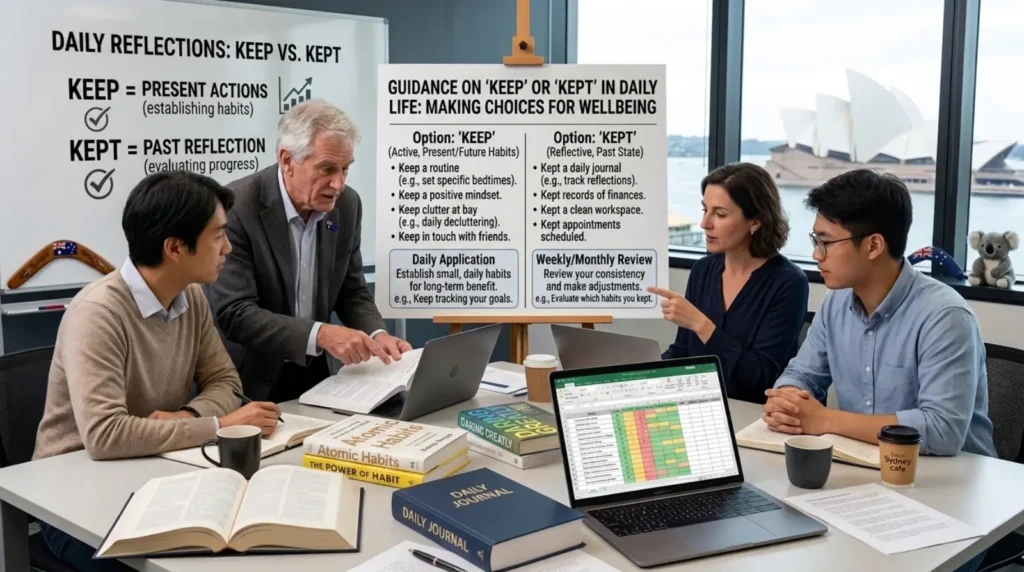
Keep or Kept in Daily Life
You use these words more often than you think.
Examples include:
- Keeping important documents.
- Keeping your room clean.
- Keeping promises.
- Keeping a diary.
- Keeping money safe.
- Keeping healthy habits.
- Keeping pets.
- Keeping in touch with friends.
Past examples include:
- Kept old photos.
- Kept family traditions.
- Kept important emails.
- Kept meeting notes.
Internal Linking Suggestions
To build topical authority, consider linking this article to related grammar guides such as:
- Keep vs Hold
- Keep vs Maintain
- Keep vs Save
- Lose vs Loose
- Chose vs Choose
- Lie vs Lay
- Bring vs Take
- Past Tense of Common Irregular Verbs
FAQs:
Is it keep or kept?
Use keep for the present or future. Use kept for the past.
Is kept the past tense of keep?
Yes. Kept is both the past tense and past participle of keep.
Can I say “I have keep”?
No. The correct sentence is I have kept.
Is keep an irregular verb?
Yes. It changes from keep to kept, not keeped.
What is the difference between keep and kept?
Keep refers to the present or future. Kept refers to completed past actions.
Can I use kept with yesterday?
Yes. Yesterday refers to the past, so kept is correct.
Example:
- Yesterday I kept all the receipts.
What is the past participle of keep?
The past participle is kept.
Conclusion
Understanding keep or kept becomes easy once you remember the role of time. Keep is the base verb used for present and future actions, while kept is the past tense and past participle used for actions that have already happened. Paying attention to words like today, tomorrow, yesterday, and last week will help you choose the correct form. Practice these verbs in everyday conversations and writing to build confidence. Over time, using keep and kept correctly will become natural. Whenever you are unsure, ask yourself one simple question: Is the action happening now, or did it already happen? The answer will lead you to the right choice every time.

Michael Reed is a language content writer and word comparison researcher based in the United States. He studied English Language and Communication and focuses on grammar, spelling differences, and word usage. His work helps readers understand confusing English words through clear comparisons and practical explanations. Michael creates simple, reader-friendly content designed to improve everyday language skills.