
Laying or lying down is one of the most common grammar questions in English. Many people mix these words because they sound similar. However, they have different meanings. Knowing the difference helps you speak and write with confidence. The good news is that the rule is simple once you understand it. This guide explains everything in easy words. You will learn what each word means, when to use it, and how to remember the correct choice. You will also see comparison tables, real-life examples, common mistakes, and expert tips. By the end of this article, you will never wonder whether to say laying down or lying down again.
Quick Summary Box
- Lying down means resting your body on a bed, sofa, or floor.
- Laying means putting something else down.
- Lie does not need an object.
- Lay always needs an object.
- Say “I am lying down” when you rest.
- Say “I am laying the book down” when placing an item somewhere.
- Remember: People lie. Objects get laid.
What Does “Lying Down” Mean?
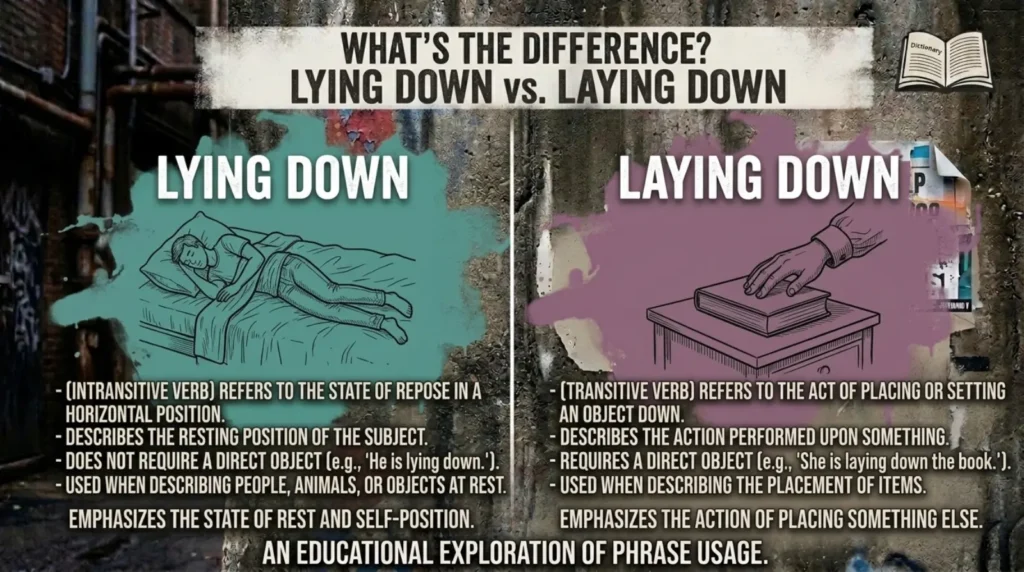
Lying down means resting in a flat or reclining position.
You use lie when no object receives the action.
Examples
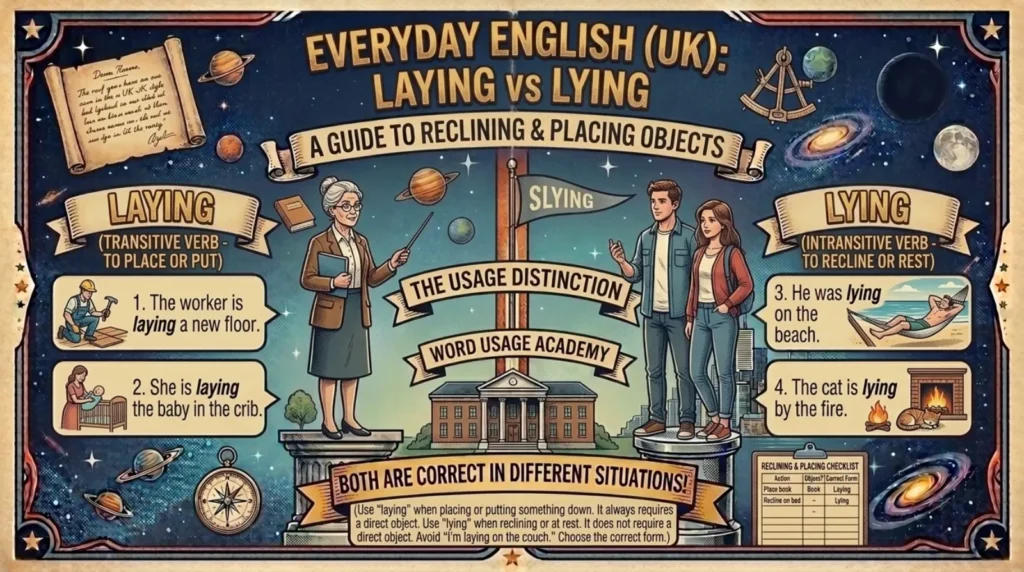
- I am lying down because I feel tired.
- The baby is lying down in the crib.
- She was lying down after work.
- We enjoy lying down on the beach.
In every example, nobody is placing something.
What Does “Laying Down” Mean?
Laying down means putting something in a certain place.
The verb lay always needs an object.
Examples
- I am laying the phone on the table.
- She is laying the blanket on the bed.
- They are laying bricks for the house.
- He keeps laying his keys everywhere.
Notice that each sentence tells what is being placed.
Laying or Lying Down: The Key Difference
The biggest difference is whether there is an object.
| Lying Down | Laying Down |
|---|---|
| Means resting | Means placing something |
| No object needed | Needs an object |
| Uses the verb lie | Uses the verb lay |
| “I am lying down.” | “I am laying the bag down.” |
| Focuses on your position | Focuses on moving an object |
Easy Rule
Ask yourself:
Are you resting?
- Yes → Lying down
- No, you are placing something → Laying down
Why Do People Confuse Laying and Lying?
Several reasons cause confusion.
- The words sound alike.
- Their past tenses are unusual.
- Many people hear incorrect speech every day.
- Native speakers often make the same mistake.
Even experienced writers sometimes double-check these verbs.
Grammar Rule Explained in Simple Words
Here are the base verbs.
| Verb | Meaning | Needs an Object? |
|---|---|---|
| Lie | Rest | No |
| Lay | Put something down | Yes |
Present Tense
- I lie down every afternoon.
- I lay the notebook on the desk.
Present Continuous
- I am lying down.
- I am laying the notebook down.
Past Tense
| Verb | Past Tense |
|---|---|
| Lie | Lay |
| Lay | Laid |
Examples:
- Yesterday I lay on the couch.
- Yesterday I laid my phone on the desk.
This is where many mistakes happen.
Real-Life Examples of Laying or Lying Down
At Home
✅ I am lying down after dinner.
✅ She is laying the clean towels on the bed.
At School
✅ The student is lying down because he feels sick.
✅ The teacher is laying papers on every desk.
At Work
✅ He is lying down during his break.
✅ She is laying the files on the conference table.
At the Beach
✅ We spent the afternoon lying down in the sun.
✅ They were laying towels on the sand.
Common Mistakes People Make
Incorrect
❌ I am laying down because I’m tired.
Correct:
✅ I am lying down because I’m tired.
Incorrect
❌ She is lying the books on the shelf.
Correct:
✅ She is laying the books on the shelf.
Incorrect
❌ He laid down to sleep.
This can be confusing.
Better:
✅ He lay down to sleep.
How to Remember the Difference
Try these easy tricks.
Trick 1: People Lie
People lie down.
Objects get laid down.
Trick 2: Look for an Object
Ask:
“What is being placed?”
If you can answer, use lay.
Example:
She is laying the blanket down.
The blanket is the object.
Trick 3: Think About Rest
If someone is resting, use lie.
Example:
The dog is lying down.
Verb Forms Cheat Sheet
| Base Verb | Present Participle | Past | Past Participle |
|---|---|---|---|
| Lie | Lying | Lay | Lain |
| Lay | Laying | Laid | Laid |
Examples:
- I lie down every day.
- I am lying down now.
- Yesterday I lay down.
- I have lain here all afternoon.
Laying or Lying Down in Everyday Conversations
Here are common situations.
Correct
“I’m lying down because I have a headache.”
“I’m laying the groceries on the counter.”
“The cat is lying down by the fireplace.”
“She is laying fresh flowers on the table.”
“We are lying down to watch a movie.”
Synonyms and Related Keywords
Lying Down
- Resting
- Reclining
- Relaxing
- Stretching out
- Leaning back
Laying
- Placing
- Putting
- Setting
- Positioning
- Arranging
Related Search Terms
- laying vs lying
- lay or lie grammar
- lying down meaning
- laying down meaning
- lay vs lie examples
- grammar rules for lay and lie
- when to use laying
- when to use lying
Common Grammar Tips
Follow these simple rules.
- Use lie for people or animals resting.
- Use lay for placing objects.
- Always look for an object.
- Read the sentence aloud.
- Practice with simple examples.
Small grammar habits build better writing.
Expert Insight
Many grammar mistakes happen because English verbs change in unusual ways. Lay is both the present tense of one verb and the past tense of another. That makes learning harder. Instead of memorizing every form first, remember the meaning. If someone is resting, use lie. If someone is placing an object, use lay. This simple approach improves writing accuracy and helps you avoid one of English’s most common grammar errors.
FAQs:
Is it correct to say “I’m laying down”?
Usually, no. If you are resting, say I’m lying down.
Why do people say laying down?
Many people confuse the verbs because they sound similar and have unusual past tenses.
Is lying down grammatically correct?
Yes. It is correct when someone is resting.
Example:
“I am lying down.”
When should I use laying?
Use laying when placing something.
Example:
“I am laying the phone on the desk.”
Is “lay down” ever correct?
Yes. It is correct as the past tense of lie.
Example:
“Yesterday I lay down early.”
It is also correct as a command.
Example:
“Lay down your backpack.”
What is the easiest way to remember?
Remember this sentence:
People lie. Things get laid.
Can animals lie down?
Yes.
Example:
“The horse is lying down.”
Internal Linking Suggestions
To improve SEO and user engagement, consider linking to related articles such as:
- Lie vs Lay: Complete Grammar Guide
- Laid vs Lain Explained
- Past Tense of Lie and Lay
- Common English Grammar Mistakes
- Everyday English Grammar Rules
- Present Tense vs Past Tense Verbs
SEO Keywords Used Naturally
Primary Keyword
- laying or lying down
Secondary Keywords
- laying vs lying
- lie vs lay
- lying down meaning
- laying down meaning
- lay or lie grammar
- lie and lay examples
- grammar rules
- English grammar tips
- common grammar mistakes
- lay vs lie difference
- when to use laying
- when to use lying
- lie down or lay down
- correct English grammar
- everyday grammar examples
Featured Snippet: Laying or Lying Down
Lying down means resting in a flat position and does not take an object. Laying down means placing something somewhere and always takes an object. If you are resting yourself, say “I am lying down.” If you are putting an object down, say “I am laying the book down.”
Conclusion
Understanding laying or lying down becomes easy once you know the basic rule. Lie means to rest, while lay means to put something down. The key is to look for an object. If nothing is being placed, use lying down. If an object receives the action, use laying down. Although many people confuse these words, regular practice makes the difference clear. Reading examples and using the simple memory trick, “People lie, objects get laid,” can help you choose the correct word every time. With this rule in mind, your writing and speaking will sound more natural and grammatically correct.

James Carter is a comparison writer and research specialist with over 10 years of experience in digital publishing. With a background in business communication and consumer research, he creates detailed comparison articles, buying guides, and reviews that help readers make informed decisions with confidence. “Every comparison should help readers make better decisions. My goal is to turn complex information into clear, practical guidance that people can trust.” — James Carter