
Lay or lie down is one of the most confusing grammar topics in English. Many people use these words incorrectly every day. Even native speakers often mix them up.
The good news is that the difference is simple once you learn the basic rule.
The word lie means to rest or recline. The word lay means to put something down. One action needs an object, and the other does not.
In this guide, you will learn the meaning of each word, see real-life examples, avoid common mistakes, and discover easy memory tricks. By the end, you will know exactly when to use lay and when to use lie down in everyday conversations and writing.
Quick Summary Box
Lay or Lie Down at a Glance
- Lie = to rest or recline yourself
- Lay = to place something down
- Lie does not need an object
- Lay needs an object
- Correct: I need to lie down.
- Correct: Please lay the book on the table.
- Incorrect: I am going to lay down for a nap. (unless you are placing something down)
What Does “Lay or Lie Down” Mean?
The confusion comes from the fact that both words relate to being in a resting position.
However, they have different meanings.
Lie
“Lie” means to recline, rest, or be in a flat position.
Examples:
- I want to lie down.
- The cat likes to lie on the couch.
- Please lie still.
Lay
“Lay” means to place or put something down.
Examples:
- Lay the blanket on the bed.
- Please lay your keys here.
- Lay the papers on my desk.
The Simple Difference Between Lay and Lie
The easiest rule is this:
| Word | Meaning | Needs an Object? |
|---|---|---|
| Lie | To rest or recline | No |
| Lay | To put something down | Yes |
Example
Lie
- I am tired.
- I will lie down.
No object appears in the sentence.
Lay
- I will lay the baby in the crib.
The object is “the baby.”

Why Do People Confuse Lay and Lie?
Several reasons create confusion.
Similar Meanings
Both words involve a flat position.
Similar Forms
The past tense of “lie” is “lay.”
This causes many mistakes.
Everyday Speech
Many people use “lay down” incorrectly in casual conversation. Over time, the mistake becomes common.
Lay vs Lie Down Comparison Table
| Feature | Lie | Lay |
|---|---|---|
| Meaning | Rest or recline | Put something down |
| Object Needed | No | Yes |
| Present Tense | Lie | Lay |
| Past Tense | Lay | Laid |
| Past Participle | Lain | Laid |
| Example | Lie down on the bed | Lay the book down |
How to Use Lie Down Correctly
Use “lie down” when talking about yourself or something resting.
Examples
- I need to lie down after work.
- The dog likes to lie near the fireplace.
- She will lie down for a few minutes.
- Babies should lie on their backs while sleeping.
Everyday Sentences
- Lie down and relax.
- I usually lie down after lunch.
- The patient must lie still.
How to Use Lay Correctly
Use “lay” when placing an object somewhere.
Examples
- Lay the phone on the desk.
- Lay the clothes on the chair.
- Lay the cards face down.
- Please lay the package by the door.
Everyday Sentences
- Lay your bag here.
- Lay the towel on the bed.
- Lay the dishes on the table.
Real-Life Examples of Lay and Lie
At Home
Correct:
- I want to lie down on the sofa.
- Lay the remote on the coffee table.
Work
Correct:
- He needs to lie down because he feels sick.
- Lay the documents on my desk.
School
Correct:
- Students should not lie on the classroom floor.
- Lay your notebooks on the table.
Doctor’s Office
Correct:
- Please lie down for the examination.
- Lay your belongings in the basket.
Common Mistakes With Lay and Lie
Many people make these errors.
Mistake #1
❌ I am going to lay down.
✅ I am going to lie down.
Reason: You are resting yourself, not placing something down.
Mistake #2
❌ Lie the book on the table.
✅ Lay the book on the table.
Reason: The book is the object.
Mistake #3
❌ She laid down for a nap yesterday.
✅ She lay down for a nap yesterday.
Reason: The past tense of “lie” is “lay.”
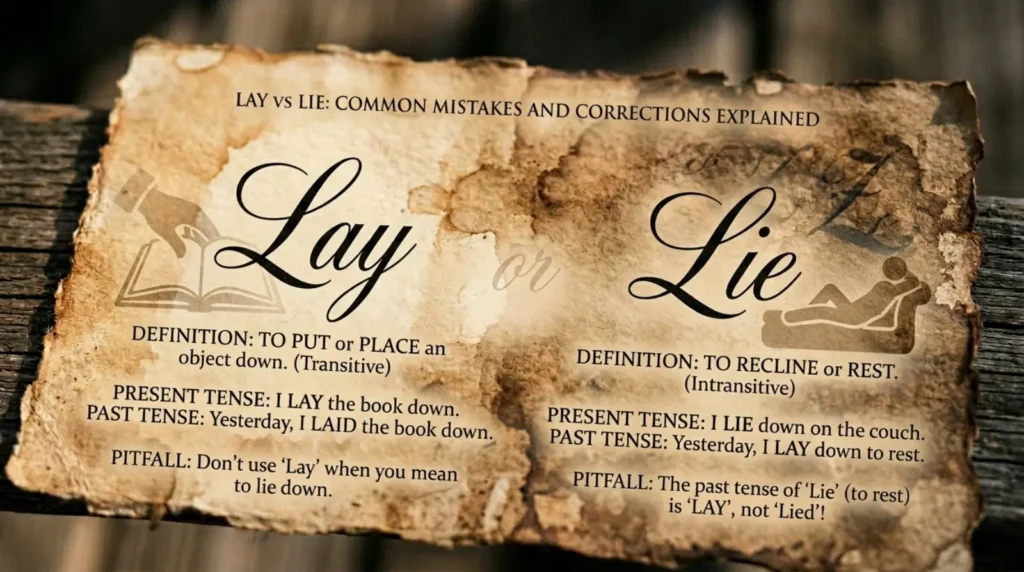
Understanding the Verb Forms
This is where many learners struggle.
| Tense | Lie | Lay |
|---|---|---|
| Present | Lie | Lay |
| Past | Lay | Laid |
| Past Participle | Lain | Laid |
| Present Participle | Lying | Laying |
Examples
Lie
- Today: I lie down.
- Yesterday: I lay down.
- Before: I have lain down.
Lay
- Today: I lay the book down.
- Yesterday: I laid the book down.
- Before: I have laid the book down.
Easy Memory Trick to Remember Lay or Lie Down
Use this simple question:
Is There an Object?
If YES → Use lay
If NO → Use lie
Examples
Object present:
- Lay the phone down.
- Lay the blanket down.
No object:
- Lie down.
- Lie on the couch.
This trick works in most situations.
Lay or Lie Down in Everyday Conversation
Native speakers often use these expressions daily.
Common Examples
- I need to lie down.
- Go lie down and rest.
- Lay the groceries on the counter.
- Lay your coat on the chair.
- The cat likes to lie in the sun.
Learning these common phrases helps improve natural English.
Synonyms and Related Words
Lie
- Recline
- Rest
- Relax
- Stretch out
- Lounge
Lay
- Place
- Put
- Set
- Position
- Arrange
Related Keywords
- lay versus lie
- lie down meaning
- lay down meaning
- grammar rules for lay and lie
- lay or lie grammar
- correct use of lay and lie
- English grammar mistakes
- lay down or lie down
Expert Insight: Why This Grammar Rule Matters
Grammar experts recommend learning the object rule first.
Many grammar mistakes happen because writers focus on memorizing forms instead of understanding meaning.
When you know that lay requires an object and lie does not, the choice becomes much easier.
Correct grammar improves:
- Professional writing
- Academic work
- Business communication
- Speaking confidence
- English fluency
Small grammar improvements can make your writing look more polished and trustworthy.
Common Situations Where People Ask “Lay or Lie Down?”
Before Sleeping
Correct:
- I am going to lie down.
Putting a Baby in Bed
Correct:
- Lay the baby in the crib.
Resting on a Couch
Correct:
- Lie down on the couch.
Placing a Book
Correct:
- Lay the book on the shelf.
Featured Snippet: Lay Down or Lie Down?
Use “lie down” when you mean to rest or recline yourself. Use “lay down” when you mean to place something down. The key difference is that “lay” requires an object, while “lie” does not.
Example:
- Correct: I need to lie down.
- Correct: Lay the pillow on the bed.

FAQs
Is it correct to say “lay down”?
Yes, if you are placing something down.
Example:
- Lay down the book.
Is it correct to say “I need to lay down”?
In formal grammar, no.
Correct version:
- I need to lie down.
Why is “lie down” correct?
Because you are reclining yourself, and no object is involved.
What is the past tense of lie?
The past tense of “lie” is “lay.”
Example:
- Yesterday, I lay down for an hour.
What is the past tense of lay?
The past tense of “lay” is “laid.”
Example:
- She laid the blanket on the bed.
How can I remember the difference?
Check for an object.
If there is an object, use “lay.”
If there is no object, use “lie.”
Do native speakers confuse lay and lie?
Yes. Many native speakers use them incorrectly in casual speech.
Which form should I use in professional writing?
Use the standard grammar rule:
- Lie down = recline
- Lay down = place something
Internal Linking Suggestions
Link this article to related grammar topics such as:
- Affect vs Effect
- Who vs Whom
- Your vs You’re
- Then vs Than
- Chose vs Choose
- Loose vs Lose
- Farther vs Further
Conclusion
Understanding lay or lie down becomes easy when you remember one simple rule. Lie means to recline or rest, while lay means to place something down. The biggest difference is that lay needs an object and lie does not.
When you want to rest, use lie down. When you want to put something somewhere, use lay. This small grammar rule can improve your writing, speaking, and confidence in English.
The next time you wonder whether to use lay or lie down, ask yourself one question: Is there an object? If the answer is yes, use lay. If not, use lie. That simple trick will help you get it right every time.

James Carter is a comparison writer and research specialist with over 10 years of experience in digital publishing. With a background in business communication and consumer research, he creates detailed comparison articles, buying guides, and reviews that help readers make informed decisions with confidence. “Every comparison should help readers make better decisions. My goal is to turn complex information into clear, practical guidance that people can trust.” — James Carter