Led or lead UK is a common grammar question. Many English learners and native speakers confuse these two words. They look similar but have different meanings. The confusion often happens because lead can be both a verb and a noun. Meanwhile, led is only the past tense of the verb lead. Knowing the difference helps you write clearly and avoid mistakes. This guide explains both words in simple English. You will learn easy grammar rules, real-life examples, memory tricks, and common errors. By the end, you will know exactly when to use led and when to use lead in UK English.
Quick Summary Box
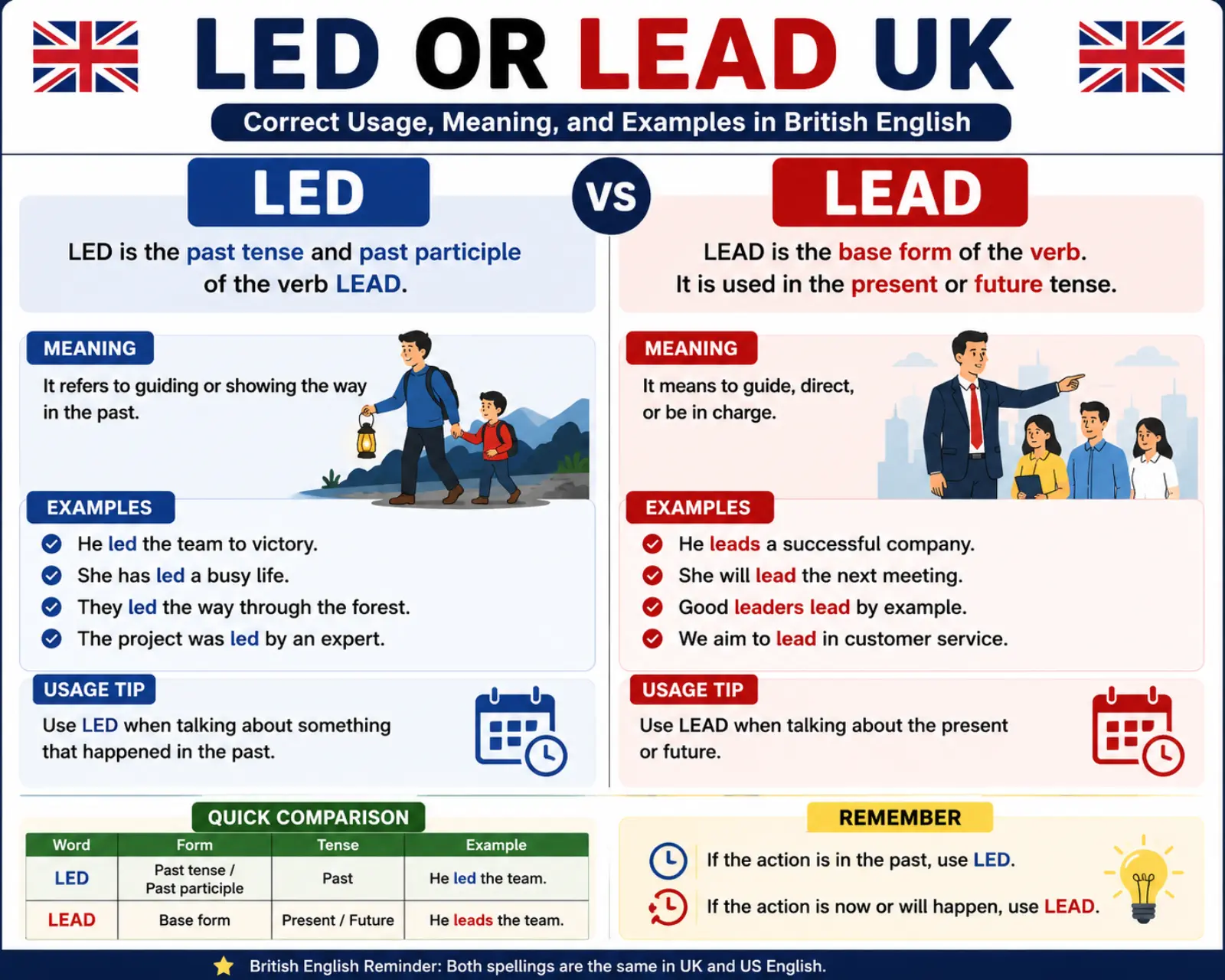
Lead is the present tense of the verb.
Led is the past tense of lead.
Lead can also mean a soft metal.
In UK English, the grammar rule is the same as American English.
Never write “I lead the meeting yesterday.”
Correct sentence: “I led the meeting yesterday.”
What Does “Lead” Mean?
The word lead has two meanings.
As a verb
It means to guide, direct, or show the way.
Examples:
I lead the team every Monday.
She leads the project.
They lead by example.
As a noun
It means a heavy, soft metal.
Examples:
The pipe contains lead.
Lead is used in some batteries.
What Does “Led” Mean?
Led is the past tense and past participle of the verb lead.
It describes an action that already happened.
Examples:
She led the meeting yesterday.
They led the group safely home.
Our captain led us to victory.
Led vs Lead UK Comparison Table
Feature
Lead
Led
Part of speech
Verb or noun
Verb
Tense
Present
Past
Meaning
Guide someone
Guided someone
Example
I lead the class.
I led the class yesterday.
UK spelling
Correct
Correct
Is the Rule Different in UK English?
No.
The grammar rule stays exactly the same in British English.
You use:
Lead for present actions.
Led for past actions.
Examples:
Present:
She leads our football club.
Past:
She led our football club last year.
The spelling does not change between UK and US English.
Why Do People Confuse Led and Lead?
Many people expect the past tense of lead to look like read.
For example:
Present:
Read
Past:
Read
But lead works differently.
Present:
Lead
Past:
Led
The pronunciation also causes confusion.
Word
Pronunciation
Lead (verb)
LEED
Led
LED
Lead (metal)
LED
Notice that lead (the metal) sounds exactly like led.
Real-Life Examples of Lead and Led
At work
✅ I lead the sales team.
✅ I led the sales meeting yesterday.
At school
✅ The teacher leads the class.
✅ The teacher led the class trip.
In sports
✅ Our captain leads the team.
✅ Our captain led the team to victory.
During travel
✅ The guide leads visitors.
✅ The guide led us through the castle.
In business
✅ Sarah leads the company.
✅ Sarah led the company during difficult times.
When Should You Use Lead?
Use lead when the action happens now or regularly.
Examples:
I lead the discussion.
He leads every project.
We lead by example.
They lead the market.
She leads the charity.
When Should You Use Led?
Use led when talking about something that already happened.
Examples:
I led the meeting yesterday.
He led the campaign.
They led the parade.
She led us home.
We led the competition.
Common Mistakes with Led and Lead
Incorrect
❌ She lead the class yesterday.
Correct
✅ She led the class yesterday.
Incorrect
❌ They lead us to victory last year.
Correct
✅ They led us to victory last year.
Incorrect
❌ I have lead many projects.
Correct
✅ I have led many projects.
Incorrect
❌ He lead the team last month.
Correct
✅ He led the team last month.
Easy Trick to Remember the Difference
Think about time.
Present
Today = Lead
Example:
I lead the team today.
Past
Yesterday = Led
Example:
I led the team yesterday.
A simple memory tip:
Today = Lead
Yesterday = Led
Led or Lead in Daily Conversations
Here are common examples.
Conversation 1
Person A:
Who leads this department?
Person B:
Emma leads it.
Conversation 2
Person A:
Who led the meeting yesterday?
Person B:
David led it.
Conversation 3
Person A:
Who will lead tomorrow?
Person B:
Our manager will lead.
Synonyms of Lead
Depending on the meaning, you can replace lead with:
Guide
Direct
Manage
Supervise
Control
Command
Head
Conduct
Organize
Inspire
For led, simply use the past tense of these verbs.
Examples:
Guided
Directed
Managed
Conducted
Inspired
Expert Grammar Tips
Grammar experts recommend checking the time in your sentence first.
Ask yourself:
Is the action happening now?
Use lead.
Did it happen already?
Use led.
Also remember:
After have, has, or had, use led.
Never use lead after a past-time word like yesterday or last week.
Examples:
✅ She has led many teams.
❌ She has lead many teams.
Featured Snippet: Led or Lead UK
Lead is the present tense verb meaning “to guide.” Led is the past tense and past participle of lead. In UK English, the grammar rule is the same as American English. Use lead for present actions and led for past actions.
Common Grammar Patterns
Sentence Pattern
Correct Word
I ___ the team today.
Lead
I ___ the team yesterday.
Led
She has ___ the project.
Led
They will ___ tomorrow.
Lead
We ___ by example every day.
Lead
Practice Quiz
Choose the correct answer.
1.
She _____ the meeting yesterday.
✅ Led
2.
He will _____ the project.
✅ Lead
3.
Our coach has _____ the team for years.
✅ Led
4.
They _____ the group every Monday.
✅ Lead
5.
The guide _____ us safely home.
✅ Led
Internal Linking Suggestions
You can improve your grammar knowledge by reading related guides such as:
Lie vs Lay
Chose vs Choose
Affect vs Effect
Past Tense of Read
Stationary vs Stationery
Whose vs Who’s
Led vs Lead Pronunciation Guide
FAQs:
Is it lead or led in the UK?
Use lead for present tense and led for past tense. The rule is the same in UK English.
Is “I lead the meeting yesterday” correct?
No.
Correct sentence:
I led the meeting yesterday.
Why is the past tense of lead spelled led?
English has many irregular verbs. Lead changes to led in the past tense.
Is lead always pronounced the same?
No.
The verb lead sounds like leed.
The metal lead sounds like led.
Can lead be a noun?
Yes.
It refers to a heavy metal used in batteries and other products.
Is “has lead” correct?
No.
Correct:
Has led
How do I remember the difference?
Think about time.
Present = Lead
Past = Led
Expert Insight
Many grammar mistakes happen because English contains irregular verbs. Lead is one of them. Professional editors often see writers use lead instead of led in past-tense sentences. A quick tense check can prevent this mistake. If the action happened before now, choose led. Consistent use of correct verb forms improves clarity, builds trust with readers, and strengthens your writing for school, work, and online content.
Conclusion
Understanding led or lead UK is easier once you know the grammar rule. Lead is the present tense verb that means to guide or direct someone. Led is the past tense and past participle of lead. These rules are identical in British and American English, so you never need different spellings based on region. Before choosing a word, check when the action happens. If it is happening now or in the future, use lead. If it already happened, use led. With regular practice and the simple memory trick of “Today = Lead, Yesterday = Led,” you can avoid this common mistake and write with confidence.
Michael Reed is a language content writer and word comparison researcher based in the United States. He studied English Language and Communication and focuses on grammar, spelling differences, and word usage. His work helps readers understand confusing English words through clear comparisons and practical explanations. Michael creates simple, reader-friendly content designed to improve everyday language skills.