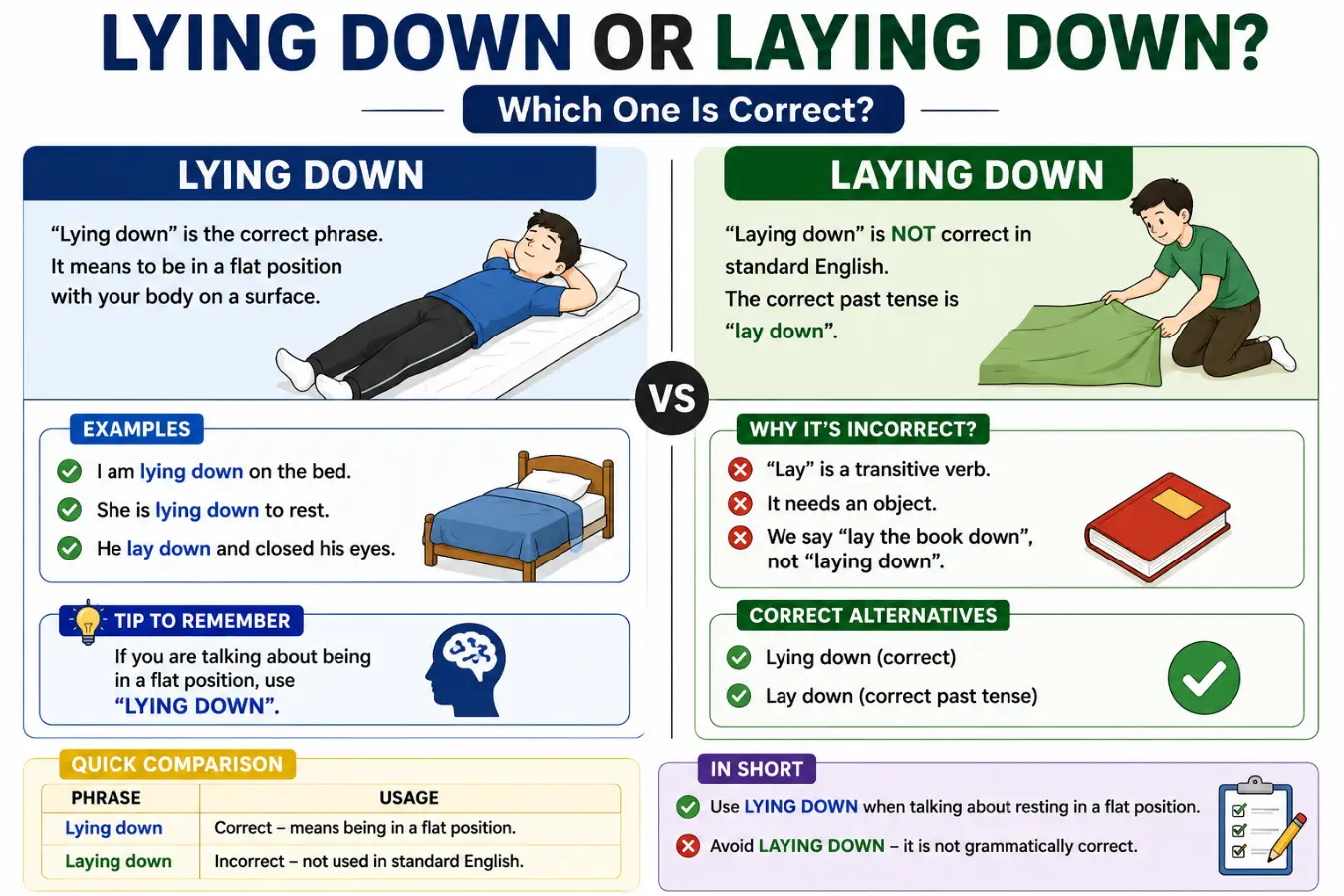
Lying down or laying down is one of the most common grammar questions in English. Many people use these phrases the wrong way. Even native speakers often mix them up. The good news is that the rule is simple once you understand it.
The confusion happens because the verbs lie and lay look alike. They also share similar forms. However, they have different meanings. One means to rest. The other means to place something somewhere.
This guide explains everything in easy words. You will learn the difference, see real-life examples, avoid common mistakes, and remember the correct form every time. By the end, you will know exactly when to say lying down and when laying down is the right choice.
Quick Summary Box
- Lying down means resting your body on a surface.
- Laying down means placing something down.
- Lie does not need an object.
- Lay always needs an object.
- Say: I am lying down.
- Say: I am laying down my phone.
- If nothing is being placed, use lying down.
What Does “Lying Down” Mean?
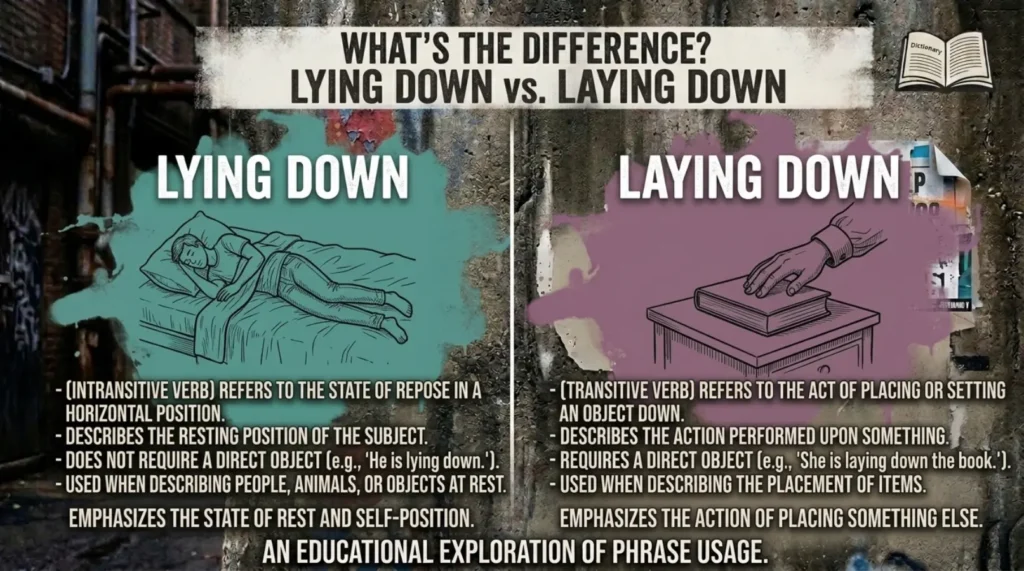
Lying down means your body is resting in a flat or relaxed position.
You are not putting another object anywhere. You are simply resting yourself.
Examples
- I am lying down after work.
- She is lying down on the couch.
- The baby is lying down in the crib.
- We were lying down under the stars.
- He likes lying down after lunch.
Simple Rule
If a person is resting, use lying down.
What Does “Laying Down” Mean?
Laying down means placing something onto a surface.
The action affects another object.
Examples
- I am laying down my phone.
- She is laying down the book.
- He is laying down the tools.
- They are laying down new carpet.
- We are laying down fresh paint.
Notice that every sentence includes an object.
Lying Down vs Laying Down Comparison Table
| Feature | Lying Down | Laying Down |
|---|---|---|
| Meaning | Resting your body | Placing something |
| Verb | Lie | Lay |
| Needs an object? | No | Yes |
| Correct example | I am lying down. | I am laying down my bag. |
| Common use | Sleeping, resting | Putting objects somewhere |
Why Do People Confuse Lying Down and Laying Down?
Several reasons cause this mistake.
- The verbs sound similar.
- Their past forms are confusing.
- People hear incorrect speech every day.
- Informal conversations often ignore grammar rules.
Many English learners think laying down always sounds correct. In fact, lying down is correct when talking about resting.
Grammar Rule Made Simple
Here is an easy way to remember it.
Use Lie when no object follows.
Example:
- I am lying down.
Nothing is being placed.
Use Lay when an object follows.
Example:
- I am laying down the blanket.
The blanket is the object.
Easy Memory Trick
Lay = Place
If you can replace the verb with place, then lay is correct.
Example:
- I am laying down the book.
- I am placing the book.
It works.
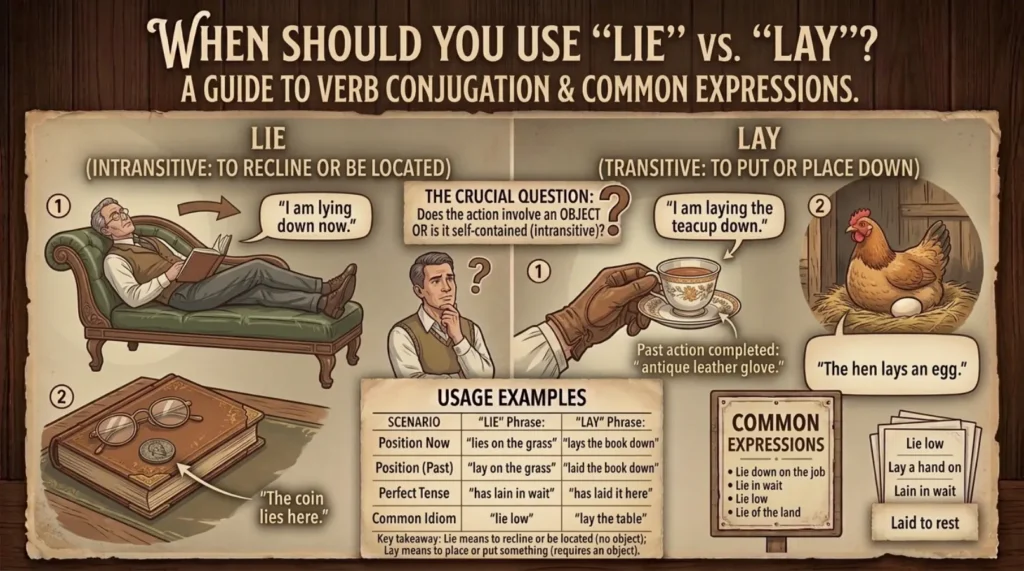
Verb Forms of Lie and Lay
Understanding the verb forms makes everything easier.
| Verb | Present | Past | Past Participle | Present Participle |
|---|---|---|---|---|
| Lie (rest) | Lie | Lay | Lain | Lying |
| Lay (place) | Lay | Laid | Laid | Laying |
Examples
Lie
- Today I lie on the bed.
- Yesterday I lay on the bed.
- I have lain here for hours.
- I am lying down now.
Lay
- Today I lay the keys down.
- Yesterday I laid the keys down.
- I have laid the keys there.
- I am laying down the keys.
Real-Life Examples
At Home
✅ I am lying down because I feel tired.
✅ She is laying down the baby blanket.
At Work
✅ He is lying down during his break.
✅ She is laying down the documents.
At School
✅ The student is lying down after gym class.
✅ The teacher is laying down the classroom rules.
At the Hospital
✅ The patient is lying down for an examination.
✅ The nurse is laying down fresh sheets.
Common Mistakes People Make
Incorrect
❌ I am laying down because I feel sleepy.
Correct
✅ I am lying down because I feel sleepy.
Incorrect
❌ She is lying down the groceries.
Correct
✅ She is laying down the groceries.
Incorrect
❌ We were laying down on the beach.
Correct
✅ We were lying down on the beach.
Incorrect
❌ He is lying down his backpack.
Correct
✅ He is laying down his backpack.
Lying Down or Laying Down in Daily Conversations
Here are common situations.
Resting
“I need to lie down.”
“I’m lying down now.”
Putting Something Away
“I’m laying down my laptop.”
“Please lay down your cards.”
After Exercise
“I was lying down after my workout.”
Before Bed
“The kids are lying down.”
Moving Furniture
“They are laying down new flooring.”
Tips to Remember the Difference
Tip 1
Ask yourself:
Am I resting?
If yes, use lying down.
Tip 2
Ask:
Am I placing something?
If yes, use laying down.
Tip 3
Look for an object.
Object present?
Use lay.
No object?
Use lie.
Tip 4
Remember this phrase.
People lie. Things get laid.
This simple trick helps many learners.
Synonyms and Related Keywords
Lying Down
- Resting
- Reclining
- Relaxing
- Stretching out
- Sleeping
- Lounging
Laying Down
- Placing
- Setting
- Putting
- Positioning
- Arranging
Related Search Terms
- lie vs lay
- lying or laying
- laying or lying in bed
- lie down grammar
- lay down meaning
- lying down meaning
- correct use of lie and lay
- grammar rules for lie and lay
Common Expressions Using Lie and Lay
Lie Down
- Lie down and relax.
- Lie down for a nap.
- Lie down on the sofa.
Lay Down
- Lay down the law.
- Lay down your weapons.
- Lay down the book.
- Lay down the rules.
Some expressions use lay down in an idiomatic way rather than literally.
Expert Insight
Many grammar mistakes happen because spoken English often ignores formal rules. However, correct grammar improves your writing and builds trust with readers.
Professional writers, teachers, and editors use lying down for resting and laying down when placing an object. Learning this difference makes your English sound more natural and polished.
When writing blogs, emails, or school assignments, check whether the sentence includes an object. This quick check prevents most mistakes.
FAQs:
Is it correct to say “I am laying down”?
Usually, no. If you are resting, say I am lying down.
Why do people say “laying down” instead of “lying down”?
Many people learn the wrong form through casual speech. The correct grammar depends on whether there is an object.
Is “lying down in bed” correct?
Yes. You are resting, so lying down is correct.
When should I use “laying down”?
Use it when placing something.
Example:
“I am laying down my phone.”
Does “lay” always need an object?
Yes. Something must be placed.
Is “lie down” an action verb?
Yes. It describes the action of resting.
What is the easiest way to remember the rule?
Remember:
People lie. Things get laid.
If you are resting, use lie.
If you are placing something, use lay.
Internal Linking Suggestions
To improve SEO and user engagement, link this article to related grammar guides such as:
- Lie Down or Lay Down: Complete Grammar Guide
- Lay vs Laid: What’s the Difference?
- Lied vs Lay vs Lain Explained
- Who’s vs Whose
- Your vs You’re
- Then vs Than
- Its vs It’s
- Affect vs Effect
Featured Snippet Answer
Lying down is correct when someone is resting because the verb lie means to recline and does not need an object. Laying down is correct when someone is placing something because the verb lay means to put an object somewhere and always requires an object.
Conclusion
Understanding lying down or laying down is easier than it first appears. The key difference is whether an object is involved. If you are resting your body, use lying down. If you are placing something on a surface, use laying down. This simple rule helps you avoid one of the most common grammar mistakes in English.
Practice with everyday sentences until the difference feels natural. Soon, you will recognize the correct form without thinking. Whether you are writing emails, school assignments, blog posts, or social media captions, using these verbs correctly makes your English clearer and more professional. Remember the simple trick: people lie, but they lay things down. That one sentence can help you choose the right phrase every time.

Emma Collins is a language writer and grammar enthusiast specializing in English vocabulary, spelling comparisons, and word usage guides. She creates easy-to-understand content that helps readers improve their writing, communication, and language skills with confidence.