
Lie down or lay down is a common grammar question that confuses many English speakers. These two phrases look similar, but they have different meanings. Because of this, people often use the wrong one in writing and speech.
The good news is that the difference is easy to learn. Once you know what each word means, you can choose the correct phrase with confidence.
In this guide, you will learn the meaning of lie down and lay down, see simple examples, discover common mistakes, and learn easy tricks to remember the difference. By the end, you will know exactly when to use each phrase in daily conversations and professional writing.
Quick Summary Box
- Lie down means to rest or recline.
- Lay down means to place something somewhere.
- Lie does not need an object.
- Lay needs an object.
- You lie down on a bed.
- You lay down a book on a table.
- Remember: If you are putting something down, use lay.
- If you are resting yourself, use lie.
What Does “Lie Down” Mean?
The phrase lie down means to move into a resting position. It refers to a person or animal reclining on a surface.
Examples
- I need to lie down after work.
- The dog likes to lie down near the fireplace.
- She will lie down for a short nap.
In these examples, nobody is placing an object anywhere. The subject performs the action alone.
What Does “Lay Down” Mean?
The phrase lay down means to put or place something onto a surface.
The key point is that lay always acts on an object.
Examples
- Please lay down your phone.
- He laid down the newspaper.
- She will lay down the blanket.
Here, an object receives the action.
Lie Down vs Lay Down: Key Difference
Many people mix up these phrases because their past-tense forms create extra confusion.
The simplest rule is:
- Lie down = recline
- Lay down = place something
Ask yourself one question:
Is there an object being placed somewhere?
If yes, use lay down.
If no, use lie down.
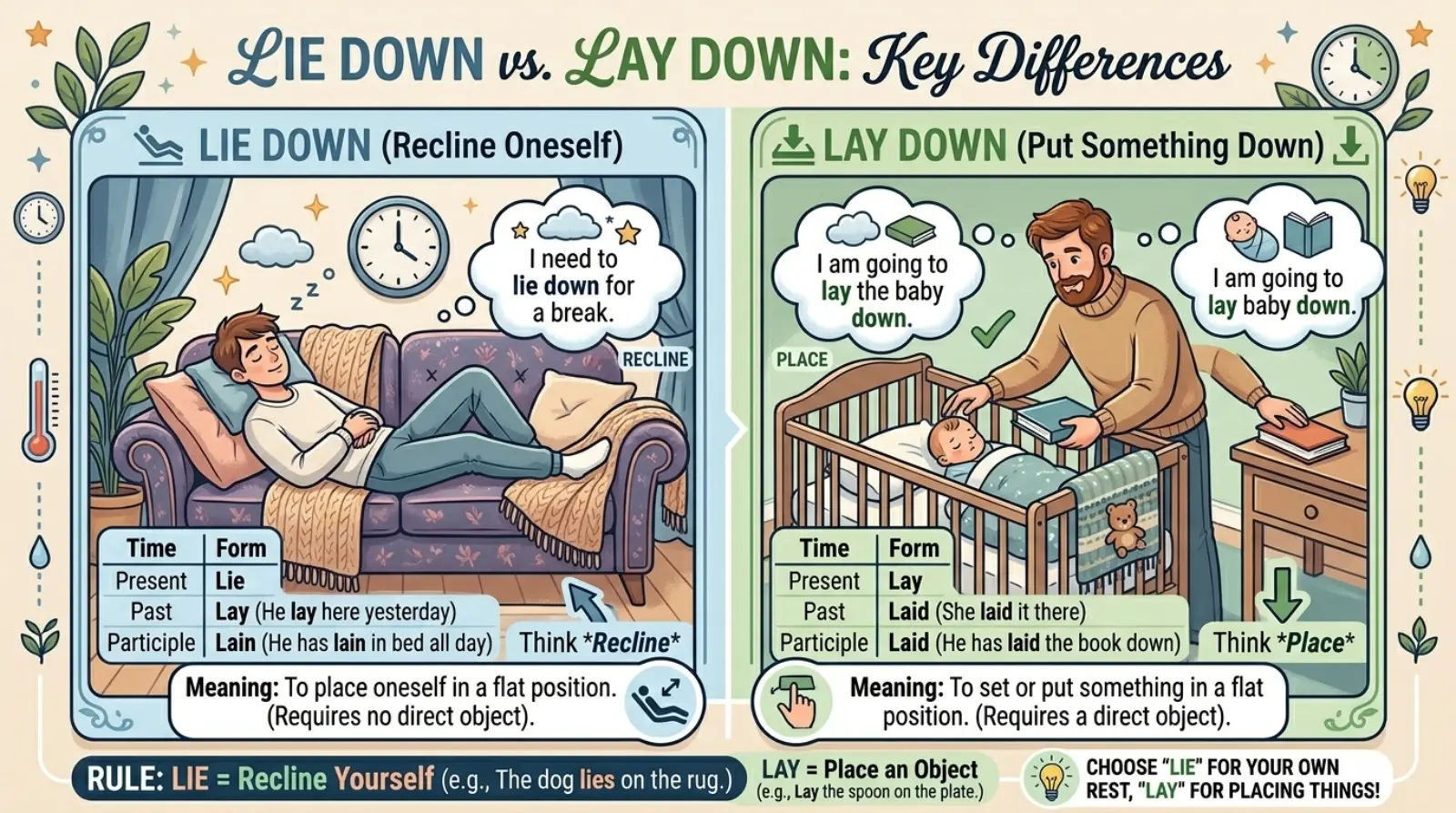
Lie Down or Lay Down Comparison Table
| Feature | Lie Down | Lay Down |
|---|---|---|
| Meaning | To recline or rest | To place something |
| Needs an Object? | No | Yes |
| Action | Done by the subject | Done to an object |
| Present Tense | Lie | Lay |
| Past Tense | Lay | Laid |
| Example | I lie down every afternoon. | I lay down my keys. |
Why Do People Confuse Lie and Lay?
Several reasons cause confusion.
1. Similar Spellings
The words look almost identical.
2. Similar Pronunciation
Many speakers pronounce them quickly in conversation.
3. Tricky Past Tenses
The past tense of lie is lay.
For example:
- Today: I lie down.
- Yesterday: I lay down.
Meanwhile:
- Today: I lay down the book.
- Yesterday: I laid down the book.
This overlap creates confusion.
Simple Trick to Remember the Difference
A quick memory trick can help.
Think About the Letter “A”
Lay contains the letter A.
A = Action on an object.
Examples:
- Lay down a backpack.
- Lay down a pencil.
- Lay down a towel.
If there is an object, choose lay.
If there is no object, choose lie.
Real-Life Examples of Lie Down
Here are common situations where people use lie down.
Home
- I want to lie down on the couch.
- She lies down after dinner.
The Doctor’s Office
- Please lie down on the examination table.
The Beach
- We lie down on the sand.
After Exercise
- He needed to lie down and rest.
Real-Life Examples of Lay Down
These examples show correct use of lay down.
Cleaning the House
- Lay down the rug carefully.
Working in the Office
- She laid down the documents.
Moving Furniture
- They laid down protective sheets.
Daily Activities
- Please lay down your bags.
Common Mistakes People Make
Mistake 1: Using Lay Instead of Lie
❌ I am going to lay down for a nap.
✅ I am going to lie down for a nap.
A nap does not involve placing an object.
Mistake 2: Using Lie Instead of Lay
❌ Please lie down the book.
✅ Please lay down the book.
The book is the object.
Mistake 3: Confusing Past Tenses
❌ Yesterday, I laid down for an hour.
✅ Yesterday, I lay down for an hour.
The past tense of lie is lay.
Lie and Lay Verb Forms
Understanding verb forms makes everything easier.
| Tense | Lie (Recline) | Lay (Place Something) |
|---|---|---|
| Present | Lie | Lay |
| Past | Lay | Laid |
| Past Participle | Lain | Laid |
| Present Participle | Lying | Laying |
Examples
- I am lying down now.
- Yesterday I lay down.
- I have lain down all afternoon.
And:
- I am laying down the cards.
- Yesterday I laid down the cards.
- I have laid down the cards already.
Usage in Daily Life
Most people use these phrases regularly.
Common Uses of Lie Down
- Taking a nap
- Resting after work
- Relaxing on a sofa
- Sleeping in bed
Common Uses of Lay Down
- Placing books
- Setting down tools
- Putting down bags
- Arranging furniture
Knowing the difference helps you sound more natural and professional.
Synonyms and Related Words
Lie Down
- Recline
- Rest
- Relax
- Stretch out
- Lounge
Lay Down
- Place
- Put
- Set
- Position
- Arrange
Related Keywords
- lie vs lay
- lay or lie grammar
- lie down meaning
- lay down meaning
- when to use lay and lie
- lie and lay examples
- grammar rules for lie and lay
- lay down or lie down correctly
Expert Insight: Why This Grammar Rule Matters
Grammar experts often highlight lie and lay as one of the most misunderstood verb pairs in English.
Using the correct form improves:
- Writing clarity
- Professional communication
- Academic work
- Business emails
- Content quality
Writers who understand this rule make fewer grammar mistakes and appear more credible.
Small grammar improvements create a stronger impression on readers.
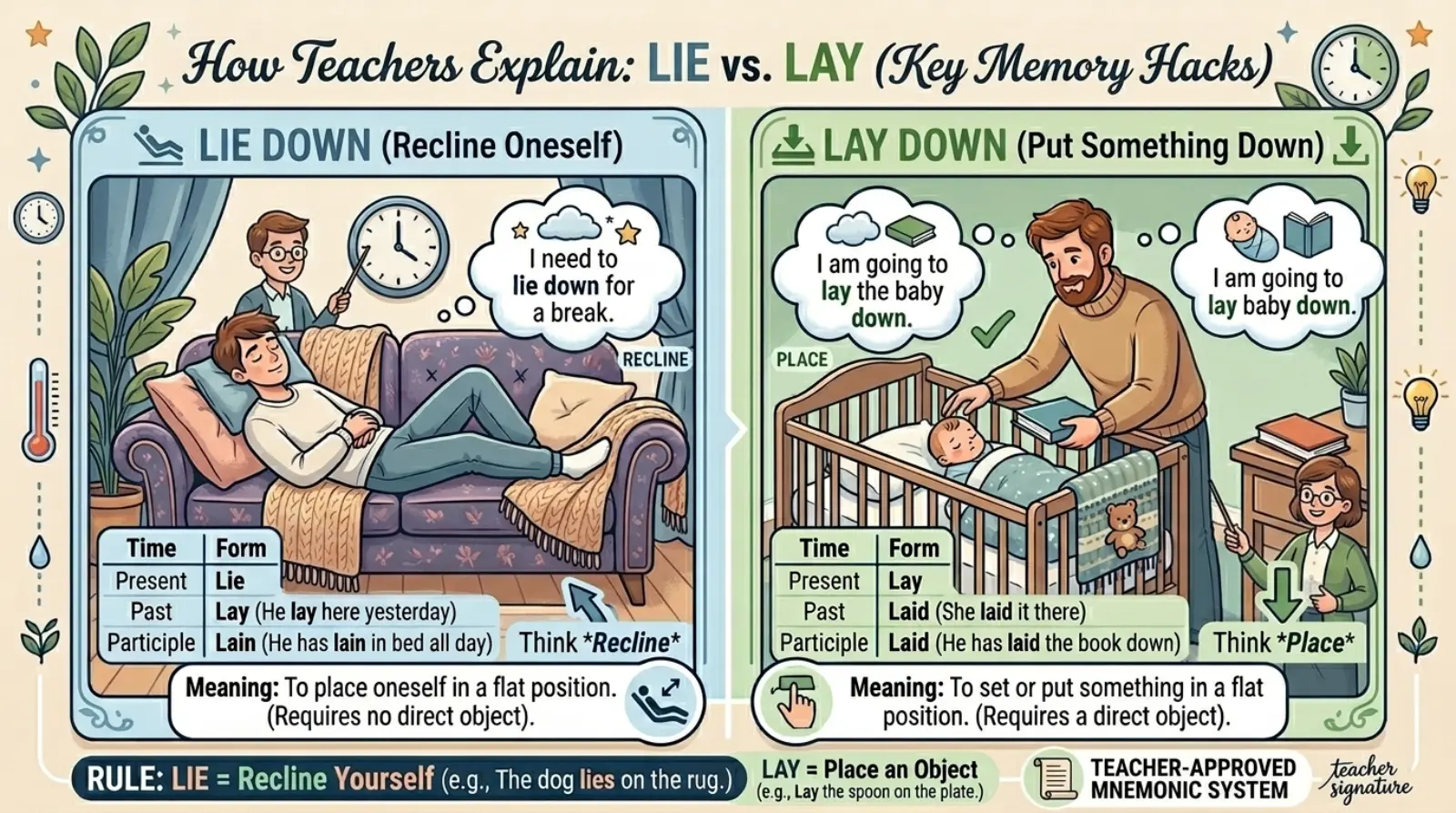
How Teachers Explain Lie and Lay
Many teachers use this simple formula:
Lie = Recline
You do it yourself.
Example:
- I lie down.
Lay = Place
You put something somewhere.
Example:
- I lay down the book.
This simple explanation works for most situations.
Quick Practice Quiz
Choose the correct answer.
1. I need to _____ after work.
Answer: lie down
2. Please _____ the keys on the table.
Answer: lay down
3. Yesterday I _____ for an hour.
Answer: lay
4. She _____ the blanket on the bed.
Answer: laid
FAQs
Is it correct to say “lay down for a nap”?
No. The correct phrase is lie down for a nap.
What is the difference between lie down and lay down?
Lie down means to recline. Lay down means to place something.
Why is lie and lay so confusing?
The past tense of lie is lay, which causes confusion.
Does lay always need an object?
Yes. You must place something.
What is the past tense of lie?
The past tense of lie is lay.
What is the past tense of lay?
The past tense of lay is laid.
Can I say “I am laying down”?
Only if you are placing something down. Otherwise, use lying down.
Which phrase is more common?
Both are common. The correct choice depends on the situation.
Internal Linking Suggestions
Consider linking this article to:
- Lie vs Lay Grammar Guide
- Common English Grammar Mistakes
- Affect vs Effect
- Then vs Than
- Who vs Whom
- Everyday English Writing Tips
Conclusion
Understanding lie down or lay down becomes easy once you know the basic rule. Lie down means to recline or rest. Lay down means to place something somewhere. The biggest difference is that lay needs an object, while lie does not.
Although the verb forms can seem confusing, a simple memory trick helps. If you are putting an object down, use lay. If you are resting yourself, use lie. With a little practice, these phrases will become natural in both speech and writing.
The next time you wonder whether to use lie down or lay down, remember this simple rule and choose the correct phrase with confidence.

Emma Collins is a language writer and grammar enthusiast specializing in English vocabulary, spelling comparisons, and word usage guides. She creates easy-to-understand content that helps readers improve their writing, communication, and language skills with confidence.