
Lied down or laid down is a grammar question that confuses many English learners. These two phrases look similar, but they have different meanings. Choosing the wrong one can change the meaning of your sentence. The good news is that the rule is simple once you understand it. This guide explains the difference in easy English. You will learn when to use each phrase, how to remember the rule, and how to avoid common mistakes. You will also see real-life examples, a comparison table, and expert tips. By the end of this article, you will confidently know whether to write lied down or laid down.
Quick Summary Box (Featured Snippet)
- Lied down is the past tense of lie, which means to rest or recline.
- Laid down is the past tense of lay, which means to put something down.
- Lie does not take an object.
- Lay always needs an object.
- Example: She lied down to sleep.
- Example: She laid down her bag.
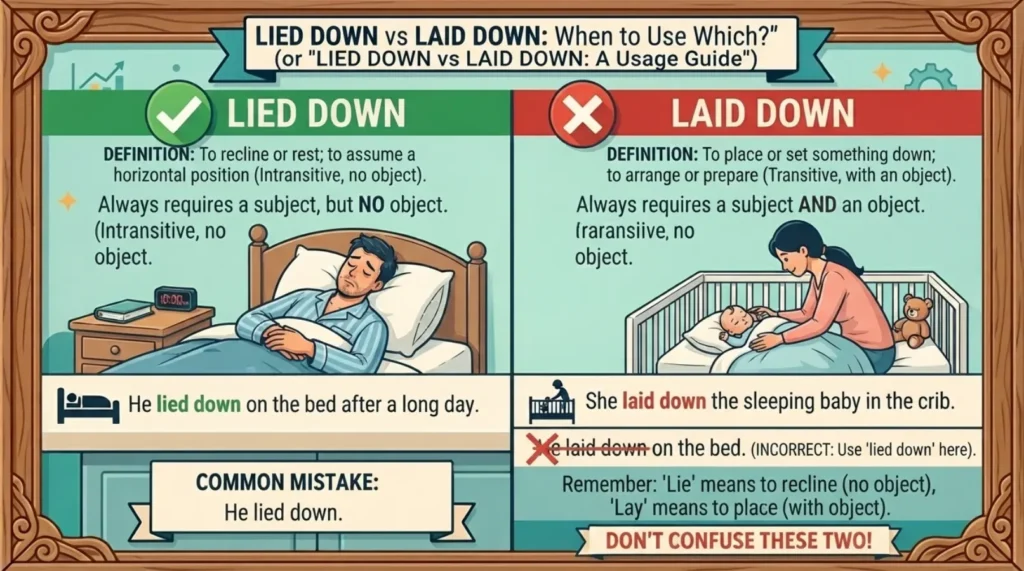
What Does “Lied Down” Mean?
Lied down is the past tense of lie.
Lie means:
- To rest
- To recline
- To move into a flat position
It does not need an object.
Examples
- I lied down after work.
- He lied down on the sofa.
- They lied down under the tree.
- The baby lied down for a nap.
- We lied down because we felt tired.
In each sentence, nobody is placing an object anywhere.
What Does “Laid Down” Mean?
Laid down is the past tense of lay.
Lay means:
- To place something somewhere
- To put an object down
It always needs an object.
Examples
- She laid down her phone.
- I laid down my keys.
- They laid down the carpet.
- He laid down the newspaper.
- We laid down the tools.
Notice that every sentence includes something being placed down.
Lied Down vs Laid Down Comparison Table
| Feature | Lied Down | Laid Down |
|---|---|---|
| Base verb | Lie | Lay |
| Meaning | Rest or recline | Put something down |
| Needs an object? | No | Yes |
| Action | Person rests | Person places something |
| Correct example | She lied down. | She laid down her coat. |
Grammar Rule in Simple Words
The easiest rule is this:
Ask one question.
Did someone place something?
- Yes → Laid down
- No → Lied down
Examples
✅ He lied down because he was tired.
✅ He laid down his backpack.
This simple question helps you choose the correct phrase every time.
Why People Mix Up Lied Down and Laid Down
These verbs have unusual forms.
Here is the complete pattern.
| Present | Past | Past Participle |
|---|---|---|
| Lie | Lied | Lain |
| Lay | Laid | Laid |
Many people confuse lay with the past tense of lie because the present form of one verb looks like the past form of the other.
Real-Life Examples of Lied Down and Laid Down
Home
- I lied down after dinner.
- She laid down the blanket.
School
- The child lied down during story time.
- The teacher laid down the books.
Work
- He lied down during lunch break.
- She laid down the report on the desk.
Hospital
- The patient lied down for the examination.
- The nurse laid down the medical file.
Common Mistakes to Avoid
❌ Incorrect
I laid down because I was tired.
✅ Correct
I lied down because I was tired.
❌ Incorrect
She lied down her jacket.
✅ Correct
She laid down her jacket.
❌ Incorrect
He laid down on the couch.
✅ Correct
He lied down on the couch.
Easy Trick to Remember the Difference
Use this memory tip.
Lie = Lounge
Both begin with L.
If someone is resting, use lied down.
Lay = Place
If someone puts something somewhere, use laid down.
Think:
- Lie → You
- Lay → Something
Daily Life Usage
You hear these phrases every day.
Correct
- I lied down after my workout.
- The dog lied down beside me.
- She laid down her shopping bags.
- He laid down the menu.
- We laid down fresh towels.
These examples show the difference clearly.
Synonyms and Related Words
Lied Down
- Reclined
- Rested
- Stretched out
- Relaxed
- Settled down
Laid Down
- Placed
- Put
- Positioned
- Set down
- Deposited
LSI Keywords
- lie vs lay
- lied or laid
- grammar rules
- English verb forms
- lay and lie examples
- proper English grammar
- common grammar mistakes
- correct verb usage
- past tense of lie
- past tense of lay
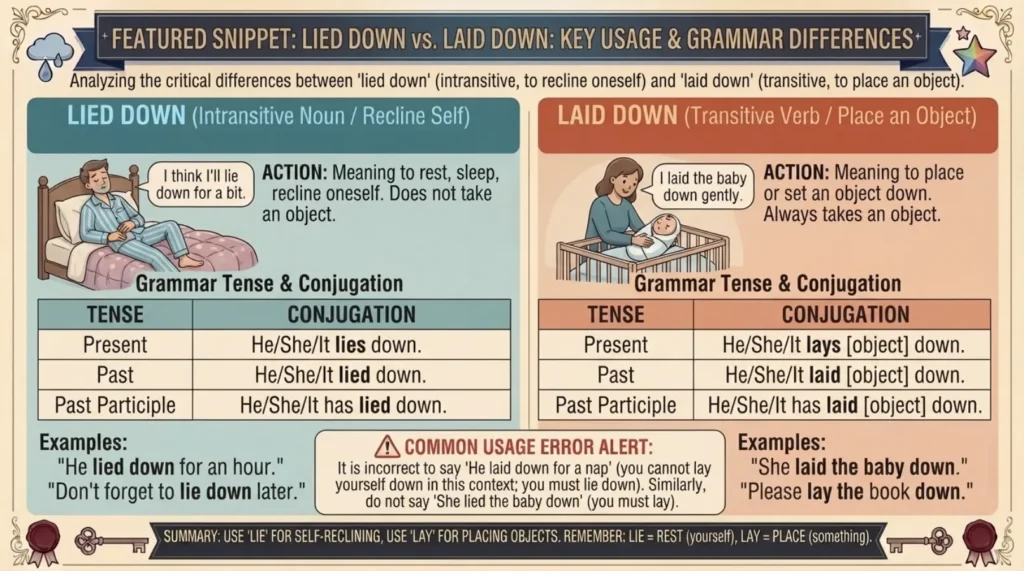
Featured Snippet: Lied Down or Laid Down?
Lied down means someone rested in a flat position. Laid down means someone placed an object somewhere. Use lied down without an object. Use laid down with an object.
Practice Sentences
Choose the correct answer.
- I _____ after the long walk.
1.Answer: lied down
- She _____ her purse on the table.
2.Answer: laid down
- The cat _____ near the fireplace.
3.Answer: lied down
- He _____ the newspaper beside the chair.
4.Answer: laid down
- We _____ for a short rest.
5.Answer: lied down
Expert Insights
Professional editors recommend learning the difference between lie and lay early. These verbs appear in daily writing, school assignments, and business communication. Correct grammar builds trust and improves readability. Writers who understand these verbs make fewer mistakes and communicate more clearly. Remember to check whether your sentence has an object before choosing the correct verb.
FAQs:
Is “lied down” grammatically correct?
Yes. It is the correct past tense of lie, meaning to rest.
Is “laid down” correct?
Yes. It is correct when someone places an object down.
Why do people confuse lied and laid?
The verb forms are similar. Also, the present tense of lay looks like the past tense of lie.
Which is correct: “I laid down” or “I lied down”?
If you rested, say I lied down.
If you placed something down, say I laid down my phone.
Does “lay” always need an object?
Yes. You must lay something down.
What is the past tense of “lie”?
The past tense is lied.
What is the past tense of “lay”?
The past tense is laid.
How can I remember the difference?
Remember this simple rule:
- Lie = Rest
- Lay = Put
Internal Linking Suggestions
You can strengthen your grammar content by linking to related articles such as:
- Lie vs Lay Explained
- Lain vs Laid
- Took or Taken
- Sat or Set
- Farthest or Furthest
- Who’s or Whose
- Than or Then
- Affect vs Effect
Conclusion
Understanding lied down or laid down becomes easy when you remember one simple rule. Use lied down when someone rests. Use laid down when someone places something somewhere. Always check whether your sentence includes an object. If it does, choose laid down. If it does not, choose lied down. This small grammar rule can greatly improve your writing and speaking. Practice with everyday examples until the difference feels natural. Soon, you will use both phrases with confidence and avoid one of the most common English grammar mistakes.

Emma Collins is a language writer and grammar enthusiast specializing in English vocabulary, spelling comparisons, and word usage guides. She creates easy-to-understand content that helps readers improve their writing, communication, and language skills with confidence.