
Monies or moneys often confuse English learners and even native speakers. Both words exist, but they do not mean the same thing in every situation. Most people only use money in everyday English. However, monies appears in legal, financial, and business writing. On the other hand, moneys is an accepted spelling in some dictionaries but is much less common.
Knowing the difference helps you write clearly and correctly. It also prevents mistakes in business reports, legal papers, and academic writing. In this guide, you will learn the meaning of each word, when to use it, and which one sounds natural. You will also see simple examples, common mistakes, and expert grammar tips.
Quick Summary Box
- Money is the normal word for cash or wealth.
- Monies is the preferred plural in legal and financial English.
- Moneys is a less common alternative spelling.
- Most everyday writing uses money, not monies or moneys.
- Use monies when talking about separate funds from different sources.
- Avoid moneys unless a style guide specifically accepts it.
What Does “Money” Mean?
Money is the standard noun for currency, cash, or wealth.
It usually works as an uncountable noun, so it does not need a plural form in daily conversation.
Examples
- I need more money.
- She saved enough money for college.
- They spent too much money last month.
- Money cannot buy happiness.
- He earned money through freelance work.
In normal English, money is almost always the correct choice.
What Does “Monies” Mean?
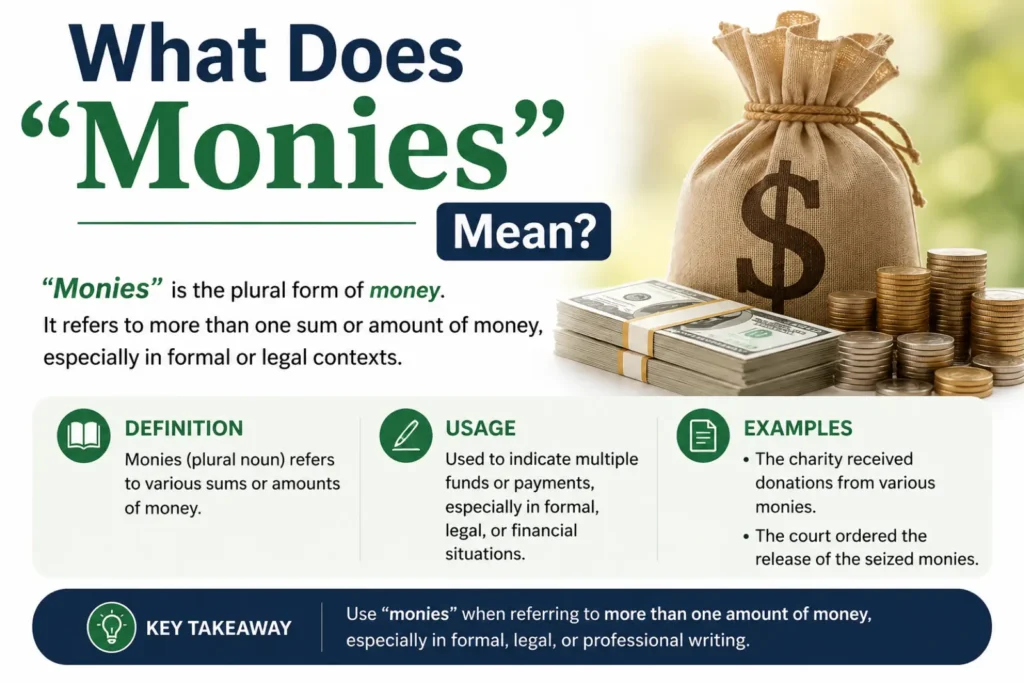
Monies is the preferred plural form used in legal, accounting, banking, and government documents.
It refers to different amounts or sources of money rather than money in general.
Examples
- The grant monies will support local schools.
- The company separated the investment monies.
- All monies received must be reported.
- Government agencies tracked public monies carefully.
- The settlement monies arrived on Friday.
Here, the focus is on separate funds instead of one amount.
What Does “Moneys” Mean?
Moneys is also a recognized plural spelling.
However, it appears much less often than monies.
Many modern style guides and editors prefer monies because it has become the standard in legal and financial English.
Examples
- The trust moneys remained protected.
- Insurance moneys covered the repairs.
Although correct, many writers replace moneys with monies.
Monies or Moneys: What’s the Difference?
The biggest difference is usage, not meaning.
Both words describe separate sums of money.
However, monies has become far more common in professional writing.
| Feature | Monies | Moneys |
|---|---|---|
| Meaning | Separate sums of money | Separate sums of money |
| Common today | Yes | Rare |
| Legal writing | Very common | Sometimes |
| Financial reports | Common | Rare |
| Everyday English | Rare | Very rare |
| Best choice | Usually | Only in specific cases |
Simple Rule
- Everyday English → money
- Legal or finance → monies
- Moneys → uncommon alternative spelling
Why Does “Monies” Exist?
English sometimes creates plural forms for nouns that are usually uncountable.
These plural forms help describe separate groups or sources.
For example:
- Tax monies
- Federal monies
- Investment monies
- Insurance monies
- Public monies
Each refers to different pools of funds.
Real-Life Examples of Monies and Moneys
Here are simple examples from different situations.
Business
- Company monies funded the new office.
- Investment monies grew quickly.
Government
- Public monies supported road repairs.
- State monies paid for education.
Banking
- Client monies stayed in separate accounts.
- Trust monies remained protected.
Legal
- All settlement monies were distributed.
- Court monies covered legal costs.
Everyday Conversation
Instead of saying:
❌ I lost my monies.
People naturally say:
✅ I lost my money.
When Should You Use “Money” Instead?
Use money almost every time in everyday English.
Correct Examples
- I need more money.
- She borrowed money from her friend.
- Money makes business possible.
- They donated money to charity.
- We saved money every month.
This sounds natural and correct.
Common Mistakes
Many learners confuse these words.
Mistake 1
❌ I have many monies.
✅ I have a lot of money.
Mistake 2
❌ She earns many moneys.
✅ She earns a lot of money.
Mistake 3
❌ The company received much monies.
✅ The company received funding.
OR
✅ The company received grant monies.
Mistake 4
Using monies in casual conversation.
Instead say:
✅ I forgot my money.
Easy Trick to Remember
Use this simple memory trick.
Think About the Situation
Talking with friends?
Use money.
Writing legal or financial documents?
Use monies.
Not sure?
Choose money.
It is almost always correct.
Monies or Moneys in Daily Life
Most people never use either plural form.
Here are natural situations.
Grocery Shopping
- I forgot my money.
Paying Bills
- We need more money this month.
Business Meeting
- The investment monies came from several partners.
Government Report
- Public monies funded the project.
Notice how money appears much more often.

Synonyms and Related Words
Synonyms for Money
- Cash
- Funds
- Currency
- Wealth
- Capital
- Income
- Earnings
- Assets
- Finances
- Resources
Related LSI Keywords
- monies meaning
- moneys meaning
- money grammar
- plural of money
- legal English money
- financial writing
- business English grammar
- separate funds
- legal terminology
- accounting vocabulary
Expert Insight
Professional editors rarely use moneys today.
Most legal, accounting, and government documents prefer monies because it has become the accepted standard.
However, ordinary writing almost never needs either plural.
Choosing the correct word improves clarity and professionalism. It also helps your writing match modern grammar standards.
When in doubt, use money unless you specifically discuss separate funds in legal or financial contexts.
Frequently Asked Questions
Is it monies or moneys?
Both spellings are correct. However, monies is much more common today.
Which word do lawyers use?
Most lawyers use monies in contracts and legal documents.
Can I say “many monies”?
Usually no.
Instead say:
- a lot of money
- several sources of funding
Why is money usually singular?
Money is an uncountable noun in everyday English.
Is moneys outdated?
It is not completely outdated.
However, it is much less common than monies.
Can I use monies in daily conversation?
You can, but it sounds formal.
Most people simply say money.
What is the plural of money?
Normally, there is no plural in everyday English.
In legal and financial contexts, the plural is usually monies.
Common Grammar Rules
Remember these simple rules.
- Money is uncountable.
- Do not say “many money.”
- Say “a lot of money.”
- Use monies for separate funds.
- Avoid moneys unless required by a specific style guide.
Featured Snippet: Monies vs. Moneys
| Word | Best Use | Example |
|---|---|---|
| Money | Everyday English | I need more money. |
| Monies | Legal and financial writing | Grant monies were distributed. |
| Moneys | Rare alternative spelling | Trust moneys remained protected. |
Internal Linking Suggestions
To strengthen your website’s SEO, consider linking this article to related grammar guides such as:
- Money vs Cash: What’s the Difference?
- Amount vs Number Explained
- Funds vs Funding
- Affect vs Effect
- Fewer vs Less
- Advice vs Advise
- Principal vs Principle
- Ensure vs Insure vs Assure
Conclusion
Understanding monies or moneys is easier than it first appears. In everyday English, money is almost always the right choice because it is an uncountable noun. When you write legal, financial, or government documents, monies is the preferred plural for separate funds from different sources. Although moneys is still recognized, it is uncommon and rarely recommended in modern writing. Choosing the correct form makes your writing clearer and more professional. If you are unsure which word to use, remember this simple rule: use money for daily conversations and monies for formal financial or legal contexts.

Emma Collins is a language writer and grammar enthusiast specializing in English vocabulary, spelling comparisons, and word usage guides. She creates easy-to-understand content that helps readers improve their writing, communication, and language skills with confidence.