
Weather or whether is one of the most common grammar questions in English. These two words sound the same, but they have different meanings. Many people confuse them when writing emails, essays, or social media posts.
The good news is that the difference is easy to learn. Once you know what each word means, you can use them correctly every time.
In this guide, you will learn the meaning of weather and whether, see simple examples, compare both words side by side, and discover easy memory tricks. By the end, you’ll know exactly when to use each word with confidence.
Quick Summary Box
- Weather means the condition of the atmosphere.
- Whether introduces choices or possibilities.
- Weather relates to rain, sunshine, wind, snow, and temperature.
- Whether usually means if or which choice.
- They sound the same but have different meanings.
- Remember: Weather = climate. Whether = choice.
What Does “Weather” Mean?
Weather is a noun. It describes the condition of the air outside at a certain time and place.
It includes:
- Rain
- Sunshine
- Wind
- Snow
- Clouds
- Temperature
- Storms
Examples
- The weather is sunny today.
- Bad weather delayed our flight.
- I always check the weather before traveling.
- Cold weather makes the roads icy.
- The weather changes quickly in spring.
What Does “Whether” Mean?
Whether is a conjunction. It connects two or more choices or possibilities.
It often means:
- If
- Which option
- Either…or
Examples
- I don’t know whether to stay home.
- She asked whether I was ready.
- We must decide whether to buy the house.
- Tell me whether you agree.
- They discussed whether the plan would work.

Weather or Whether: Comparison Table
| Feature | Weather | Whether |
|---|---|---|
| Part of speech | Noun | Conjunction |
| Meaning | Condition of the atmosphere | Expresses a choice or possibility |
| Related to | Rain, snow, wind, climate | Decisions and options |
| Example | The weather is cold. | I don’t know whether to go. |
| Can replace with “if”? | No | Often yes |
| Common use | Forecasts and seasons | Questions and decisions |
Weather vs Whether Explained in Simple Words
The easiest way to remember these words is this:
Use weather when talking about nature.
Examples:
- The weather is beautiful.
- Warm weather makes people happy.
- Stormy weather caused delays.
Use whether when talking about choices.
Examples:
- I can’t decide whether to travel.
- We wondered whether they would arrive.
- Tell me whether you can help.
Think of it like this:
- Weather = outside
- Whether = decision
Real-Life Examples of Weather and Whether
Here are everyday situations.
Talking About Today’s Forecast
✔ The weather looks rainy.
❌ The whether looks rainy.
Choosing Dinner
✔ I don’t know whether to order pizza.
❌ I don’t know weather to order pizza.
Planning a Vacation
✔ The weather is perfect for the beach.
✔ We haven’t decided whether to travel next week.
School Example
✔ The teacher asked whether everyone finished the test.
Sports Example
✔ Bad weather canceled the football match.
Family Example
✔ My parents discussed whether we should move.
Common Mistakes People Make
Many writers mix these words because they sound identical.
Mistake 1
❌ I don’t know weather to go.
✔ I don’t know whether to go.
Mistake 2
❌ Whether today is sunny.
✔ The weather today is sunny.
Mistake 3
❌ Check whether before leaving.
✔ Check the weather before leaving.
Mistake 4
❌ Bad whether caused delays.
✔ Bad weather caused delays.
Mistake 5
❌ I’m unsure weather he’ll come.
✔ I’m unsure whether he’ll come.
Easy Memory Tricks
Remembering these words becomes easy with these tricks.
Trick 1
Weather has “ea.”
Think of:
- Earth
- Environment
- Air
All relate to weather.
Trick 2
Whether starts with “wh.”
Think:
- Which?
- What choice?
Those questions involve decisions.
Trick 3
Ask yourself:
“Am I talking about nature?”
If yes, use weather.
If not, you’re probably talking about a choice.
Weather and Whether in Daily Conversations
People use these words every day.
Home
- Check the weather before school.
- We don’t know whether Grandma will visit.
Work
- The weather delayed deliveries.
- We must decide whether to accept the offer.
While Traveling
- The weather is perfect today.
- We haven’t decided whether to fly or drive.
School
- Students discussed whether homework helps learning.
- The bad weather closed the school.
Grammar Rules for Weather and Whether
Weather
- Usually a noun.
- Sometimes used as a verb.
Examples:
- We watched the weather report.
- The old building weathered many storms.
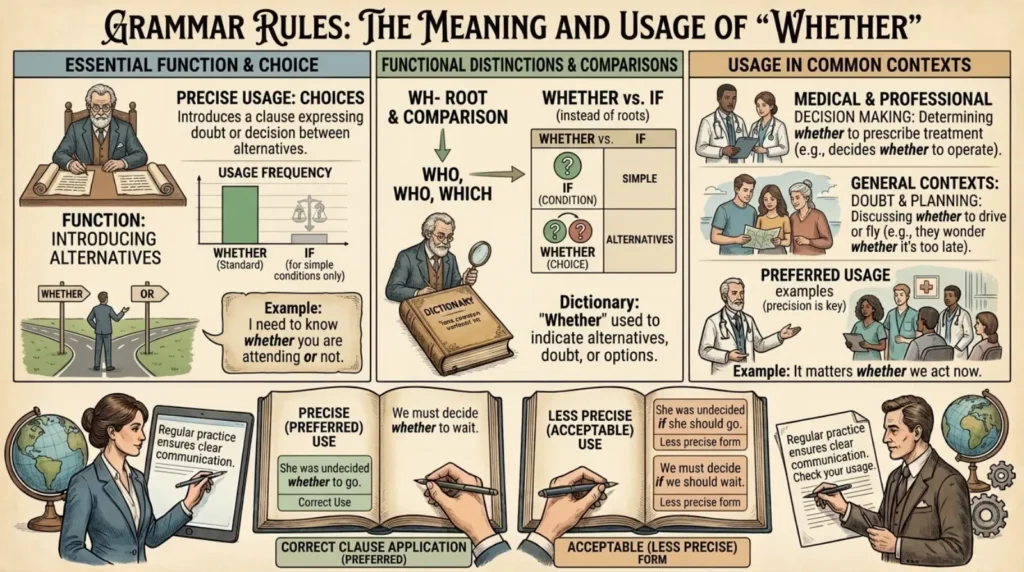
Whether
- Always introduces alternatives.
- Often followed by “or not.”
Examples:
- Tell me whether you’re coming.
- I don’t know whether or not she called.
Weather vs Whether in Common Expressions
Weather
- Weather forecast
- Weather report
- Extreme weather
- Warm weather
- Cold weather
- Severe weather
- Weather conditions
- Fair weather
Whether
- Whether or not
- Whether to stay
- Whether you agree
- Whether it works
- Whether they know
Synonyms and Related Words
Weather Synonyms
- Climate
- Forecast
- Conditions
- Atmosphere
- Temperature
- Environment
Whether Related Words
- If
- Either
- Choice
- Decision
- Option
- Alternative
LSI Keywords
- weather vs whether
- weather meaning
- whether meaning
- difference between weather and whether
- weather or whether grammar
- when to use weather
- when to use whether
- confusing English words
- English homophones
- grammar mistakes
Expert Insights
Grammar experts recommend learning confusing word pairs through context instead of memorization alone.
Read complete sentences instead of single words. This helps you understand meaning naturally.
Also, proofread your writing before publishing. Spell check may not catch mistakes because both words are spelled correctly.
Writers who master common homophones produce clearer and more professional content. Correct grammar also builds trust with readers and improves readability.
Featured Snippet: Weather vs Whether
Weather refers to outdoor atmospheric conditions such as rain, sunshine, wind, snow, or temperature. Whether is a conjunction that introduces choices, alternatives, or possibilities. Although they sound the same, they have different meanings and uses.
Practice Quiz
Choose the correct word.
1.
The ______ is very hot today.
Answer: weather
2.
I don’t know ______ to stay home.
Answer: whether
3.
Bad ______ caused traffic delays.
Answer: weather
4.
She asked ______ I finished my homework.
Answer: whether
5.
The television showed the ______ forecast.
Answer: weather
Frequently Asked Questions
Is it weather or whether?
Use weather when talking about climate or outdoor conditions. Use whether when talking about choices or possibilities.
Why do weather and whether sound the same?
They are homophones. Homophones have the same pronunciation but different meanings and spellings.
Can whether mean “if”?
Yes. In many sentences, whether can replace if, especially when introducing alternatives.
Example:
- I don’t know whether he’ll come.
Is weather ever used as a verb?
Yes.
Example:
- The ship weathered the storm safely.
Here, weathered means survived.
What is the easiest way to remember the difference?
Remember:
- Weather = climate
- Whether = choice
Can spell check find this mistake?
Not always. Both words are correct spellings, so context matters.
Which word appears in weather forecasts?
Always weather.
Example:
- Check today’s weather forecast.
Why do learners confuse these words?
They sound identical in speech, making them easy to mix up when writing.
Internal Linking Suggestions
Consider linking this article to related grammar topics, such as:
- Their vs There vs They’re
- Your vs You’re
- Affect vs Effect
- Than vs Then
- Accept vs Except
- Who vs Whom
- Its vs It’s
- To vs Too vs Two
Conclusion
Understanding weather or whether is easier than it seems. Although these words sound the same, they serve different purposes. Weather describes outdoor conditions like rain, sunshine, wind, or temperature. Whether introduces choices, options, or uncertainty.
The best way to remember the difference is simple: weather belongs to nature, while whether belongs to decisions. Reading examples, practicing sentences, and proofreading your writing will help you avoid mistakes.
Using these words correctly makes your writing clearer, stronger, and more professional. The next time you write, ask yourself one question: Am I talking about the climate or making a choice? Your answer will tell you whether to use weather or whether.

Michael Reed is a language content writer and word comparison researcher based in the United States. He studied English Language and Communication and focuses on grammar, spelling differences, and word usage. His work helps readers understand confusing English words through clear comparisons and practical explanations. Michael creates simple, reader-friendly content designed to improve everyday language skills.