
My heart sunk or sank is a common grammar question. Many people wonder which word is correct. The answer is simple once you know the rule. Both sunk and sank come from the verb sink, but they have different jobs in a sentence.
English verbs can be confusing because they change forms. That is why many writers use the wrong word. If you have ever written, “My heart sunk,” you are not alone.
In this guide, you will learn the correct grammar. You will also see easy examples, common mistakes, and memory tips. By the end, you will know exactly when to use sank and when sunk is correct.
Quick Summary Box
- Correct phrase: “My heart sank.”
- Sank is the simple past tense of sink.
- Sunk is the past participle.
- Use sunk only with helping verbs like has, have, had, was, or is.
- Saying “My heart sank” is correct in modern English.
- Saying “My heart sunk” is considered incorrect in standard grammar.
Featured Snippet
Is it “my heart sunk” or “my heart sank”?
The correct expression is “my heart sank.” The word sank is the simple past tense of sink. Sunk is the past participle and should only be used with helping verbs such as has, have, or had.
Example:
- ✅ My heart sank when I heard the news.
- ❌ My heart sunk when I heard the news.
What Does “My Heart Sank” Mean?
“My heart sank” is an idiom.
It means you suddenly felt:
- Sad
- Worried
- Disappointed
- Afraid
- Hopeless
The feeling happens quickly after hearing or seeing bad news.
Examples
- My heart sank when I saw the exam result.
- Her heart sank after reading the email.
- Our hearts sank when the flight was canceled.

Why Do People Say “My Heart Sunk”?
Many native speakers accidentally say my heart sunk.
There are several reasons.
- They confuse sank and sunk.
- Both words come from the same verb.
- The mistake sounds natural in conversation.
- Some regional dialects use sunk informally.
However, formal English still prefers my heart sank.
Sink, Sank, and Sunk Explained
Understanding the verb makes everything easier.
| Verb Form | Word | Example |
|---|---|---|
| Base Form | Sink | Ships sink in storms. |
| Present | Sink/Sinks | The boat sinks quickly. |
| Past Simple | Sank | The ship sank yesterday. |
| Past Participle | Sunk | The ship has sunk. |
Remember this pattern:
- Today → sink
- Yesterday → sank
- Has/Have/Had → sunk
My Heart Sank vs My Heart Sunk
| My Heart Sank | My Heart Sunk |
|---|---|
| Correct | Incorrect in standard grammar |
| Simple past tense | Past participle used incorrectly |
| Used without helping verbs | Needs a helping verb |
| Best choice for writing | Avoid in formal English |
Correct
- My heart sank when she left.
- My heart sank after hearing the news.
Incorrect
- My heart sunk when she left.
- My heart sunk after hearing the news.
When Should You Use “Sunk”?
Use sunk only with helping verbs.
Examples:
- My heart has sunk many times this year.
- The ship has sunk.
- Their hopes had sunk before the meeting.
- The treasure was sunk in deep water.
Notice that every sentence includes a helping verb.
Real-Life Examples
Here are common situations.
School
My heart sank when I forgot my homework.
Sports
His heart sank after missing the winning goal.
Work
Our hearts sank when the project failed.
Family
My mother’s heart sank after the doctor’s call.
Travel
My heart sank when I realized my passport was missing.
Common Grammar Mistakes
Many learners make these errors.
Mistake 1
❌ My heart sunk.
✅ My heart sank.
Mistake 2
❌ The boat sank under the sea for years.
✅ The boat has sunk under the sea for years.
Mistake 3
❌ The ship has sank.
✅ The ship has sunk.
Mistake 4
❌ My hopes sunk.
✅ My hopes sank.
Easy Trick to Remember
Use this simple rule.
Yesterday = Sank
Has/Have/Had = Sunk
Think of this sentence:
Yesterday my heart sank.
It has sunk many times before.
This trick works almost every time.
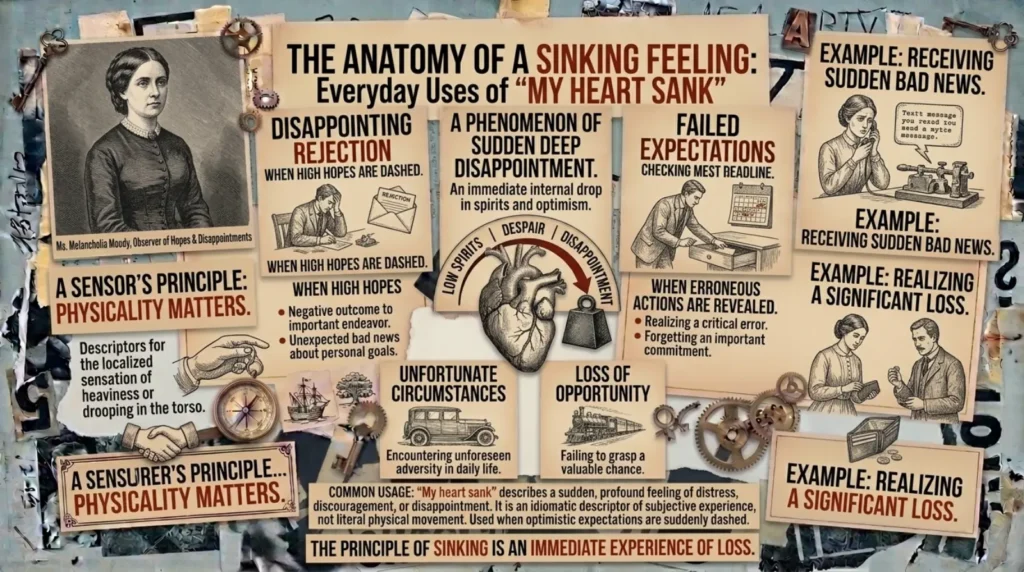
Everyday Uses of “My Heart Sank”
People use this expression every day.
Examples include:
- Receiving bad news
- Losing a job
- Failing a test
- Missing a flight
- Breaking something valuable
- Forgetting an important date
- Seeing a warning message
- Reading a disappointing email
The phrase describes an emotional reaction.
Synonyms and Related Expressions
You can also say:
- My heart dropped.
- My heart skipped a beat.
- I felt crushed.
- I felt devastated.
- My stomach dropped.
- I felt discouraged.
- I lost hope.
- I felt worried.
Related Keywords
- sink past tense
- sink past participle
- sank vs sunk
- my heart sank meaning
- sunk meaning
- sank meaning
- grammar rules
- English verb forms
- common grammar mistakes
Expert Insight
Professional editors and grammar experts recommend using my heart sank in formal writing.
Why?
- It follows standard English grammar.
- It appears in trusted dictionaries.
- It improves writing quality.
- It sounds natural to readers.
- It builds credibility.
Although you may hear my heart sunk in casual speech, avoid it in school papers, business writing, and published content.
Internal Linking Suggestions
You may also enjoy reading:
- Lay vs Lie
- Took vs Taken
- Gone vs Went
- Brought vs Bought
- Burst vs Bursted
- Sunk vs Sank
- Stationary vs Stationery
- Affect vs Effect
Frequently Asked Questions
Is “my heart sunk” grammatically correct?
No. Standard English uses my heart sank.
Why is “my heart sank” correct?
Because sank is the simple past tense of sink.
Can I ever use “my heart sunk”?
Only if sunk follows a helping verb.
Example:
“My heart has sunk before.”
Is “sunk” a real word?
Yes. It is the past participle of sink.
What does “my heart sank” mean?
It means you suddenly felt worried, disappointed, or sad.
Do native speakers say “my heart sunk”?
Some do in casual speech, but formal English prefers my heart sank.
How can I remember the difference?
Remember:
- Yesterday = sank
- Has/Have/Had = sunk
Common Examples
Correct
- My heart sank when I saw the bill.
- Her heart sank after the interview.
- Our hearts sank as the storm arrived.
- The ship has sunk.
- Their hopes had sunk before help arrived.
Incorrect
- My heart sunk yesterday.
- The ship has sank.
- My hopes sunk after the test.
Final Comparison Table
| Question | Correct Answer |
|---|---|
| My heart sank or sunk? | My heart sank |
| Past tense of sink | Sank |
| Past participle of sink | Sunk |
| “Has sunk” correct? | Yes |
| “Has sank” correct? | No |
| Formal writing | Use sank |
| Everyday speech | Some people say sunk, but avoid it in writing |
Conclusion
Many writers struggle with my heart sunk or sank, but the grammar rule is straightforward. Use my heart sank when describing something that happened in the past. The word sank is the simple past tense of sink, making it the correct choice in this common expression. Reserve sunk for sentences that include helping verbs such as has, have, or had. Learning this difference will make your writing more accurate and professional. Whether you are writing an email, school assignment, blog post, or social media update, choosing the correct form helps readers trust your English. Remember the easy rule: Yesterday = sank. Has/Have/Had = sunk. Once you practice this pattern, you’ll rarely make the mistake again.

James Carter is a comparison writer and research specialist with over 10 years of experience in digital publishing. With a background in business communication and consumer research, he creates detailed comparison articles, buying guides, and reviews that help readers make informed decisions with confidence. “Every comparison should help readers make better decisions. My goal is to turn complex information into clear, practical guidance that people can trust.” — James Carter