
Many English learners ask about there exist or there exists. The answer depends on one simple grammar rule. The verb must match the noun that follows it.
This topic often causes confusion because people focus on the word “there.” However, “there” is never the subject. Instead, the real subject comes after the verb.
Once you understand this rule, choosing the correct form becomes easy. You will also sound more natural in both speaking and writing.
This guide explains everything in simple English. You will learn the meaning, grammar rules, common mistakes, examples, and helpful tips. By the end, you will know exactly when to use there exist and when to use there exists.
Quick Summary Box
Featured Snippet Answer
- There exists is correct with a singular noun.
- There exist is correct with a plural noun.
- The verb agrees with the noun after it.
- “There” is not the subject.
- Example: There exists a solution.
- Example: There exist many solutions.
What Does “There Exist or There Exists” Mean?
The phrase there exists or there exist means that something is present, available, or real.
It introduces the existence of a person, object, idea, or situation.
Examples:
- There exists a better way.
- There exist many opportunities.
- There exists little evidence.
- There exist several reasons.
The meaning stays the same. Only the verb changes based on the noun.
Why Do People Get Confused?
Many people think “there” is the subject.
It is not.
The real subject comes after the verb.
Look at these examples:
❌ There exist a problem.
✅ There exists a problem.
The subject is problem, not there.
Likewise:
✅ There exist several problems.
The subject is problems, which is plural.
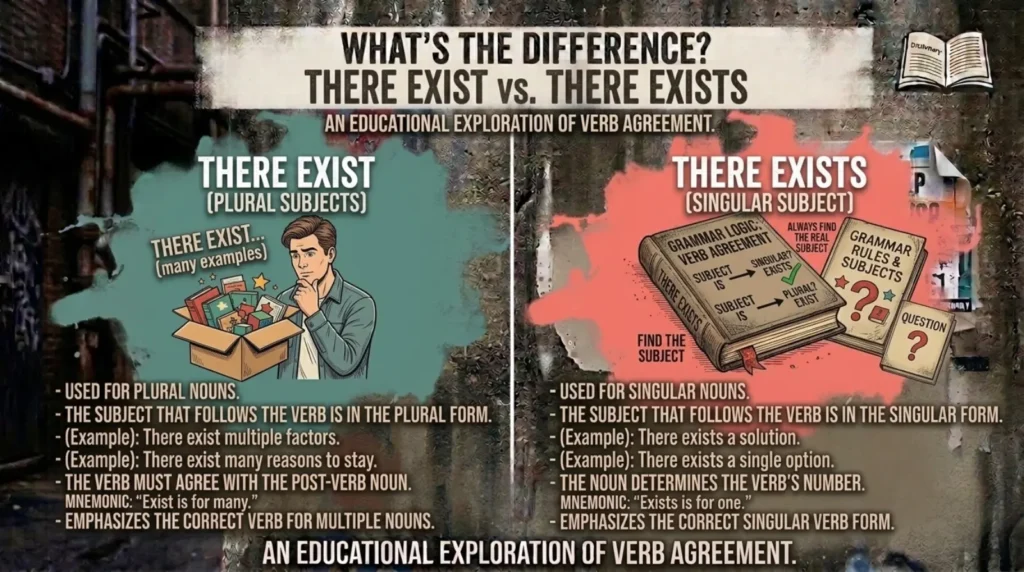
The Simple Grammar Rule
The verb agrees with the noun after it.
Use “There Exists”
Use it with:
- one person
- one thing
- one idea
- one place
Examples:
- There exists one answer.
- There exists a possibility.
- There exists a solution.
- There exists a chance.
Use “There Exist”
Use it with:
- two or more people
- multiple things
- several ideas
- many places
Examples:
- There exist many answers.
- There exist several options.
- There exist many solutions.
- There exist different opinions.
There Exist vs There Exists Comparison Table
| Feature | There Exists | There Exist |
|---|---|---|
| Number | Singular | Plural |
| Verb | Exists | Exist |
| Noun | One item | More than one item |
| Grammar | Singular agreement | Plural agreement |
| Example | There exists a problem. | There exist many problems. |
| Formality | Formal writing | Formal writing |
When Should You Use “There Exists”?
Use there exists when the noun is singular.
Examples:
- There exists a simple answer.
- There exists only one winner.
- There exists a strong reason.
- There exists an opportunity.
- There exists enough evidence.
- There exists a mistake in the report.
- There exists a better option.
Notice that every noun is singular.
When Should You Use “There Exist”?
Use there exist when the noun is plural.
Examples:
- There exist many books.
- There exist several reasons.
- There exist different cultures.
- There exist many questions.
- There exist many ways to learn English.
- There exist many useful websites.
- There exist several solutions.
Each noun is plural.
Real-Life Examples
At School
There exists one correct answer.
There exist many practice questions.
At Work
There exists a problem with the software.
There exist several ways to solve it.
In Science
There exists strong evidence.
There exist many theories.
In Daily Conversation
1.There exists a chance of rain.
2.There exist many restaurants nearby.
There Is vs There Exists
People often use there is instead of there exists.
Both are correct.
However, they have different tones.
| There Is | There Exists |
|---|---|
| Common in speech | More formal |
| Everyday English | Academic English |
| Natural conversation | Professional writing |
| Short and simple | More emphatic |
Example:
There is a solution.
There exists a solution.
Both are correct.
Common Mistakes
Mistake 1
❌ There exist a problem.
✅ There exists a problem.
Mistake 2
❌ There exists many reasons.
✅ There exist many reasons.
Mistake 3
Matching the verb with “there.”
Wrong thinking:
“There” is singular.
Correct thinking:
Match the verb with the noun.
Mistake 4
Using “exists” after plural nouns.
❌ There exists many books.
✅ There exist many books.
Easy Trick to Remember
Ignore the word there.
Look only at the noun.
Ask yourself:
Is it one?
Use exists.
Is it more than one?
Use exist.
Example:
There exists one answer.
There exist many answers.
This trick works almost every time.
There Exist or There Exists in Formal Writing
Academic writing often uses these phrases.
Examples:
- There exists little research on this topic.
- There exist several explanations.
- There exists a possibility of error.
- There exist many published studies.
Research papers, legal writing, and reports commonly use this structure.
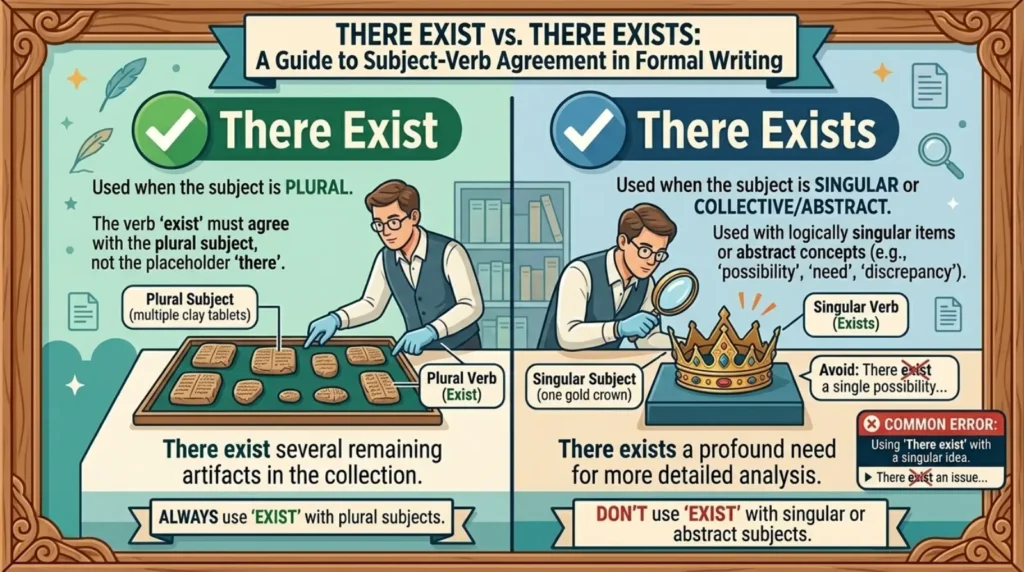
Synonyms and Related Expressions
Instead of saying there exists, you can write:
- There is
- There are
- Exists
- Can be found
- Is available
- Is present
- Is located
- Remains
- Appears
- Occurs
Related LSI Keywords:
- there is vs there exists
- there are grammar
- subject verb agreement
- English grammar rules
- singular and plural verbs
- exists meaning
- grammar examples
- English writing tips
Common Usage in Daily Life
You may hear these examples:
- There exists a better option.
- There exist many choices.
- There exists hope.
- There exist many opportunities.
- There exists a solution for everyone.
- There exist different opinions.
- There exists one important rule.
- There exist many possibilities.
Native speakers often use there is or there are in casual speech. However, there exists and there exist remain correct, especially in formal writing.
Expert Grammar Insights
Professional editors follow one important rule.
Always match the verb with the noun after it.
Do not let the word “there” confuse you.
Formal documents often prefer there exists because it sounds precise.
Good grammar builds trust.
It also improves readability.
If you write blogs, essays, reports, or business emails, this rule helps you avoid mistakes.
Frequently Asked Questions
Is “there exists” grammatically correct?
Yes. Use it with a singular noun.
Example:
There exists one answer.
Is “there exist” grammatically correct?
Yes. Use it with plural nouns.
Example:
There exist many answers.
Which is more common, “there is” or “there exists”?
“There is” is more common in everyday conversation.
“There exists” sounds more formal.
Can I use “there exists” with plural nouns?
No.
Use there exist instead.
Why isn’t “there” the subject?
“There” only introduces the sentence.
The noun after the verb is the real subject.
Is “there exists” used in academic writing?
Yes.
Researchers and professional writers often use it.
How can I remember the rule?
Ignore “there.”
Look at the noun.
Singular = exists.
Plural = exist.
Internal Linking Suggestions
Consider linking this article to related grammar guides such as:
- There Is vs There Are
- Subject-Verb Agreement Rules
- Is vs Are Explained
- Singular vs Plural Nouns
- Common English Grammar Mistakes
- Affect vs Effect
- Who’s vs Whose
Conclusion
Understanding there exist or there exists is easier than it first appears. The key rule is simple. Match the verb with the noun that follows it. Use there exists for singular nouns and there exist for plural nouns. Do not match the verb with the word “there” because it is not the subject. This grammar pattern is common in formal writing, reports, and academic work. It also appears in everyday English, although people often choose there is or there are instead. Practice with simple examples until the rule feels natural. Once you remember to check the noun, you will choose the correct form every time and write with greater confidence.

James Carter is a comparison writer and research specialist with over 10 years of experience in digital publishing. With a background in business communication and consumer research, he creates detailed comparison articles, buying guides, and reviews that help readers make informed decisions with confidence. “Every comparison should help readers make better decisions. My goal is to turn complex information into clear, practical guidance that people can trust.” — James Carter