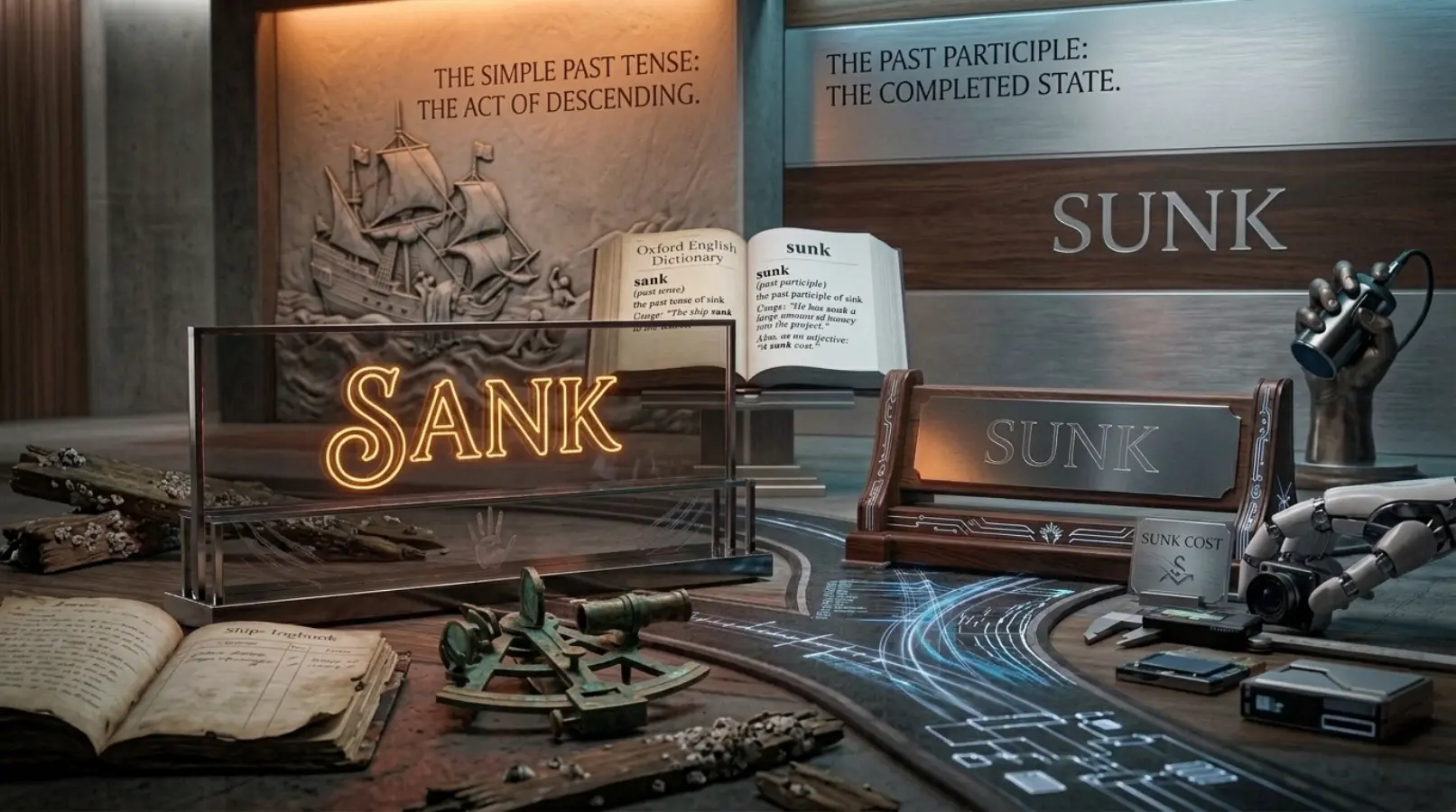
Sank vs sunk is a common grammar question. Many English learners mix these two words. They both come from the verb sink, but they have different jobs in a sentence.
Knowing when to use sank and sunk helps you write and speak clearly. It also makes your English sound more natural.
The good news is that the rule is simple. Once you understand it, you will rarely make this mistake again.
In this guide, you will learn the meaning of each word, see many real-life examples, compare them side by side, and discover easy memory tricks. By the end, you will know exactly when to use sank and when to use sunk.
Quick Summary Box (Featured Snippet)
- Sink = Base form of the verb.
- Sank = Simple past tense of sink.
- Sunk = Past participle of sink.
- Use sank without helping verbs.
- Use sunk after has, have, had, is, was, were, be, been.
- Correct: The boat sank yesterday.
- Correct: The boat has sunk.
- Incorrect: The boat has sank.
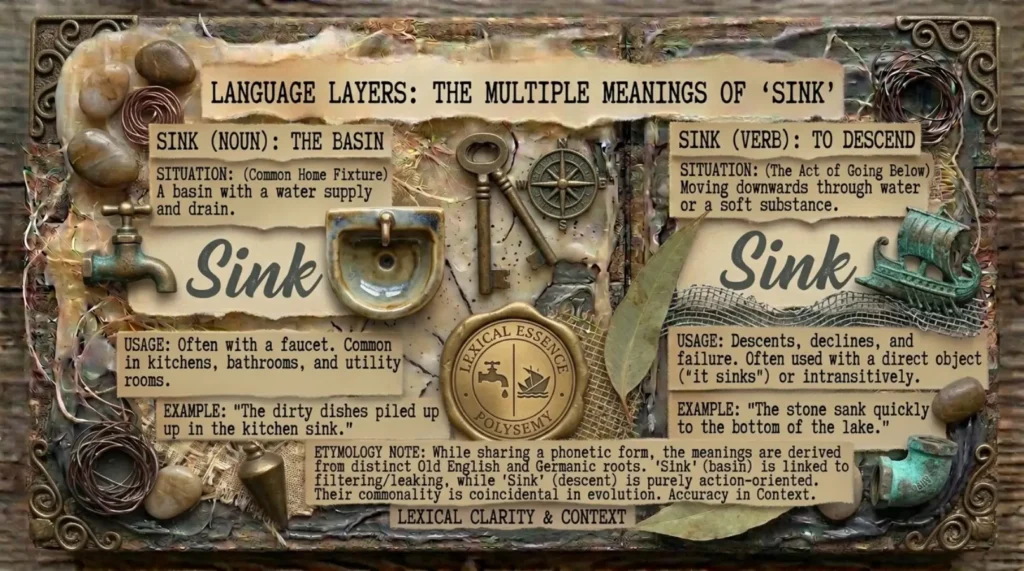
What Does “Sink” Mean?
The verb sink means to:
- Go below the surface of water.
- Fall to a lower level.
- Drop slowly.
- Become lower or weaker.
Examples
- The ship began to sink.
- My heart seemed to sink after hearing the news.
- The sun will sink below the horizon.
What Does “Sank” Mean?
Sank is the simple past tense of sink.
It describes an action that happened and finished in the past.
Formula
Subject + sank
Examples
- The boat sank during the storm.
- The stone sank to the bottom.
- His phone sank into the river.
- The old ship sank many years ago.
- The market sank after the bad news.
Whenever the action happened in the past and does not need a helping verb, use sank.
What Does “Sunk” Mean?
Sunk is the past participle of sink.
It almost always appears with a helping verb.
Formula
- has sunk
- have sunk
- had sunk
- is sunk
- was sunk
- were sunk
Examples
- The ship has sunk.
- Several boats have sunk this year.
- The treasure had sunk before divers arrived.
- The fishing boat was sunk during the battle.
- The city has sunk into silence.
Never use sunk alone as the simple past tense.
Sank vs Sunk Comparison Table
| Feature | Sank | Sunk |
|---|---|---|
| Verb Form | Simple Past | Past Participle |
| Needs Helping Verb? | No | Yes |
| Time | Finished past action | Completed action with helper |
| Correct Example | The ship sank yesterday. | The ship has sunk. |
| Incorrect Example | Has sank | Sunk yesterday |
Sank vs Sunk in Simple Words
Think of it like this:
- Yesterday → Sank
- Has/Have/Had → Sunk
Examples
Yesterday:
- The boat sank.
Today:
- The boat has sunk.
Last year:
- The ferry sank.
By morning:
- The ferry had sunk.
This simple trick works almost every time.
Real-Life Examples of Sank vs Sunk
Example 1
✅ The Titanic sank in 1912.
Example 2
✅ The Titanic has sunk to the ocean floor.
Example 3
✅ My keys sank into the lake.
Example 4
✅ My keys have sunk beyond reach.
Example 5
✅ The basketball sank through the hoop.
Example 6
✅ The basketball has sunk into the net perfectly.
Sank vs Sunk in Daily Conversations
Talking about yesterday
“I dropped my phone, and it sank.”
Talking about something completed
“My phone has sunk, so I can’t recover it.”
News report
“The fishing boat sank last night.”
Weather discussion
“Several small boats have sunk because of heavy waves.”
Common Mistakes People Make
Many learners confuse these forms.
Incorrect
❌ The ship has sank.
✅ The ship has sunk.
Incorrect
❌ The boat sunk yesterday.
✅ The boat sank yesterday.
Incorrect
❌ The stone has sank.
✅ The stone has sunk.
Incorrect
❌ My phone sunk last week.
✅ My phone sank last week.
Easy Trick to Remember Sank vs Sunk
Remember this rule:
No helping verb = Sank
Examples
- The boat sank.
- The ship sank yesterday.
Helping verb = Sunk
Examples
- Has sunk
- Have sunk
- Had sunk
- Was sunk
A simple memory phrase is:
Yesterday, it sank. Today, it has sunk.

Grammar Rule for Sank and Sunk
The verb forms are:
| Verb Form | Word |
|---|---|
| Base Verb | Sink |
| Present | Sink / Sinks |
| Past | Sank |
| Past Participle | Sunk |
| Present Participle | Sinking |
Example:
- I sink every time.
- Yesterday I sank.
- I have sunk before.
- I am sinking now.
Synonyms and Related Words
Synonyms of Sink
- Drop
- Fall
- Descend
- Go down
- Submerge
- Plunge
- Settle
- Collapse
Related Grammar Keywords
- sink past tense
- sink past participle
- sank meaning
- sunk meaning
- sank or sunk
- when to use sank
- when to use sunk
- grammar mistakes
- English verb forms
- irregular verbs
Expert Insight
English uses many irregular verbs. Sink is one of them.
Many grammar mistakes happen because learners treat sink like a regular verb.
Learning all three forms—sink, sank, sunk—improves your grammar and writing. It also helps you perform better in school, exams, and professional communication.
A good habit is to memorize irregular verbs together. This makes them easier to remember in real conversations.
Featured Snippet: Sank vs Sunk
Question: What is the difference between sank and sunk?
Answer: Sank is the simple past tense of sink. Sunk is the past participle and must be used with helping verbs like has, have, had, was, or were. For example, “The ship sank yesterday,” but “The ship has sunk.”
FAQs:
Is it “sank” or “sunk”?
Use sank for the simple past. Use sunk with helping verbs.
Which is correct: “has sank” or “has sunk”?
Has sunk is correct.
Can I say “the boat sunk yesterday”?
No. Say the boat sank yesterday.
Why is “sunk” used with has or have?
Because sunk is the past participle.
Is “sank” an irregular verb?
No. Sink is the irregular verb. Sank is its past tense.
Is “sunk” ever an adjective?
Yes.
Example:
- The sunk ship attracted many divers.
What is the past tense of sink?
The past tense is sank.
What is the past participle of sink?
The past participle is sunk.
Practice Sentences
Choose the correct word.
- The ship _____ during the storm.
- ✅ sank
- The ship has _____.
- ✅ sunk
- My keys _____ into the river yesterday.
- ✅ sank
- My wallet has _____.
- ✅ sunk
- The submarine _____ quickly.
- ✅ sank
Internal Linking Suggestions
To build topical authority, consider linking this article to related grammar guides such as:
- Sink vs Sinks
- Lay vs Lie
- Rose vs Risen
- Broke vs Broken
- Took vs Taken
- Went vs Gone
- Burst vs Bursted
- Farthest vs Furthest
Conclusion
Understanding sank vs sunk becomes easy once you know their roles. Sank is the simple past tense, so use it for actions that happened and ended in the past. Sunk is the past participle, so it follows helping verbs like has, have, had, was, and were. Remember the simple rule: Yesterday, it sank. Today, it has sunk. This small grammar difference makes your writing more accurate and professional. Practice with real-life examples, and soon the correct choice will feel natural. Mastering sank vs sunk is another step toward speaking and writing confident, correct English.

James Carter is a comparison writer and research specialist with over 10 years of experience in digital publishing. With a background in business communication and consumer research, he creates detailed comparison articles, buying guides, and reviews that help readers make informed decisions with confidence. “Every comparison should help readers make better decisions. My goal is to turn complex information into clear, practical guidance that people can trust.” — James Carter