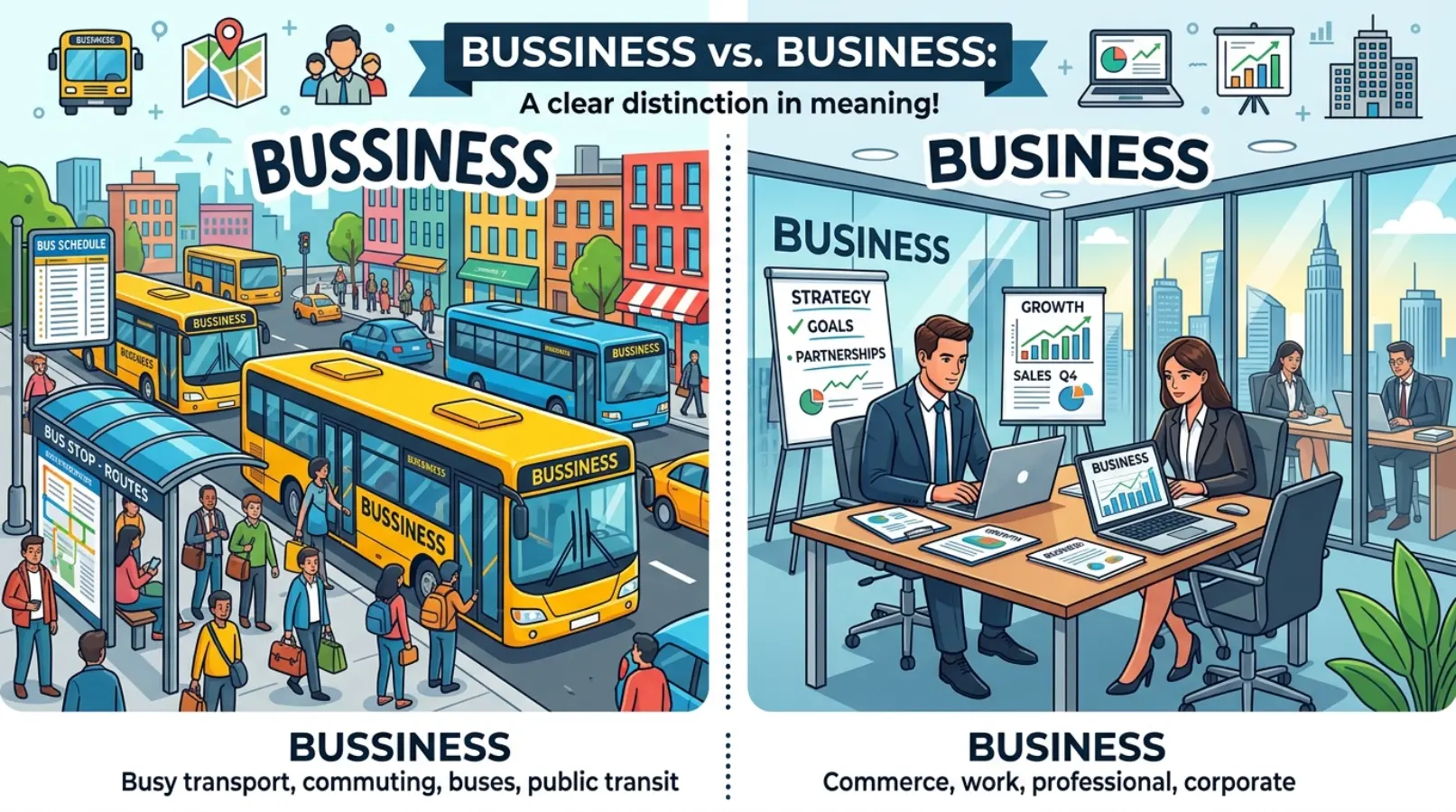
Business or bussiness is a common spelling question that many people ask. Students, professionals, and business owners often get confused about the correct spelling.
The correct word is business. The spelling bussiness is incorrect.
Many people make this mistake because the word sounds different from how it is written. English spelling can be tricky. However, learning the correct spelling is important for emails, school work, job applications, and professional communication.
In this guide, you will learn the meaning of business, why people misspell it, real-life examples, common mistakes, and easy tips to remember the correct spelling. By the end, you will never confuse business and bussiness again.
Quick Summary Box
- The correct spelling is business
- Bussiness is incorrect
- Business means work, trade, or a company
- Many people misspell it because of pronunciation
- Using the correct spelling improves professionalism
- Business is used in schools, workplaces, and daily communication
- Remember: bus + iness = business
What Is the Correct Spelling: Business or Bussiness?
The correct spelling is business.
❌ Bussiness
✅ Business
The word “business” contains only one letter “s” after “bu”.
Many people accidentally add an extra “s” and write “bussiness.” However, dictionaries and grammar guides recognize only “business” as correct.
Example
Correct:
- I started a new business last year.
- She studies business management.
Incorrect:
- I started a new bussiness last year.
- She studies bussiness management.
What Does Business Mean?
Business refers to activities that involve buying, selling, producing, or providing goods and services.
A business can be:
- A small shop
- A large company
- An online store
- A service provider
Simple Definition
A business is an organization or activity that earns money by offering products or services.
Examples
- A bakery sells cakes.
- A clothing store sells fashion items.
- A software company creates digital products.
All of these are businesses.

Why Do People Spell Business as Bussiness?
Many people spell business incorrectly because of pronunciation.
When spoken, the word sounds similar to “biz-ness.”
This sound can confuse writers. They may assume the word needs two “s” letters.
Other reasons include:
- Fast typing
- Lack of proofreading
- Learning English as a second language
- Autocorrect mistakes
Fortunately, this error is easy to fix.
Business vs Bussiness: Comparison Table
| Feature | Business | Bussiness |
|---|---|---|
| Correct English spelling | Yes | No |
| Found in dictionaries | Yes | No |
| Accepted in professional writing | Yes | No |
| Used in academic work | Yes | No |
| Recommended for SEO content | Yes | No |
| Grammar correct | Yes | No |
Key Takeaway
Always use business in professional, academic, and personal writing.
Types of Business
Businesses come in many forms.
Small Business
Owned by one person or a small group.
Examples:
- Local grocery stores
- Coffee shops
- Repair services
Medium Business
Larger than small businesses but smaller than major corporations.
Examples:
- Regional manufacturers
- Marketing agencies
Large Business
Operates nationally or globally.
Examples:
- Apple
- Microsoft
- Amazon
Online Business
Operates mainly through the internet.
Examples:
- E-commerce stores
- Digital marketing agencies
- Online education platforms
Real-Life Examples of Business
Understanding real examples makes learning easier.
Example 1: Bakery
A bakery sells bread, cakes, and pastries.
It earns money from customers.
Example 2: Freelance Designer
A graphic designer offers design services online.
This is also a business.
Example 3: Clothing Store
The owner buys products and sells them for profit.
This activity creates a business.
Example 4: Online Course Creator
A teacher sells digital courses.
This online model is a growing business type.
Importance of Correct Spelling in Business Communication
Correct spelling builds trust.
People notice writing mistakes quickly.
A spelling error can affect:
- Job applications
- Business proposals
- Emails
- Marketing materials
- Website content
Example
Imagine receiving two emails.
Email A:
“Welcome to our business.”
Email B:
“Welcome to our bussiness.”
Most people trust Email A more.
Professional writing matters.
Common Mistakes People Make
Many writers repeat the same spelling mistakes.
Mistake 1: Adding an Extra “S”
Incorrect:
- Bussiness
Correct:
- Business
Mistake 2: Typing Too Quickly
Fast typing often causes spelling errors.
Mistake 3: Ignoring Spell Check
Modern tools can catch mistakes.
Always review your work.
Mistake 4: Copying Incorrect Content
Some websites contain spelling errors.
Verify information before using it.
Easy Tricks to Remember the Correct Spelling
These simple memory tricks help many learners.
Trick 1: Think “Bus + Iness”
Break the word into parts:
Bus + iness = Business
Trick 2: Use Repetition
Write the word several times:
- Business
- Business
- Business
Trick 3: Read More Business Content
Regular exposure helps your brain remember the correct spelling.
Trick 4: Use Spell-Checking Tools
Grammar tools can identify mistakes instantly.
Business in Everyday Life
Business affects daily life more than many people realize.
Every time you:
- Buy food
- Order online
- Visit a doctor
- Use a mobile app
You interact with a business.
Businesses create:
- Jobs
- Products
- Services
- Economic growth
They play a major role in modern society.
Synonyms and Related Terms for Business
Using related words helps improve vocabulary and SEO relevance.
Synonyms
- Company
- Enterprise
- Organization
- Firm
- Venture
- Corporation
- Trade
- Commerce
LSI Keywords
- Small business
- Business management
- Business growth
- Online business
- Business owner
- Business strategy
- Startup business
- Business planning
- Business development
- Entrepreneurship
These terms often appear in content related to business.
Tips for Writing About Business Professionally
Good business writing is clear and direct.
Keep Sentences Short
Short sentences improve readability.
Avoid Grammar Errors
Proofread before publishing.
Use Simple Language
Readers prefer clear explanations.
Focus on Value
Provide useful information.
Check Spelling Carefully
Always use “business,” never “bussiness.”
Expert Insights: Why Correct Spelling Matters
Professional writers understand the value of accuracy.
Search engines evaluate content quality.
Readers also judge credibility based on writing standards.
A simple spelling mistake can:
- Reduce trust
- Hurt professionalism
- Lower content quality
- Create confusion
Experts recommend proofreading every important document before sharing it.
Correct spelling supports strong communication and a positive reputation.
FAQs
Is business or bussiness correct?
Business is correct. Bussiness is incorrect.
Why do people spell business as bussiness?
The pronunciation can confuse people and lead to adding an extra “s.”
Is bussiness in the dictionary?
No. Standard dictionaries recognize only “business.”
How can I remember the correct spelling?
Use the memory trick: Bus + iness = Business.
Is business important in professional writing?
Yes. Correct spelling improves credibility and professionalism.
What does business mean?
Business refers to activities that earn money through products or services.
Can spelling mistakes affect job applications?
Yes. Employers often notice grammar and spelling errors.
Is business used in academic writing?
Yes. Business is commonly used in education, research, and professional communication.
Internal Linking Suggestions
Consider linking this article to:
- How to Start a Small Business
- Business Communication Skills
- Business Management Basics
- Entrepreneurship Guide for Beginners
- Online Business Ideas
- Common English Spelling Mistakes
These related topics improve user engagement and SEO performance.
Conclusion
The debate between business or bussiness has a simple answer. The correct spelling is business. The word bussiness is a common mistake and should not be used in professional, academic, or personal writing.
Understanding the correct spelling helps improve communication and credibility. It also creates a stronger impression in emails, reports, websites, and job applications.
Remember the simple trick: Bus + iness = Business.
Whenever you write about a company, trade, entrepreneurship, or commercial activities, always use the correct spelling. Small details matter, and accurate writing helps you appear more professional and trustworthy.

James Carter is a comparison writer and research specialist with over 10 years of experience in digital publishing. With a background in business communication and consumer research, he creates detailed comparison articles, buying guides, and reviews that help readers make informed decisions with confidence. “Every comparison should help readers make better decisions. My goal is to turn complex information into clear, practical guidance that people can trust.” — James Carter