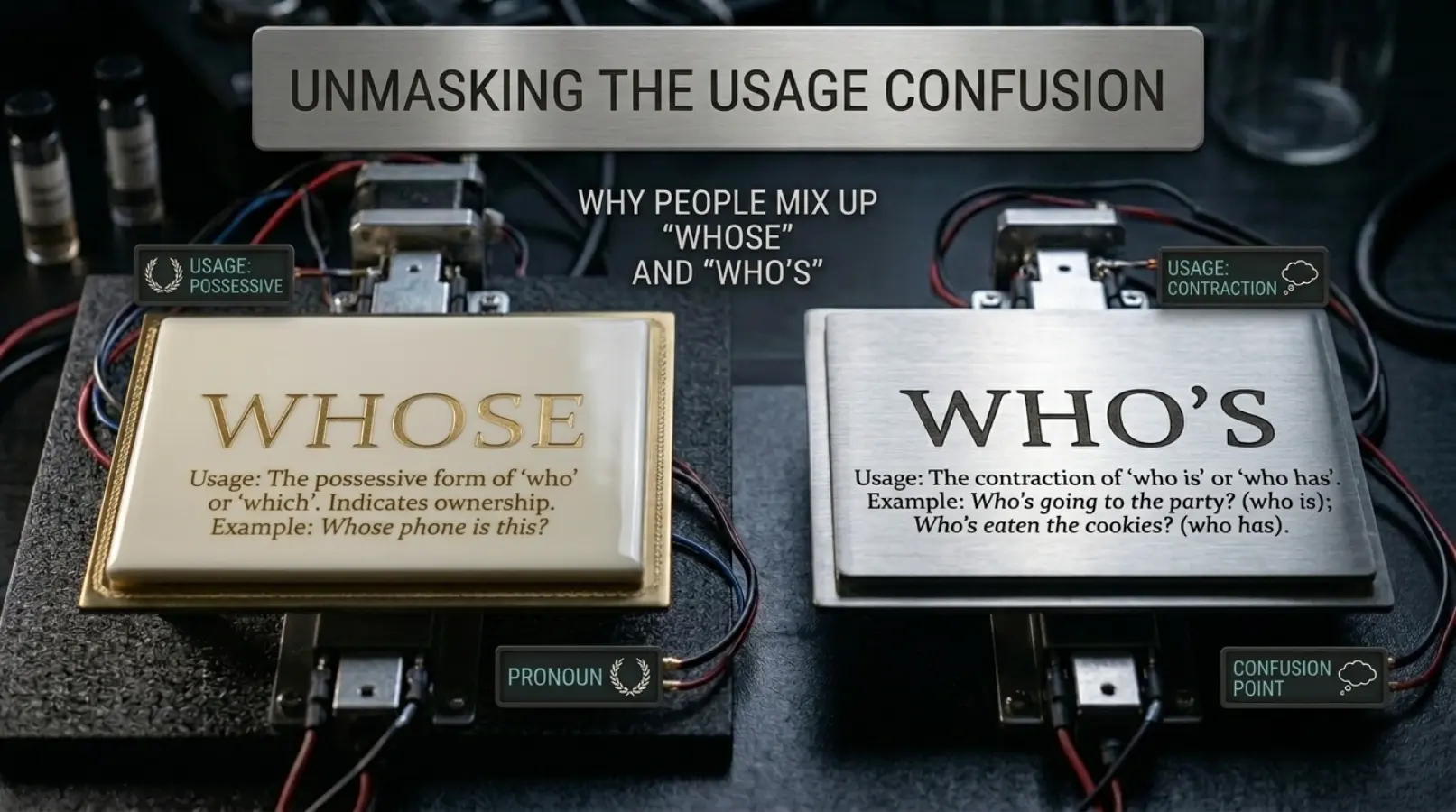
Whose vs who’s is one of the most common grammar questions in English. Many people mix them up because they sound the same. However, they have different meanings and uses.
The good news is that the rule is simple. Once you learn it, you can avoid this mistake forever.
In this guide, you will learn the meaning of whose and who’s in easy words. You will also see real-life examples, a comparison table, common mistakes, memory tricks, and expert tips. By the end, you will know exactly when to use each word with confidence.
Whether you are a student, writer, blogger, or English learner, this guide will help you improve your grammar and write more clearly.
Quick Summary Box
- Whose shows ownership or possession.
- Who’s is a short form of who is or who has.
- Whose = belonging to someone
- Who’s = who is / who has
- Never use who’s to show ownership.
- Simple trick: Expand who’s into who is. If it works, use who’s.
What Does “Whose” Mean?
Whose is a possessive word. It asks or tells who owns something.
It answers the question:
To whom does this belong?
Examples
- Whose jacket is this?
- I know whose phone rang.
- Whose dog is barking outside?
- She forgot whose notebook it was.
- Whose idea was this?
In every example, whose talks about ownership.
What Does “Who’s” Mean?
Who’s is a contraction.
It combines:
- Who is
- Who has
The apostrophe replaces missing letters.
Examples
- Who’s coming tonight?
- Who’s ready to begin?
- Who’s been using my laptop?
- Who’s your teacher?
- Who’s going first?
If you can replace who’s with who is or who has, it is correct.
Whose vs Who’s Comparison Table
| Feature | Whose | Who’s |
|---|---|---|
| Meaning | Shows ownership | Means who is or who has |
| Part of Speech | Possessive pronoun/determiner | Contraction |
| Apostrophe | No | Yes |
| Shows possession | Yes | No |
| Can replace with “who is”? | No | Yes |
| Example | Whose bag is this? | Who’s coming today? |
Why Do People Confuse Whose and Who’s?
These words sound exactly alike.
They are called homophones.
Since they have the same pronunciation, many writers choose the wrong spelling.
Another reason is that many possessive words use apostrophes.
For example:
- John’s book
- Sarah’s car
People think who’s should also show possession.
However, English is different here.
Whose never uses an apostrophe.

How to Remember the Difference
Here is an easy trick.
Use this test:
Replace who’s with who is.
If the sentence still makes sense, use who’s.
If not, use whose.
Example 1
Who’s at the door?
↓
Who is at the door?
✔ Correct
Example 2
Whose shoes are these?
↓
Who is shoes are these?
❌ Wrong
Use whose.
Real-Life Examples of Whose
These examples show ownership.
School
- Whose pencil is on the desk?
- Whose homework is missing?
Office
- Whose laptop is connected?
- Whose report should I review?
Family
- Whose birthday is today?
- Whose turn is it?
Shopping
- Whose wallet was found?
- Whose shopping bag is this?
Real-Life Examples of Who’s
These examples mean who is or who has.
Friends
- Who’s calling you?
- Who’s free this weekend?
School
- Who’s the new student?
- Who’s absent today?
Work
- Who’s leading the meeting?
- Who’s finished the project?
Home
- Who’s cooking dinner?
- Who’s been eating my cookies?
Common Mistakes People Make
Many writers accidentally switch these words.
Incorrect
Who’s backpack is this?
Correct
Whose backpack is this?
Incorrect
Whose coming with us?
Correct
Who’s coming with us?
Incorrect
I know who’s keys these are.
Correct
I know whose keys these are.
Incorrect
Who’s car is parked outside?
Correct
Whose car is parked outside?
Grammar Rule You Should Know
Remember this simple rule.
Whose = Possession
Who’s = Who is / Who has
The apostrophe does not show ownership here.
Instead, it shows missing letters.
This rule is similar to:
- it’s = it is
- he’s = he is
- she’s = she is
But notice:
- its = possession
- whose = possession
Whose vs Who’s in Daily Conversations
People use these words every day.
School
“Whose notebook is this?”
“Who’s absent today?”
Home
“Whose socks are these?”
“Who’s making breakfast?”
Work
“Whose presentation starts first?”
“Who’s joining the meeting?”
With Friends
“Whose phone keeps ringing?”
“Who’s driving tonight?”
Simple Practice Sentences
Choose the correct word.
- _____ coming to dinner?
- _____ shoes are by the door?
- _____ been using my computer?
- _____ backpack is on the chair?
- _____ your favorite teacher?
Answers
- Who’s
- Whose
- Who’s
- Whose
- Who’s
Synonyms and Related Grammar Terms
Understanding related words makes grammar easier.
Related Search Terms
- whose meaning
- who’s meaning
- whose vs who’s grammar
- when to use whose
- when to use who’s
- difference between whose and who’s
- English grammar rules
- possessive pronouns
- contractions in English
- grammar mistakes in writing
Similar Grammar Comparisons
- your vs you’re
- its vs it’s
- there vs their vs they’re
- affect vs effect
- then vs than
- who vs whom
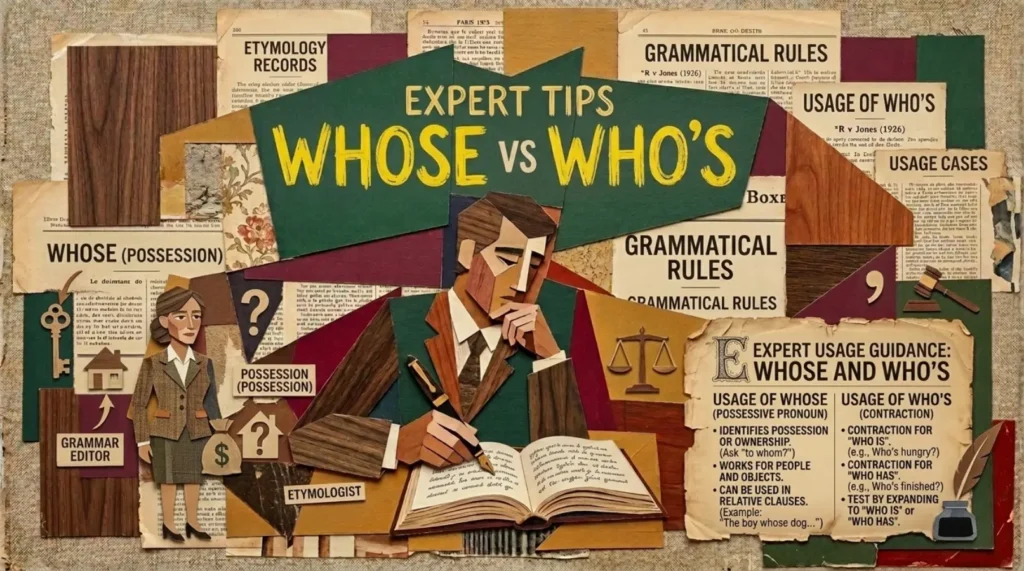
Expert Tips for Using Whose and Who’s
Good grammar builds trust.
Readers notice grammar mistakes quickly.
Professional writers always check contractions before publishing.
Before you submit an email, article, or assignment, ask one question:
Can I replace it with “who is”?
If yes, use who’s.
If not, use whose.
This simple habit prevents one of the most common English mistakes.
Why Learning This Difference Matters
Correct grammar improves communication.
It also helps in:
- School assignments
- Job applications
- Professional emails
- Blog writing
- Social media posts
- Business communication
Small grammar improvements make your writing look more professional.
Featured Snippet: Whose vs Who’s
Whose shows ownership or possession. It asks who something belongs to.
Who’s is the contraction of who is or who has.
Example:
- Whose jacket is this?
- Who’s coming to the party?
Remember: If you can replace the word with who is, use who’s.
FAQs:
Is “who’s” the same as “whose”?
No.
Whose shows ownership.
Who’s means who is or who has.
Is “whose” possessive?
Yes.
It is used to show ownership.
Example:
Whose notebook is this?
Can “who’s” show possession?
No.
It never shows possession.
Use whose instead.
Why doesn’t “whose” have an apostrophe?
Because it is already the possessive form.
English grammar treats it like its, not it’s.
How do I remember the difference?
Replace who’s with who is.
If it works, use who’s.
Otherwise, choose whose.
Which word is more common?
Both are common.
They appear in different situations.
Use whose for ownership.
Use who’s for who is or who has.
Is it “whose idea” or “who’s idea”?
The correct phrase is:
Whose idea
Because it shows ownership.
Internal Linking Suggestions
Consider linking this article to related grammar guides, such as:
- Your vs You’re
- Its vs It’s
- There vs Their vs They’re
- Who vs Whom
- Then vs Than
- Affect vs Effect
- To vs Too vs Two
- Lay vs Lie
Conclusion
Understanding whose vs who’s is easier than many people think. The key difference is simple. Whose shows ownership, while who’s means who is or who has. Although these words sound the same, they serve different purposes in a sentence.
A quick replacement test can help every time. If you can replace the word with who is or who has, choose who’s. If the sentence talks about ownership or belonging, use whose instead.
Learning this small grammar rule can improve your writing in emails, essays, blog posts, and everyday conversations. With regular practice, using whose and who’s correctly will become a natural habit.

James Carter is a comparison writer and research specialist with over 10 years of experience in digital publishing. With a background in business communication and consumer research, he creates detailed comparison articles, buying guides, and reviews that help readers make informed decisions with confidence. “Every comparison should help readers make better decisions. My goal is to turn complex information into clear, practical guidance that people can trust.” — James Carter